


















“ACNIS ReView from Yerevan”. Let us try to imagine what tomorrow’s historians will write about present-day Armenia, having at their disposal several volumes of research shaped by the turbulent domestic political processes of the time. Certainly, it is difficult to predict which themes they will choose to highlight, but one thing is beyond doubt: they will inevitably address the bitter and soul-wearing events of our days, particularly the uncompromising confrontation launched by the authorities against the Armenian Apostolic Holy Church (AAHC). Yet disappointment awaits both near-term and distant chroniclers should they attempt to navigate the dark labyrinths of Armenia’s history in the twenties of the 21st century.
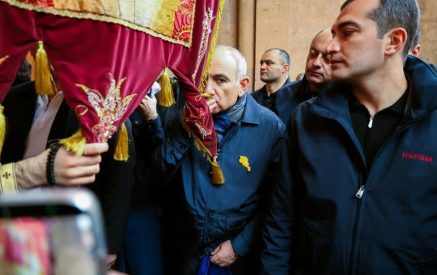
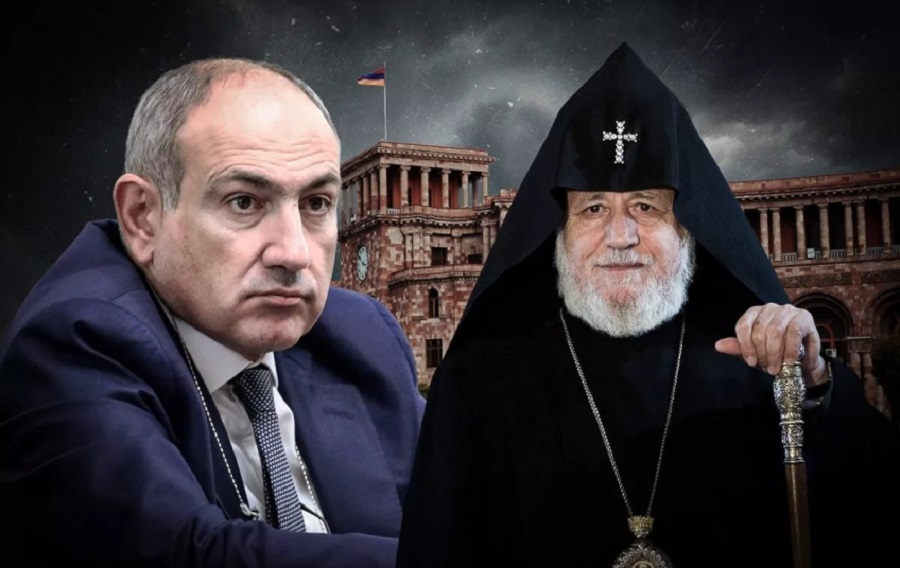
One of the most shameful pages of that history, without question, concerns the relationship between the state’s executive and the spiritual authorities, whose leaders hold irreconcilable positions. The target of the country’s ill-fated prime minister has become the Mother See, against which persecution did not cease even after June, when the chairman of the Caucasus Muslims’ Board (CMB), Sheikh-ul-Islam Allahshukur Pashazade—Azerbaijan’s top Shia Muslim cleric, closely linked to the government—branded the Armenian Church as revanchist. He declared it “a major threat to all countries neighboring Armenia in the region” and claimed that Etchmiadzin had been built on “lands belonging to Azerbaijan,” thus echoing revisionist Azerbaijani narratives. This was a whole chain of absurd accusations, to which official Yerevan never offered a proper response.
Moreover, Pashinyan and his small circle appear to have interpreted Pashazade’s reckless statements as a call to action. From that point on, they intensified their persecution of the AAHC, demanding the removal of the Catholicos from the Mother See. More recently, at a press briefing on December 4, in response to a journalist’s question, the prime minister almost verbatim—albeit with some semantic camouflage—repeated Pashazade’s phrasing. He stated: “Ktrich Nersisyan (the secular name of the Catholicos) is a threat to Armenia’s state security; his presence in Etchmiadzin causes disastrous damage to the Armenian Apostolic Holy Church. He must leave; there is no other option.”
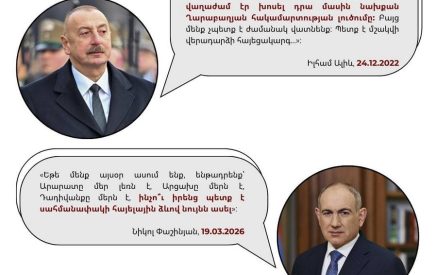
There is a well-known saying: “the pot calling the kettle black.” In life, it often happens that the notions of “target” and “threat” are deliberately reversed, because for some this is a convenient way to deflect responsibility from themselves. Let us therefore try to determine who, in this case, is truly the target and who poses the real threat. Consider one of the most recent—and most egregious—examples of endangering the state: the scandalous revelation concerning the negotiation process on the Artsakh settlement, namely the package of proposals put forward by the OSCE Minsk Group in 2019. Pashinyan not only refused to negotiate on the basis of those proposals, but also concealed them from the public, thereby forfeiting a real opportunity for a solution favorable to Armenia.
Read also
And what did the Armenian side receive as a result? It received a catastrophic war. Due to Pashinyan’s actions, the negotiations collapsed, and from Renaissance Square in Stepanakert he appeared to be sending a message to the enemy: “Artsakh is Armenia, period.” More than five years have passed, yet the wounds of the 44-day war remain unhealed. Five thousand Armenian sons in their reproductive age were martyred; more than 10,000 were wounded or disabled; countless prisoners of war and missing persons remain unaccounted for. Devastation and loss—loss upon loss—these are the horrific consequences of that war. And there is one person who bears responsibility for them: Nikol Pashinyan, who must answer before a court of law.
Why did Pashinyan take this path? Was it a tragic mistake, or a deliberate choice? In either case, accountability is inevitable. For the killing of a single person, a criminal is sentenced to ten to fifteen years in prison. Here, however, the issue is not one life, but five thousand. Some may argue, “It was war; war is not a picnic.” But this argument does not apply here. There would have been no war had the head of government proceeded with the proposed settlement package. Artsakh would have remained Armenian, and our bright young men would still be alive. Now let that individual place his hand on his heart and answer honestly: who, in fact, is the real threat to Armenia’s state security—and who, truly, should step down?