

















JAMnews. The year 2025 in Azerbaijan was marked by significant and at times contradictory developments in domestic politics, public life and foreign relations. Over the course of the year, the country’s leadership underwent serious internal changes.
Several figures long regarded as pillars of the system came under pressure, while repression of the opposition reached its highest level. At the same time, the government sought to strengthen its regional standing by signing strategic agreements with neighbouring states and international partners.
Below is a brief overview of the key events that shaped Azerbaijan in 2025.
Political developments
Read also
The first major political event of 2025 was the municipal elections held on 29 January. Across the country, more than 16,000 candidates competed for over 8,000 seats in 685 municipalities across 118 electoral districts.
According to the Central Election Commission, voter turnout stood at just 31.45%. Despite the low participation, the vote was officially declared valid and was described by the authorities as having been conducted successfully.
However, opposition parties and independent observers said the elections were marred by serious legal violations and electoral fraud. Observers noted that public interest in the vote was significantly lower than during the previous municipal elections in 2019, partly due to the limited real powers held by local municipalities.
As a result of a reform carried out at the end of 2024, the number of municipalities was reduced from 1,606 to 685, with many smaller bodies merged into larger units.
During the year, a number of personnel changes and appointments took place within the authorities. In April 2025, former military prosecutor Khanlar Valiyev was appointed as a judge of the Constitutional Court. He is one of the key figures linked to the so-called Tartar case, which involved allegations of torture of military personnel in 2017.
The appointment was sharply criticised by victims’ families and human rights defenders, who described it as an example of impunity. At the same time, the term of office of Prosecutor General Kamran Aliyev, which was due to expire in 2025, was extended, allowing him to remain in his post.
Anti-corruption measures targeting local executive authorities also continued. Towards the end of the year, the State Security Service removed Islam Rzayev, head of the Balakan district executive authority, from office and placed him under investigation.
The year 2025 was declared the “Year of the Constitution and Sovereignty” in Azerbaijan. Towards the end of the year, the 30th anniversary of the Constitution was marked, alongside a number of legislative changes. As part of these measures, the Internal Troops were placed directly under presidential control.
Human rights abuses and repression
The year 2025 proved difficult for civil society and human rights defenders. At various points, a number of opposition figures and civic activists received lengthy prison sentences.
- Prominent human rights activist Bakhtiyar Gajiyev was sentenced to 10 years in prison, while opposition politician Tofik Yagublu received a nine-year sentence. In protest against his conviction, Yagublu staged a 40-day hunger strike in prison.
- Former diplomat Emin Ibrahimov was sentenced to seven years, and activist Nijat Ibrahim received six years and six months in detention. Towards the end of the year, activist Dayanat Chelebiyev, who had criticised the government on social media, was arrested on charges of inflicting a knife wound.
Overall, human rights organisations noted that the number of political prisoners in Azerbaijan continued to rise in 2025. The European Parliament also adopted a special resolution calling for the immediate release of all political prisoners in the country.
- The year also saw a deterioration in media freedom and freedom of expression. In February, one of the country’s oldest independent news agencies, Turan, announced it was ceasing operations, citing financial difficulties.
- At the same time, authorities demanded staff reductions at the Baku offices of the Azerbaijani service of the BBC and the Russian news agency Sputnik Azerbaijan.
Against this backdrop, the country faced criticism over a new media law and legal changes that increased government control over the internet. Towards the end of the year, the Milli Majlis passed amendments in a first reading that imposed stricter penalties for online publications deemed by the authorities to violate “public morality.”
In international reports, Azerbaijan ranked among the European countries with the highest number of journalists in detention. By the end of the year, the country had the second-highest number of journalists held on politically motivated charges, after Belarus.
As part of a large-scale investigation into the so-called “NGO case,” dozens of civil society representatives were brought in for questioning. Several well-known NGO leaders were arrested, and many were banned from leaving the country.
- Journalists at the anti-corruption news outlet AbzasMedia were handed prison terms totaling 59.5 years.
- Pressure on Meydan TV also continued, with five more of its employees arrested.
- Authorities’ pressure on the LGBTQ+ community showed no signs of easing. During a police raid on the Labyrinth club, a gathering place for members of the community, 106 people were detained. Witnesses and those arrested reported that police used violence, subjected them to degrading treatment, and made threats.
Foreign policy and international relations
In 2025, Azerbaijan’s foreign policy focused on normalising relations with Armenia and consolidating the new regional realities.
After regaining full control over Karabakh in 2023, negotiations on a peace agreement entered an intensive phase. Meetings were held in various formats under the mediation of the European Union, Russia, and the United States.
On 8 August 2025, a “Joint Declaration on Future Relations” was signed in Washington during a meeting between the leaders of Azerbaijan and Armenia, and the main points of a peace treaty were initialled.
The documents expressed a commitment to formally ending the decades-long conflict. In statements made at the end of the year, Azerbaijani officials described 2025 as a successful year for the reconciliation process with Armenia and highlighted the possibility of signing a final peace agreement in 2026.
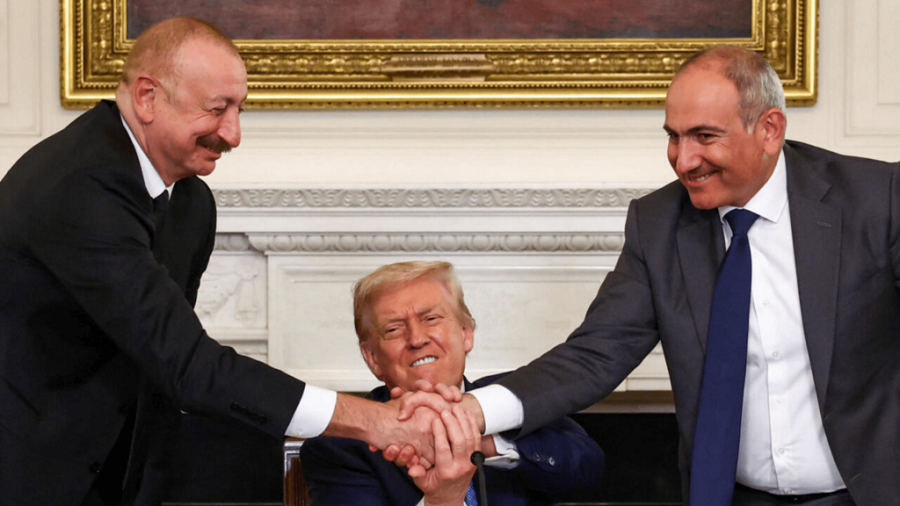
As part of the peace agenda, both sides began taking practical steps to reopen economic and transport links.
In 2025, Azerbaijan reportedly completed all necessary infrastructure work on its territory for a railway line connecting western Azerbaijan with Nakhchivan, known as the “Trump Route” (TRIPP). The railway is expected to reach the Armenian border in 2026.
Work also continued by commissions on border delimitation. Certain sections of the border between the two countries have already been agreed, and mapping efforts are ongoing.
The full text of the article is available on the original website.