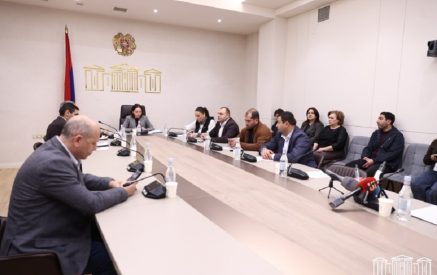










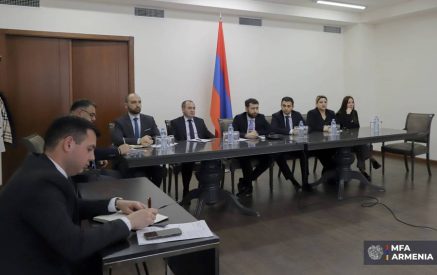














Today, the regular Cabinet meeting took place chaired by the Prime Minister of the Republic of Armenia Nikol Pashinyan.
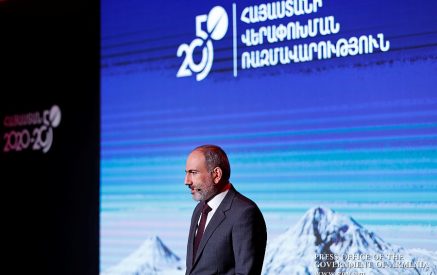
The Government approved the doctrine of economic and institutional transformation of Armenia. According to it, it is proposed to establish the ideological foundations of the new economic paradigm of the “Real Armenia”, enshrining the role of the state as a people-centered, but at the same time security, resilience and institutional strengthening system. The Prime Minister presented the doctrine and noted that it is a development guideline, the purpose of which is to review and strengthen the country’s economic structure and state institutions. “This is a guideline and an announcement of our intentions. In this context, it would be the correct thing to place the strategies and strategic documents adopted by the Government in the right place in our governance system. Strategies are, first of all, an announcement of intentions and a consolidated manifestation of ideas about what needs to be done,” said Nikol Pashinyan.
According to the Prime Minister, the doctrine is about where the Republic of Armenia is now, where it wants to move, and accordingly, the Republic of Armenia is adopting a new economic paradigm. The Prime Minister presented details on what determines the need for revision and adoption of a new economic paradigm. The Prime Minister also noted that for the first time, Armenia is purposefully shaping its economy based on the conditions of stable regional peace. “That is, the doctrine of Armenia’s economic and institutional transformation is also conditioned by the new regional and foreign political environment that is being formed around the Republic of Armenia. The formula for peace in conditions of peace: the economy must also be transformed and positioned to some extent, which is happening right before our eyes these days. Of course, the established peace and the institutionalization of peace are among our priorities, which must inevitably have its expression in the economy as well.”
The doctrine also touches upon the education sector, the development of artificial intelligence, the use of digitalization tools, the development of agriculture, energy, as well as the development of intensive agriculture, energy, and other directions. “All these approaches are based on 1 key idea: the state is considered a continuous institution, where governments are changeable, and the logic of economic policy is stable and predictable. At the heart of all this is the idea of the permanence of the state, and the idea that the development of the state is the state interest itself. We must very clearly formulate and see what the state interest is. The state interest is economic development, because without it it is simply impossible to serve any agenda,” said Nikol Pashinyan.
Read also
The Government approved the 2026-2030 Strategic Program for the Development of Tourism in the Republic of Armenia in order to provide a comprehensive solution to the problems facing the sector and coordinate the reforms launched, including legislative ones. The three main areas of development envisaged by the program are: cultural, gastronomic – cuisine, wine and Armenian brand, as well as adventure – including winter tourism. It is also planned to develop agrotourism, MICE tourism, religious, medical and resort tourism.
The Government approved the procedure for collecting, maintaining and transmitting data in the Universal Health Insurance Registry. The Registry is interoperable with electronic systems used by state and local self-government bodies to provide electronic services or perform actions, and the relevant data will be received through the interoperability platform of the Government of the Republic of Armenia from various databases that are a source of data. Nikol Pashinyan touched upon the criticisms directed at the Universal Health Insurance System and emphasized that such a large-scale reform cannot be implemented flawlessly at once. According to the Prime Minister, it is necessary to implement it and improve it in the process. “So we continue to work 24 hours a day, because a very complex system has been introduced, we carefully listen to the criticisms and try to rationally solve the problems that are pointed out,” Nikol Pashinyan emphasized.
Minister of Health Anahit Avanesyan noted that as of 10:00 on January 8, 16,266 service visits had already been registered in the insurance. In that context, the Prime Minister emphasized the need to conduct constant surveys with stakeholders to identify, prioritize, and resolve existing issues.
The Office to the Prime Minister of the Republic of Armenia