

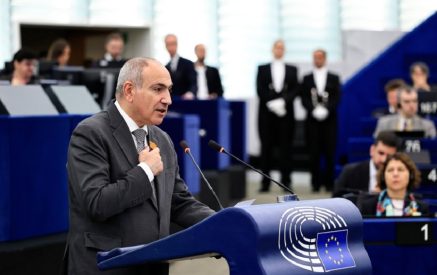















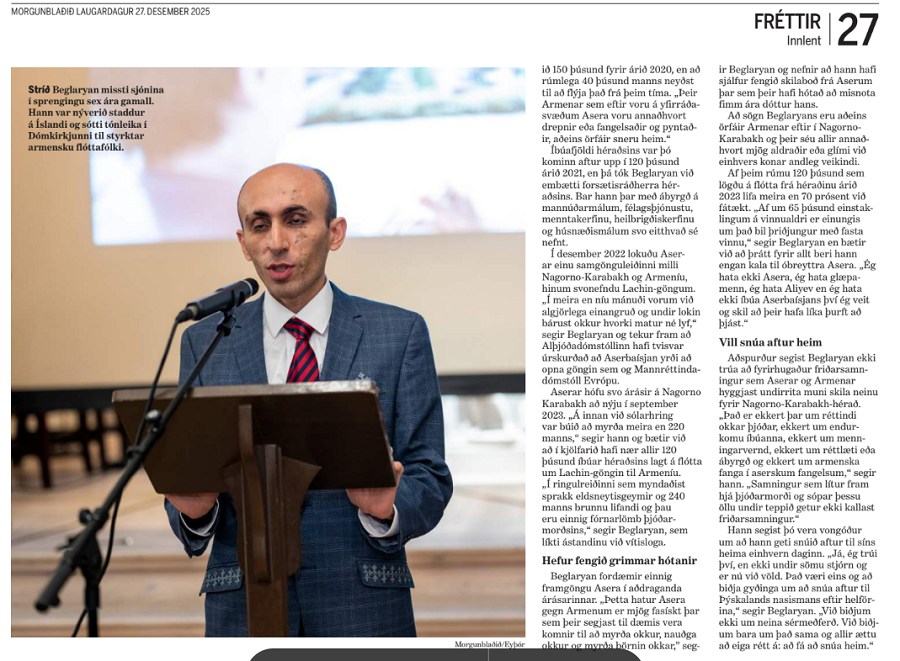
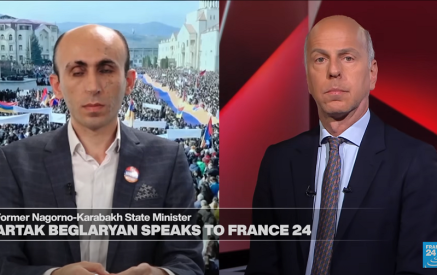
Iceland’s largenewspaper Morgunblaðið published an exclusive interview with Artak Beglaryan, President of the Artsakh Union, on December 27, 2025. The interview was conducted during his visit to Iceland in November. The full translation is provided below.
“I remember it well as a child—they blew up everything and everyone,” says Artak Beglaryan, former State Minister of Nagorno-Karabakh, a separatist region in Azerbaijan. He was only four years old in 1993 when his father was killed in clashes with Azerbaijani soldiers, and two years later he lost his eyesight when a landmine exploded in the backyard of his home.
The conflict between Azerbaijanis and Armenians over the region, where Armenians have formed the majority since time immemorial, has therefore left deep marks on Beglaryan’s life. He lost his mother at the age of sixteen due to a heart attack, and sixteen years later, in 2021, Beglaryan assumed the office of State Minister of the Republic of Artsakh, as Armenians called it, at an extremely difficult time in the history of the region.
Beglaryan was in Iceland earlier in November because of a benefit concert held at Reykjavik Cathedral to support Armenian refugees who have fled the conflict in the area. Beglaryan, who has been at the forefront of Armenians’ human rights struggle in Nagorno-Karabakh, spoke with Morgunblaðið about the planned peace agreement between Armenia and Azerbaijan and about the situation of the roughly 120,000 residents who were forced to flee their homes in September 2023 when Azerbaijan took over the region by force.
Read also
A Long History of the Region
Beglaryan places great emphasis on the history of the region, which Armenians view as ancient Armenian land, where a Christian community has lived for centuries, even millennia.
He says the turning point in the conflict with Azerbaijan came in 1921, when Joseph Stalin decided to annex the region to Soviet Azerbaijan despite the fact that over 95 percent of the population in the area were Armenians. “After that, my people were subjected to serious discrimination—cultural, economic, and social—under Soviet Azerbaijani rule,” said Beglaryan.
Beglaryan says that much changed when Mikhail Gorbachev became leader of the Soviet Union in the 1980s, as freedom of expression increased significantly. Protests then emerged across the region, where residents demanded that it be unified with Soviet Armenia.
“Then the Azerbaijani authorities began massacring Armenians who lived in Soviet Azerbaijan. Apart from Nagorno-Karabakh, more than 500,000 Armenians were living in various parts of Soviet Azerbaijan at that time,” says Beglaryan. “From 1988 to 1990, Armenians throughout Soviet Azerbaijan were either murdered or driven out. Thousands were killed and more than half a million lost their homes. This was an apparent ethnic cleansing,” he added.
Independence Declaration
After the collapse of the Soviet Union in 1991, the residents of Nagorno-Karabakh held a referendum based on the peoples’ right to self-determination, which is enshrined both in the United Nations Charter and in the Soviet constitution. Following this, the region declared its independence. Azerbaijan did not recognize the referendum, and the dispute turned into armed conflict between Azerbaijanis and Armenians. That war had profound and unforgettable effects on Beglaryan, who, as noted, lost his father early in the first Nagorno-Karabakh war and shortly afterward his eyesight.
With the support of Armenia and volunteers, Armenians in Nagorno-Karabakh prevailed, and in 1994 a ceasefire was agreed. A lengthy negotiation process then began under the auspices of the Organization for Security and Co-operation in Europe, with its Minsk Group, in which the United States, Russia, and France played key roles.
“From 1994 to 2020, we developed our democracy and institutions, despite the fact that no country recognized our independence,” says Beglaryan. “According to international benchmarks, we were doing better than Azerbaijan in terms of democracy and freedom of expression, even though we were completely isolated,” he adds. No state formally recognized the Republic of Artsakh during its lifetime.
A War under the Cover of the Pandemic
In the autumn of 2020, the Second Nagorno-Karabakh War broke out when Azerbaijan attacked the region. “They had built up their military; Aliyev, the dictator of Azerbaijan, invested heavily in the army with the income of their oil and gas. They bought advanced weapons from Turkey, Israel, and Pakistan and then attacked us in 2020, in the middle of the coronavirus pandemic.”
The war lasted 44 days and cost more than 4,000 Armenians their lives, including over 100 civilians. At that time, Beglaryan served as the human rights ombudsman of Nagorno-Karabakh and led a team that recorded and documented war crimes committed by Azerbaijan.
“We documented, among other things, beheadings of civilians, executions of prisoners, torture and humiliation of Armenians, and other war crimes,” he says, adding that Azerbaijani soldiers took photographs and videos of their crimes and shared them on social media.
It was during this period that Birgir Þórarinsson, then a member of parliament for the Centre Party of Iceland, visited Nagorno-Karabakh and met Artak Beglaryan. “This was an extremely courageous decision on his part, and he was one of very few elected officials who saw the situation with his own eyes,” says Beglaryan.
Tens of Thousands Fled the Fighting
On 9 November 2020, a ceasefire agreement was signed between Armenia, Azerbaijan, and Russia, under which Azerbaijan gained control of the majority of the region, while Russia sent peacekeepers to the remaining part of Nagorno-Karabakh.
“With this agreement, the Azerbaijanis controlled over 9,000 square kilometers of the region, while we retained only 2,700 under our control,” says Beglaryan, adding that the population of the region had been about 150,000 before 2020, but that more than 40,000 people had been forced to flee since then. “Those Armenians who remained in areas under Azerbaijani control were either killed or imprisoned and tortured; only a very few returned.”
The population of the region had, however, risen to 120,000 by 2021, when Beglaryan assumed the office of State Minister of the region. He thus bore responsibility for humanitarian affairs, social services, the education system, healthcare, and housing, among other things.
In December 2022, the Azerbaijanis closed the only transport route between Nagorno-Karabakh and Armenia, the Lachin Corridor. “For more than nine months we were completely isolated, and toward the end neither food nor medicine reached us,” says Beglaryan, noting that both the International Court of Justice and the European Court of Human Rights ordered twice that Azerbaijan must open the corridor.
The Azerbaijanis then launched renewed attacks on Nagorno-Karabakh in September 2023. “In less than a day, more than 220 people were murdered,” he says, adding that nearly all 120,000 residents of the region fled through the Lachin Corridor to Armenia. “In the chaos that followed, a fuel depot exploded and over 240 people burned alive, and they too are victims of the genocide,” says Beglaryan, who compared the situation to hellfire.
Brutal Threats
Beglaryan also condemns the conduct of hatred by Azerbaijan. “This hatred of Azerbaijanis toward Armenians is highly fascistic, as they say, for example, that they have come to kill us, rape us, and murder our children,” says Beglaryan, mentioning that he himself received such messages from Azerbaijanis.
According to Beglaryan, only a dozen of Armenians remain in Nagorno-Karabakh, and all of them are either very elderly or suffer from some form of mental illness.
Out of the approximately 120,000 who fled the region in 2023, more than 70 percent now live in poverty in Armenia. “Of around 65,000 people of working age, only about one-third have permanent employment,” says Beglaryan. He adds that despite everything he bears no hatred toward ordinary Azerbaijanis. “I do not hate Azerbaijanis; I hate criminals; I hate Aliyev, but I do not hate the people of Azerbaijan, because I know and understand that they also have had to suffer.”
Wants to Return Home
When asked, Beglaryan says he does not believe that the planned peace agreement that Azerbaijan and Armenia intend to sign will deliver anything for the Nagorno-Karabakh people. “There is nothing there about the rights of our people, nothing about the return of the displaced population, nothing about cultural heritage protection, nothing about justice or accountability, and nothing about Armenian prisoners in Azerbaijani jails,” he says. “An agreement that ignores genocide and sweeps all this under the rug cannot be called a peace agreement.”
He says, however, that he remains hopeful that his people will be able to return to their homeland one day. “Yes, I believe that, but not under the same state rule from which we fled. That would be like asking Jews to return to Nazi Germany after the Holocaust,” says Beglaryan. “We are not asking for any special treatment. We are only asking for what everyone should have the right to: to be able to return home.”
Artsakh Union