












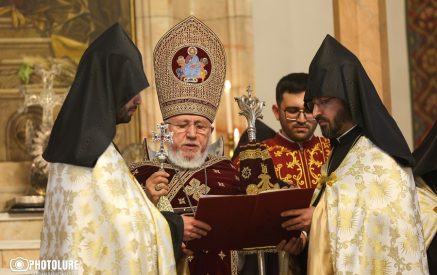












One of the key problems facing the current authorities is this: after seven and a half years in power, Pashinyan still does not see himself as a representative of the state. In a certain sense, he continues to feel like an opposition figure and pushes his team and supporters to behave accordingly—to act like an opposition force. This translates into daily defiant posts and participation in mass protest rallies, which in recent weeks have increasingly targeted Catholicos Garegin II. But giving these rallies the outward form of a “liturgy” or a “cross procession” creates cognitive dissonance even among the most loyal supporters of the authorities.
This naturally raises questions. Let me try to capture how the average nikolakan thinks. “If the issue is moral integrity, then how exactly are Kchoyan or the others any better than Garegin II? And if the problem is that the Catholicos is an FSB agent or has ‘plundered’ something,” the Pashinyan supporter reasons, “then you, my dear prime minister, are in power. You are not a popular tribune who needs to talk about this every day. Take the measures that fall within your authority as the government. This has nothing to do with morality or church reform, and there is no need for me to serve as mere crowd filler. So please, leave me alone. You’ve established peace—well done. Dumikian and Jennifer Lopez are singing—wonderful. Ten thousand people attend the wine festival—pure happiness. Just let us enjoy the bright present you’ve given us.”
This, in broad terms, is how the average nikolakan thinks—someone who has no major personal stake in the form of a position, a mandate, a bonus, or a business.
At the beginning of 2020, it was still possible to organize a nationwide referendum under the slogan “Let’s reject Hrayr Tovmasyan.” Today, the atmosphere is different. And even if Pashinyan, because of his boundless self-confidence, fails to notice this, the more sober-minded members of the Civil Contract party certainly do. It is not difficult to entice certain bishops—they are “bosses” who enjoy currying favor with those at the very top. It is also possible to pressure a number of priests into submitting to those bishops: if they refuse to sign a letter pledging loyalty to Pashinyan, they may face social and professional difficulties. But organizing a mass movement under the slogan “Let us reject Ktrich Nersisyan through liturgies” simply does not work.
Read also
What remains are the old, well-tested methods: forcing people to participate through administrative pressure, threats and coercion by the National Security Service and the police, and open repression against dissenters. This is also a lesson in the context of the upcoming elections. Such methods may make it possible to stay in power. But the “popular” support on which Pashinyan places his hopes will never return. And a government reproduced by such means, as is well known, is inherently fragile.
Aram ABRAHAMYAN
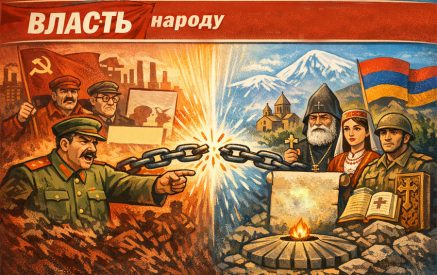
Caricature by MediaLab – Newsroom Laboratory