







































And why one must not attend the Liturgy with the aim of waging war against someone
“So when you are offering your gift at the altar, if you remember there that your brother has something against you, leave your gift there before the altar and go; first be reconciled with your brother, and then come and offer your gift.”
(Matthew 5:23–24)
Considering the religious practices of that time, the Lord’s call was more than bold. For the Jews, offering a sacrifice was a most sacred act; interrupting it was, at the very least, a sign of disrespect toward God. Yet Christ—as He Himself says in the same sermon—comes not to abolish the Law but to fulfill it, to bring it to completion.
And so it turns out that any religious ritual is less important than putting human relationships in order. More than that: the ritual becomes meaningless if you have not first set those relationships right.
Read also
Notice something important: the Lord does not say, if you have offended your brother, or if he has offended you, or if you are right or wrong. He says, “if your brother has something against you,” or, in another translation, “if your brother is upset with you.” The issue, therefore, is not your own grievance but his—regardless of whether your brother’s resentment toward you is justified or not. Enter into communication with him first, and only then communicate with God.
You might say: this is impossible—to drop everything and go “reconcile with your brother.” In everyday, practical terms, yes, that seems unrealistic. But not in biblical terms. In general, the Gospel—and the Sermon on the Mount in particular—contains many demands that seem “unrealistic.” For example, the same chapter of Matthew’s Gospel from which this quotation is taken ends with the call: “Be perfect, therefore, as your heavenly Father is perfect” (5:48). Perfect by God’s standard? That is impossible for any human being. But here the point is not absolute perfection; it is our inner spiritual movement toward wholeness, toward maturity. In the original Greek, the word τέλειοι (teleioi) carries precisely that meaning.
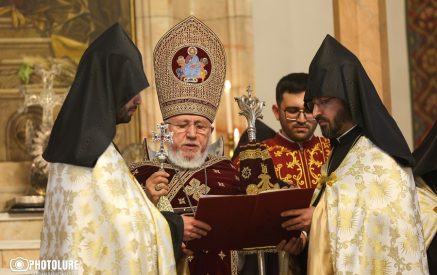
The same applies to “reconciling with your brother.” This is not only a prerequisite for the Divine Liturgy, a procession, or any other spiritual rite; it is an inseparable part of it. During the Liturgy, the priest says several times, “Peace to all.” Peace—that is, reconciliation with God, reconciliation with your brother, wholeness, healing, order, and harmony. And the prayer “peace to all” means: “May God’s fullness of grace be upon those present.”
When people come to the “Liturgy” with no intention of reconciliation in mind, and on the contrary, come in order to display their hatred toward someone—no matter whom, whether the Catholicos or the church caretaker—so that the “boss” might be pleased by this display, that is no longer a Liturgy.
…It is not inconceivable that Pashinyan, through his bishops and the National Security Service, might one day impose that during the Liturgy, instead of “peace to all,” the words “war to all” be proclaimed.
Aram ABRAHAMYAN