



























by Suren Sargsyan
Donald Trump’s recent statement that he applied pressure in order to advance Armenian-Azerbaijani peace went largely unnoticed, despite its exceptional importance. It cannot be ruled out that the statement went largely unnoticed because that what the authorities in Armenia and Azerbaijan wanted. In Armenia, elections are expected soon, and the authorities are trying to show that they are the ones bringing about peace. In Azerbaijan, it is natural that Aliyev positions himself as a regional player on whom pressure is extremely difficult to exert, even for the president of a great power.
In fact, pressure was directed exclusively at Azerbaijan, since Armenia was already under pressure and prepared to make additional concessions. In other words, it was not Armenia that brought about a change in Baku’s position through negotiations; rather, that change occurred as a result of pressure from Washington — not out of consideration for Armenia’s interests or out of any goodwill, but strictly within the logic of US interests.
Read also
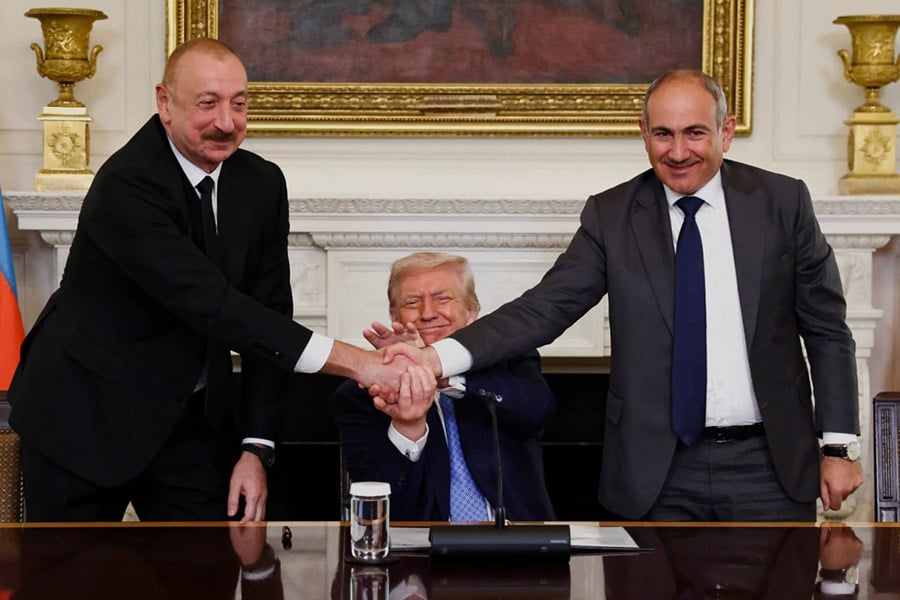
There is a high probability that Azerbaijan did not want to initial the peace agreement because, under that framework, it would have had to take into account the presence of Trump’s signature under the document as well. In other words, if Azerbaijan intended to seize additional territories from Armenia or exert pressure on Armenia before the signing of the agreement — particularly in terms of demarcation and delimitation — after initialing the document, Baku’s hands would have been somewhat tied.
Baku has, by and large, already obtained everything it wanted from Armenia, yet it continues to maintain its maximalist rhetoric. However, it should not be ruled out that, if the opportunity arises, Baku may still extract additional concessions from Armenia.
The fact that Trump’s adviser, Steven Witkoff, did not visit Armenia in March and instead traveled only to Baku for negotiations once again demonstrates that Armenia assumed a passive role in the process and that there was simply nothing to discuss with Yerevan. It is evident that Armenia has met and continues to meet a broad range of concessions. If the situation changed to some extent between the beginning and the end of 2025, this has no connection whatsoever to the actions of Armenia’s authorities.
This is a purely geopolitical process, driven by Trump within the framework of advancing US interests from Central Asia to the South Caucasus, Turkey, and Europe. A certain stabilization of the situation by no means implies that Azerbaijan has ceased to view Armenia as a hostile state. Evidence of this is abundant, ranging from official rhetoric to concrete actions. Therefore, the decisive role in these developments has been played by US policy under Trump’s leadership, while Armenia’s authorities have had virtually no involvement in this process — nor could they have.
In reality, the situation has unfolded in such a way that Washington, in order to advance its regional interests, has also taken into account the interests of Ankara and Baku. As a result, both of these states have effectively been granted the idea of being connected by a “corridor,” but this arrangement has been packaged under the American flag.
The main beneficiaries of Trump’s proposed route are Baku and Ankara, while the main losers are Moscow, Tehran, and Tbilisi. In the cases of Moscow and Tehran, this means a significant reduction of their influence in the South Caucasus. For Tbilisi, it means that Georgia is gradually losing its strategic regional role, which had been tied to the existence of the Armenia–Azerbaijan conflict as well as to its transit significance.
In essence, the only concession Baku has made to Trump is the name of the route, which will officially be called not the “Zangezur Corridor” but the “Trump Route.” However, Azerbaijan will use this road without obstruction, exactly as Baku had previously stated.
Without the involvement of the Trump administration, communications in the South Caucasus would have opened under a different logic and, in all likelihood, would have remained under Russia’s general control. However, US involvement does not mean that Armenia’s security is guaranteed, nor does it eliminate the threat to Armenia’s self-defense from Turkey and Azerbaijan—whether through economic expansion or various forms of territorial concessions, even under the pretext of demarcation and delimitation.
In the end, we see that the demarcation and delimitation taking place between Armenia and Azerbaijan are happening solely at the expense of Armenian territory.