













by Marut Vanyan
SVARANTS, Armenia — On a recent Sunday morning, a woman receives a blessing from a priest at the Tatev Monastery, the walls echoing with the Surb Surb hymn. Someone else is there with his son light a candle. The cable car passes through a blue winter sky, which immediately reminds one of Ruben Vardanyan, who financed this project. Next to the church, dehydrated fruits and herbs such as thyme, chamomile and rose hip teas, honey, knitted toys, and various souvenirs are sold.
In another corner, a woman is repairing the priest’s vest. The priest didn’t dare to throw it away because it was a gift and he asked this woman to repair it.
Read also
Knowing that I wasn’t a tourist, she didn’t offer me any shopping but suggested to catch up with Dmitri, who sells almost the same things next to her, but Dmitri’s stall is poor. I have known him since childhood; he was my grandmother’s neighbor in our village in Vaghuhas, Martakert Region, in Artsakh (Karabakh). Now he collects whatever nature offers him from the forests around Tatev and sells them next the church. Although we were talking about other things, it seemed as if we were asking each other with our eyes: “Where we are and why are we ended up here?” Dmitri says he has barely made 1,000 drams a day ($2) this season and is waiting for the tourist to come in the summer.
The knitting woman suspects that refugees from Artsakh will not settle in Svarants village, located 4 kilometers from the Tatev Monastery in Syunik Province. “Who will agree to live there?” she asks with a sigh.
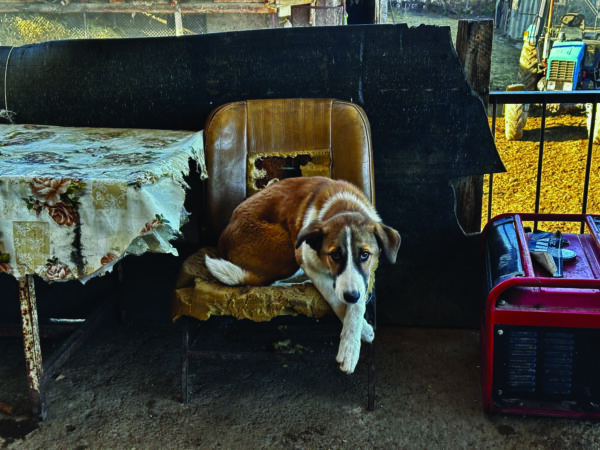
Uliyana’s faithful companion (Marut Vanyan photo)
Uliyana
“When we forced to left Karabakh in 2023, my husband decided: ‘We’ll make a quick stop in Armenia and move to Russia, it’s non-negotiable.’ But the people welcomed us here so warmly that we decided to stay. My husband even ‘went spying’ there, but when he returned, he said, ‘no, it’s not a place to live there.’ Anyway, many from my fellow villagers have left for Russia. Some are coming back, others are staying. Russia is not what it was before the war in Ukraine. That’s why many are returning. What should they do, go from one war to another? I personally know that two families from my native village have returned,” said Uliyana from Maghavuz Martakert, whose family settled in Svarants, part of the Tatev community.
Currently, her family is renting a rural house in Svarants, but Ulina says that it’s musty inside and wants to move to a new house built by the Tufenkian Foundation. “It’s so humid here that the lids on the jars of jam I canned for the winter are rusting” she said.
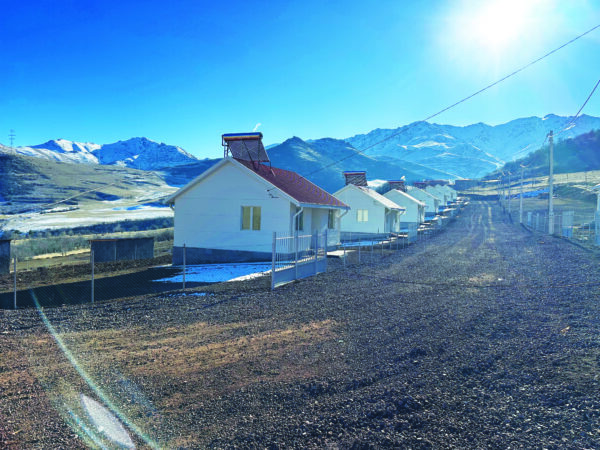
New homes built by the Tufenkian Foundation in Svarants (Marut Vanyan photo)
In Svarants, next to the derelict houses with the rickety fences, the Tufenkian Foundation has built 10 new once, which already shine in front of you from the dirt road leading to the village, but up close you can see that the houses are still unfurnished.
“There is a plot of land in front of it where we can plant vegetables, hoe, sow, as we did in Maghavuz. Basically, this is going to be a new neighborhood and I’m a little excited about who my new neighbors will be. However, I understand that not everyone can live a rural life. Half of the Karabakh population lived in the capital Stepanakert, worked in banks, pharmacies or state offices. Therefore, the majority today prefers to live in Yerevan, hoping to get a job in their profession,” she added.
The housing issue remains the most vital and urgent for Karabakh Armenians. On December 16 last year, a draft resolution was discussed at a session of the Armenian Parliament to approve a $250 million loan agreement with the Asian Development Bank, which is supposed to solve the housing issue of Karabakh refuges. During the session it become known that 26,000 Artsakh Armenians got new Armenian passports, although they all hold the same Armenian passport with the 070 code. However, the Armenian government considers the passports of Artsakh Armenians to be a travel document only.
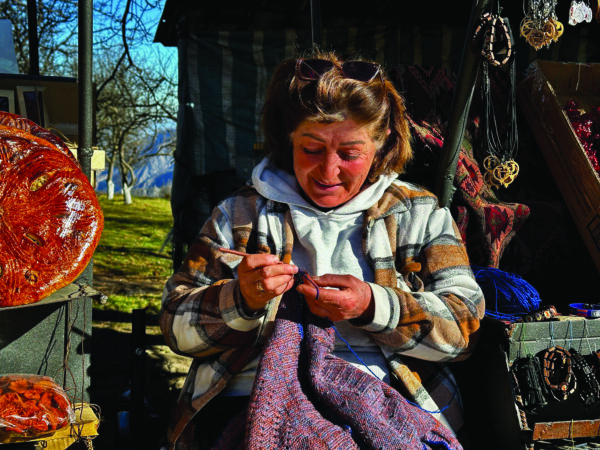
Knitting in Svarants (Marut Vanyan photo)
Three thousand and eight hundred families applied for housing certificates, but only 1,600 families (6 percent) have been able to purchase an apartment so far.
Thus, Artsakh Armenians are forced to exchange their blue passport for another blue one, where the 070 code is changed to 099, facing bureaucratic and psychological difficulties. “I just got my ‘new’ passport. Please do not congratulate me. The process took more than four months. My parents are still waiting, although they registered in the passport office on the same date as I,” said Svetlana, a former resident of Stepanakert.
Sputnik Armenian reports about 5,500 applications from former Artsakh citizens have been rejected.
“A total of 9,284 families have submitted applications within the framework of the state support program for housing for families forcibly displaced from Artsakh. This was reported by the Ministry of Labor and Social Affairs of Armenia in response to a written request from Sputnik Armenia. The main reasons for rejection are the absence of data on the applicant or any family member in the database of forcibly displaced persons registered by the Migration and Citizenship Service of the Ministry of Internal Affairs of the Republic of Armenia after September 27, 2020 and September 19, 2023,” the report noted.
According to the Armenian National Security Service statistics, around 16,000 Artsakh Armenians have left Armenia since 2023 (most, it is assumed, for Russia), while Artsakh Ombudsman Gegham Stepanyan states that the number is at least 24,000 and probably much higher.
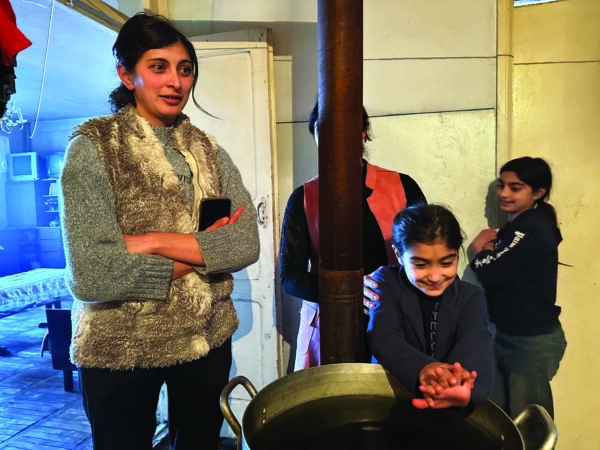
Bella, at left, Uliyana, center, and her daughter, in Svarants (Marut Vanyan photo)
Meanwhile, the profile of the capital Stepanakert has almost completely changed today. Now calling it Khankendi, Azerbaijanis are demolishing entire neighborhoods, painting the buildings white, and populating them within the framework of the “great return” program. In principle, Stepanakert never shone with its architecture, it’s simply typical Soviet architecture city, but in any case, it was the people who made it such a good place to live.
There was an old neighborhood on Tumanyan Street, which Azerbaijan demolished and builtin its place a “Victory Park,” which Azerbaijani leader Ilham Aliyev officially opened on December 24 (on his birthday). Perhaps it would be better for the Karabakh people if there was no internet and they didn’t see bulldozers demolishing their apartment buildings, where they had lived their entire lives. But what is left for them to do today other than live in rented flats in Armenia or emigrating to Russia and France?
However, what the Armenian government cannot or doesn’t want to do, the Armenian Diaspora is trying to “fix”, which, again, does not solve the problem, but when even one family has a roof over their head, it is already good news.
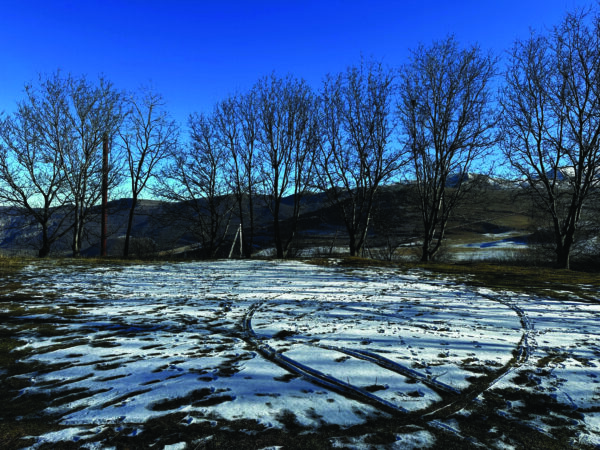
Svarants (Marut Vanyan photo)
“The first ten houses we are building for forcibly displaced Artsakhtsi families are nearly complete,” said Tufenkjian so Programs Director Hagop Ipdjian as he showed us around. The new neighborhood is being built in Svarants, as part of the Tufenkian Foundation’s “Come to Svarants’ revitalization program,” the Tufenkian Foundation announced in October.
There is a school in the Svarants and Ulyana said that, now it has only around 20-23 students, while the neighboring Tandzatap village has only one student, and sometimes one of Ulyana’s children attends school there, thus doubling the school population! She added that about 38 families live in Svarants, a number increased by two families from Artsakh. There was a medical center in the village, but the only doctor is now in Yerevan for health issues. The villagers go to nearby Tatev to see a doctor if necessary. Once a week, on Mondays, public transport comes to the village and leaves for Goris. Uliyana says the grocery’s prices are high in the village and they go shopping in Goris.
“The first year, when we arrived here, local NGO’s helped with necessary things and food, the Red Cross, the People in Need helped a lot, now there is not much attention towards the Artsakhtsis and we have to get them ourselves. Cooking oil, sugar, rice, vermicelli, buckwheat — what we need in the kitchen in a nutshell, we buy in Goris” said Uliyana.
A benefactor donated a tractor to the village, which Uliyana’s husband uses. They have 40 livestock. Her fellow villager Bella, who has also decided to live in Svarants permanently, has six. “I’m lucky, I don’t pay rent unlike Ulyana,” noted Bella.
“It’s not bad here, the nature is almost the same as in Maghavuz. Pear, black plum, cornelian cherry, everything they have here as we had in Maghavuz, but of course we miss home. For instance, I put a plate on the table, I involuntarily remember that I used to do the same action at my home, a simple movement mentally transports me to my home. It’s impossible to control humans feelings”, Uliyana explained.
Also, many have been deeply affected by the blockade, so that many don’t throw away even moldy bread, and the men keep a can of petrol for a “rainy day,” like Aram, Bella’s husband.
Artsakh Armenians are still in shock of the so-called one-day-war in September 19, 2023 and the subsequent exodus in the same month. Everyone’s story is the same, yet everyone’s is different.
Uliyana recalled, “We were preparing for one of my children’s birthday parties that day. You know, during the blockade unlike Stepanakert, in the villages there was something to put on the table at least. I used to milk the cows. My daughter loves milk very much and was constantly demanding it. I told her that first we should give it to the villagers, then to herself. But how can you explain this to 8-year-old child?”
She continued that her daughter kept demanding milk. At that moment, a powerful explosion thundered. Her daughter asked her what it was. “Don’t be afraid, honey, it’s just your dad’s truck’s hood closing.” Then the second and third came; the artillery was no longer silent, we couldn’t understand who was shooting at whom. We took shelter under a nearby hill because there were no shelters or safe places to hide in the village. They instructed us that we have two hours, to take what we need and leave for Stepanakert. I stood in the middle of the living room, stunned: a newly renovated house, I had everything, but what can I take from all of this? I don’t know why, but I yanked the image of the Virgin Mary off the wall and took it with me. I took this, and another photo of my little one. My husband had a truck, but we couldn’t get it out because there was no fuel, so 9 of us somehow got into a Niva [Russian off-road vehicle] and left. It was real chaos, I couldn’t figure out how to gather the children. My daughter came crying and said that Suzy, her sister, had fallen and broken her leg while running away, and no one was able to another, as everyone was rushing in a panic. We were stuck in those terrible traffic jams for two days until we reached Goris. My body was paralyzed by the terrible road.”
Uliyana and Bella vaguely described the future of Karabakh Armenians. “We don’t know, we can’t speak for the whole population. The reality is they are still living in other people’s houses in Armenia, facing social, psychological and bureaucratic difficulties others are emigrating. I still can’t sort my mother-in-law and father-in-law’s documents. We were so lost that we couldn’t manage to take them with us. We paid 120,000 drams ($315) to a lawyer so he could deal with the issue, but there is still no result. All of our lives have become difficult. It’s much more difficult for those living in the city. It’s impossible to live and pay rent on a salary,” says Bella.
In April, the Armenian government suspended the housing compensation program for Artsakh Armenians, under which each person was paid 50,000 drams ($130) per month. Currently, only children and vulnerable groups are paid 30,000 drams ($78) per month. However, all Karabakh Armenians consider themselves a vulnerable group, because they have all lost everything.
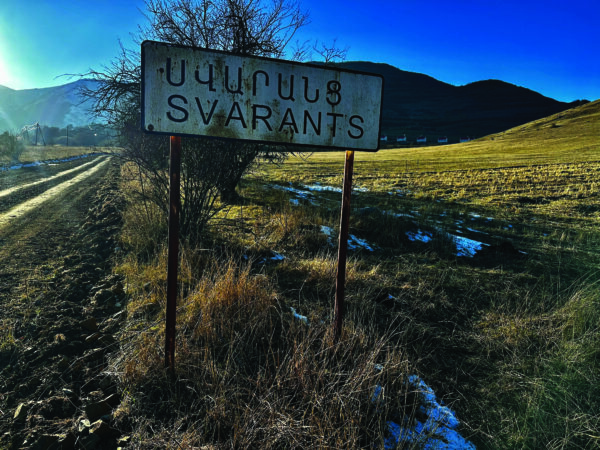
Entering Svarants (Marut Vanyan photo)
In March, Artsakh Armenians held protests in Yerevan demanding the restoration of this program, but the Armenian government said its clear “no.”
“We haven’t received the children’s money for three months now. I don’t know, Social Affairs Ministry says it was transferred, the bank says there is no money in your account. Usually they transfer 30,000 drams ($78) for my four children, if they transfer,” Uliyana said sarcastically.
When asked if the Karabakh chapter is closed, as the politicians say, Uliyana became indignant: “How come? As long as Karabakh Armenians are existing, the chapter cannot be closed.” And when asked about the possible return, she shrugged her shoulders: “Maybe by some miracle,” she said. “We will, rain or shine,” Bella’s husband Aram added.
“As for Syunik, they cannot feel it and that is natural, they have not gone through all this, God forbid. We did not believe in this tragic ending either. Who could have imagined that they would take all of Karabakh and deport the entire population, who would have imagined that this day would come?” Uliyana asked in surprise.
And if you ask children what they remember from Artsakh, it is clear from their faces that they remember their friends, but have forgotten their names. “What else do you remember from Artsakh?”, this was a question for Laura (8 y/o), Bella’s daughter. “My dad’s truck, It was blue,” said Laura as she hid behind her mom.