












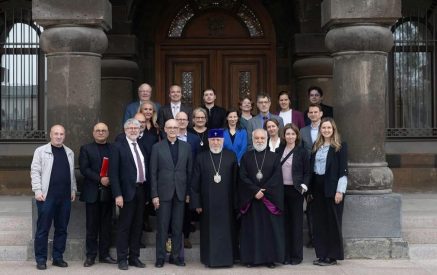





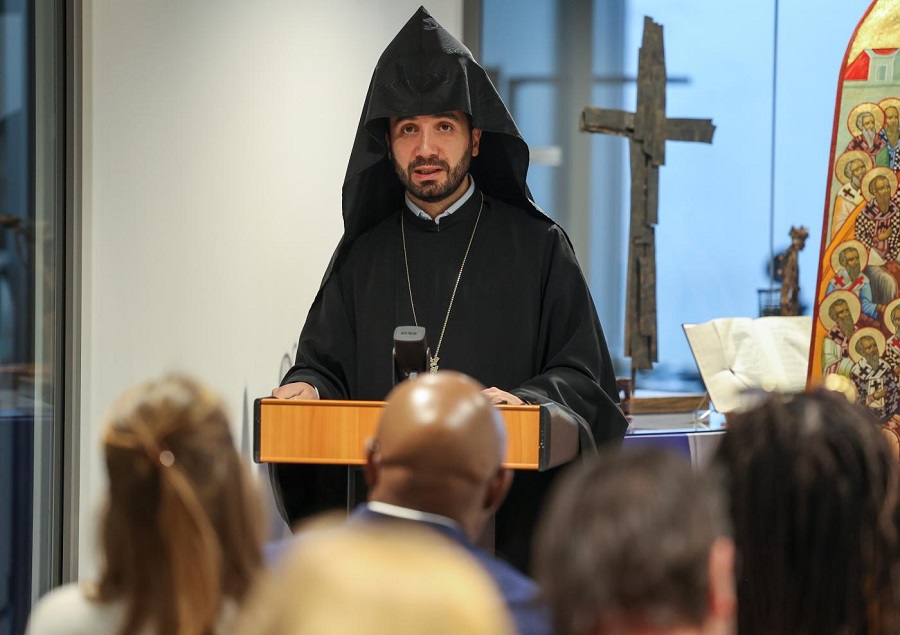
World Council of Churches. A morning prayer at the Ecumenical Centre on 19 January highlighted the annual observance of the 2026 Week of Prayer for Christian Unity. In a reflection, Rev. Archimandrite Garegin Hambardzumyan from the Mother See of Holy Etchmiadzin, Armenia, highlighted how the resources for the special week draw on the spiritual and theological heritage of St Nerses the Gracious.
For the year 2026, the prayers and reflections for the Week of Prayer for Christian Unity were prepared by the Inter-Church Relations Department of the Armenian Apostolic Church, along with their brothers and sisters of the Armenian Catholic and Evangelical Churches.
“Together with our international sisters and brothers from the World Council of Churches and the Vatican, we approached it with humility, aware that what we were offering belonged not to us alone, but to the whole Body of Christ,” said Hambardzumyan. “We are grateful that the prayers, hymns, and reflections born within our tradition are now being received, prayed, and lived by Christians across the world.”
The theme for 2026 comes from Saint Paul’s Letter to the Ephesians: “There is one body and one Spirit, just as you were called to the one hope of your calling.”
Read also
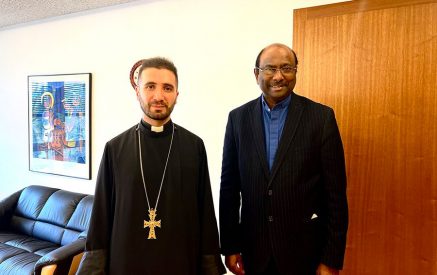
Hambardzumyan reflected that these words invite us first to recognition before action. “Unity, Saint Paul tells us, is not primarily our achievement,” he said. “It is God’s gift.”
At the same time, Hambardzumyan noted, Saint Paul is deeply realistic. “He knows that unity, though given, can be wounded,” said Hambardzumyan. “Unity does not grow through pressure, haste, or forced agreement. It grows through humility that listens, patience that endures, and love that is willing to carry the weight of difference.”
Hambardzumyan noted that this path is beautifully illuminated by St Nerses the Gracious, Shnorhali, whose prayers, hymns, and theological vision shape the materials for the Week of Prayer for Christian Unity.
“For St Nerses, unity did not mean uniformity. He rejected any notion that unity could be achieved by diminishing doctrinal integrity or erasing liturgical and cultural identity. On the contrary, he insisted that each church must be respected in its doctrine, worship, discipline, and historical experience. Differences, he taught, are not obstacles when they are embraced with humility; they become gifts that enrich the Body of Christ rather than fragment it.”
Hambardzumyan said the Armenian churches wish to convey to their Christian sisters and brothers worldwide not only theological reflections, but a word of fraternity and encouragement.
“Our history has taught us what it means to suffer and to struggle for survival. It has also taught us the strength that comes from solidarity, faithfulness, and shared prayer,” he said. “In a world marked by war, injustice, and deep polarization, Christian unity is not a luxury. It is a necessity for credible witness to the Gospel.”
In conclusion, Hambardzumyan noted that Saint Paul urges us to “make every effort to maintain the unity of the Spirit in the bond of peace”—a demanding call.
“It requires perseverance, humility, and trust that the Holy Spirit is at work even when progress feels slow or fragile,” he said. “As we pray together during this Week of Prayer for Christian Unity, may we renew our commitment to this path. May we resist discouragement and impatience. May we learn again how to listen deeply, how to wait faithfully, and how to love generously.”
Resources for the Week of Prayer for Christian Unity are jointly published annually by the Dicastery for Promoting Christian Unity and the World Council of Churches.