




















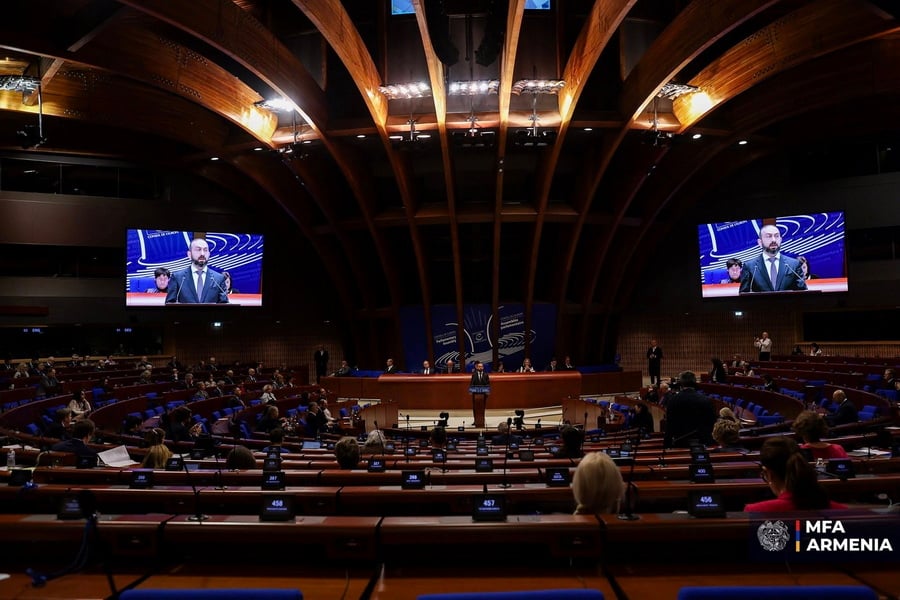
Did the Armenian authorities really succeed in “spinning” the PACE delegates and extracting a resolution that “condemns” an alleged conspiracy invented by several clergymen to seize power? Or does the concern expressed in the resolution about tensions between the Prime Minister and the head of the Church instead indicate that the Assembly expects the Armenian authorities to put an end to their campaign against the Church?
The wording is deliberately vague and evasive, allowing for multiple interpretations. The same resolution contains some vague allusions to the “misuse of public resources and the application of regulations on political party financing.” Here, too, it is unclear whether the Civil Contract party is misusing public resources. In reality, it is doing so extensively—even to ensure a “crowd” at church services, not to mention during elections. And who, exactly, is failing to comply with the rules on party financing?
As for the “conflict between the Prime Minister and the Catholicos,” PACE delegates, if they had wished, could have delved into the issue of legitimacy. If I were to say that I still consider Vahan Kerobyan to be the Minister of Economy simply because I do not like the Prime Minister, any PACE delegate—as well as any reasonable person—would simply smile and shrug.
But when members of the Civil Contract party declare that they consider this or that person to be a priest or a bishop, it does not provoke the same reaction. In this case, one could suggest that they establish their own religious organization and, within its framework, ordain and depose their bishops and priests at meetings of the Civil Contract board. The Armenian Apostolic Church, however, has its own canonical order, and neither the opinion of any Civil Contract member nor, for that matter, my own opinion (whom we “consider” or “do not consider” to be something) has any decisive significance.
Read also
What resolutions PACE adopts is, of course, not the most important issue. But overall, it is clear that Pashinyan continues to remain the “darling” of European institutions—despite the authoritarian regime he has established in Armenia.
Aram ABRAHAMYAN