






























by Muriel Mirak-Weissbach
BERLIN — What can civilians do to stop, or at least provide aid to victims of war or genocide? By no means an academic question today, it can be best addressed by learning from attempts made in the past, from those rare individuals who had the morality and courage to intervene. This was the approach taken by civil society proponents in Berlin last weekend, who viewed a film documenting one person’s attempt to stop the Armenian Genocide, then opened discussion on the implications for our world today.
The film, “Homo Politicus,” which is Latin for political man or activist, was presented on January 23 and 24, at the Lepsiushaus in Potsdam and the AKEBI civil society group office, respectively. In addition to hosts and moderators Ulrich Rosenau and Öndercan Muti, filmmaker and director Hacı Orman and genocide scholar Tessa Hofmann provided historical background to the film and the parameters of legal and institutional initiatives developed since World War II.
Read also



“Homo Politicus” reenacts an encounter between Johannes Lepsius, a German pastor and humanitarian and Ottoman War Minister Enver Pasha on August 10, 1915. Enver had been a member since 1913 of the so-called “triumvirate” leading the Committee of Unity and Progress (CUP), with Interior Minister Talaat and Naval Minister Cemal, in a government allied militarily with Imperial Germany. The Young Turk regime, as it was known abroad, used the First World war as cover for dealing with the “Armenian question,” eliminating Armenian hopes for reform, by eliminating the Armenian population through genocide.
Lepsius, who had provided humanitarian aid to victims of the Hamidian massacres in the 1890s, returned to Constantinople in 1915, in an effort to stop the genocide and succeeded in getting a private meeting with Enver on August 10, 1915. By then, the death marches were in full swing, as German Ambassador Wangenheim had reported to Berlin. Denied access to the interior, Lepsius conducted interviews with diplomats and humanitarian helpers arriving in the capital, who reported in detail on the ongoing deportations and massacres; the resulting documentation appeared in German as, The Death March of the Armenian People: Report on the Fate of the Armenian People in Turkey during the World War.
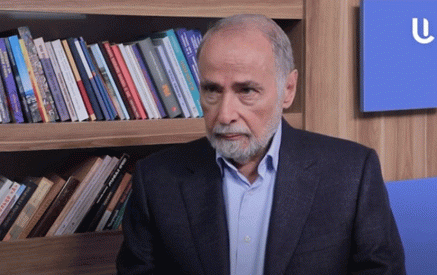
It was not this account that first acquainted filmmaker Orman with the story, but Franz Werfel’s adaptation of Lepsius in his novel The Forty Days of Musa Dagh. In an exchange with Hofmann, the director confirmed that his was the first film in Turkey that “dealt with the theme of genocide directly – and that remains so today.” There had been documentaries as well as films about Armenians, though on other themes. “Almost all of them,” he added, “were made possible especially thanks to support by Anadolu Kültür and Osman Kavala.” The former is a cultural association founded by Kavala (who has been jailed for the past eight years), dedicated to intercultural dialog, cultural cooperation, and regional peace initiatives. Officialdom in Turkey opposed the film, so it has never been shown in the country. Although, as Orman related, it had been chosen for the Istanbul Film Festival, it was never presented in festivals or normal movie theaters and could be seen only in private viewings. This “unpleasant story” of its fate in Turkey ended with the “curious” disappearance of the raw material from the hard disk. Elsewhere, it has met with positive reactions, he added, in Armenia, Canada, the US and several European countries. “At the moment,” he remarked, “the film is even the subject of a Ph.D. dissertation in France…”
Currently, Orman, who fled to Switzerland four years ago, where he is “free to work,” has two projects on his agenda: the 1921 Berlin trial of avenger Soghomon Tehlirian, often called the “Talat Pasha trial,” and the other, Jakob Künzler, often considered the Swiss counterpart to Lepsius for the work he and his wife did to save thousands of Armenian orphans.
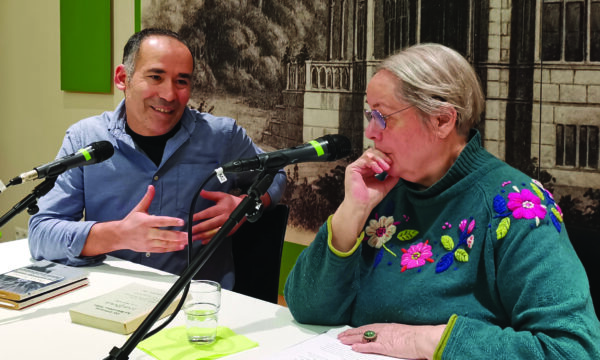
Haci Orman and Tessa Hofmann (Photo Ulrich Rosenau)
The Churchman and the Genocidalist
The 20-minute “Homo Politicus” reenacts the dramatic confrontation between Lepsius (Peter von Strombeck) and Enver (Mehmet Yilmaz). Lepsius begins with flattering words for Enver, but when he mentions the eyewitness reports of deportations, Enver categorically denies them. The German pastor appeals to Enver with boldness, to use his power to stop them: “Declare the deportations be stopped and I will praise you in Germany.” Enver insists his guest is “misinformed” and sarcastically lauds Lepsius’s interest as “admirable.” Lepsius proposes an alternative: to send him, Lepsius, with his experience in charity work, to organize the deportations. Enver’s counterproposal reveals his ruthlessness as a dealmaker.
Enver offers to improve the lot of the Armenians if Lepsius hands over to him their insurance policies, an “offer” that the humanist Lepsius finds reprehensible.
The “dialogue” develops from this point on as a clash of fundamental values: Lepsius calls for respect of international law and decency, whereas Enver argues that crime (committed by the Armenians) must be punished, for “justice.” Lepsius pleads for justice and mercy; Enver is “bound by the law” and criminals must pay. Lepsius appeals to history as a judge, while Enver recites cynical aphorisms (“As the Italians say, however the game ends, all the pieces are put back into the same box,” and “In politics, the best way to say certain things at the right time is to say them a little late.”) Formalities exchanged on departure cannot conceal their fundamental moral conflict.
Hofmann’s assessment of the Lepsius-Enver episode is sober: the German humanitarian was forced to conclude that he had no hope of exerting direct influencing to improve the Armenians’ plight; the US and German embassies would do their best. It was useless to try to influence the Young Turk government; the only recourse possible was to document the genocide, to inform public opinion in Germany the best he could, despite the complicit press. On return to Germany, he realized the Foreign Office had no illusions about the suffering of the Armenians and would sacrifice them to save the military alliance.
And Today?
The Lepsius-Enver episode, Hofmann concludes, “represents a depressing picture of a failed humanitarian intervention.” The two men faced each other on anything but equal footing, Enver, the “high-ranking statesman” and Lepsius, his “barely tolerated guest, whose own government didn’t even dare adopt Lepsius’s concern.” Now the question is: “Where do we stand today?”
She gave a sweeping overview of what has developed in terms of humanitarian legal instruments and organizations since the 1948 UN Genocide Convention, to the 1998 Rome Statute and the subsequent founding of the International Criminal Court. To deal with genocide, crimes against humanity, crimes of aggression and war, these are pillars of international law. But not all nations signed those documents or respected them. The structural weaknesses of these instruments lie in the lack of tools of implementation and independent executive organs, thus the non application of court decisions and sentences, etc. International law may be “juridically binding, but is weak in execution;” thus implementation depends largely on political pressure, international standing and di0plomacy. Similarly, with the Responsibility to Protect, and other international mechanisms.
Equally problematic are self-contradictory principles in international law, such as self-determination vs. territorial sovereignty (Kosovo, Karabakh (Artsakh), Scotland, Catalonia) and the outcome is often decided by power not principle.
Hofmann’s conclusion is that we find ourselves in a position today analogous to that of Lepsius 111 years ago. And the options open are those chosen by human rights organizations: collecting and spreading documentation of crimes, confronting political forces responsible.