



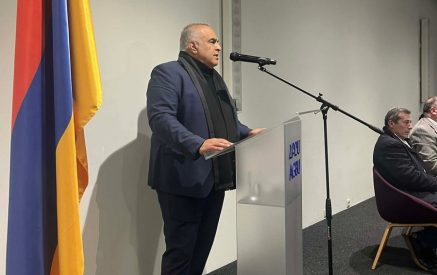









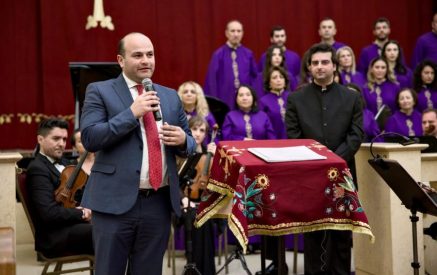

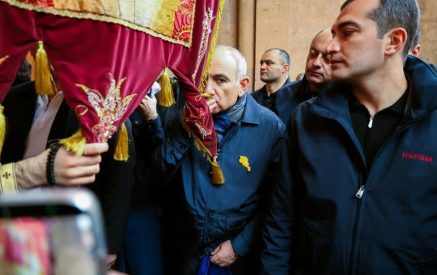

When I first went to Artsakh (the Shahumyan district), it was the summer of 1991. Alongside the young men who were fighting stood Father Grigor—Armen—whom I knew from Ajapnyak. You can hardly imagine how important the presence of a priest was for our soldiers. And not only for them. It was then, at the age of 31, that I was baptized and began to understand that, at least for us Armenians, faith and patriotism go hand in hand.
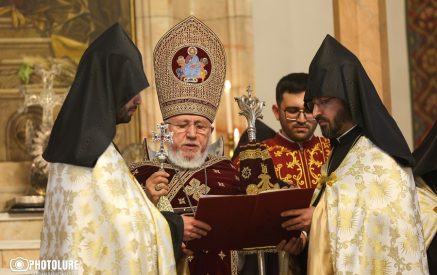
The dismantling of the military chaplaincy institution is, of course, part of the broader campaign against the Church and is also driven by Pashinyan’s petty vindictiveness toward those clergymen who refused to climb into his pocket.
But if we look at the issue more broadly, this is yet another manifestation of the concept of “Real Armenia.” What exactly are soldiers defending, and what are they prepared to fight for? From roughly the beginning of the 19th century, when mercenary armies were gradually replaced by national armies, the answer to that question was unequivocal: for the homeland. And that is precisely the answer soldiers in all modern armies would still give.
In today’s Armenia, however, the word “homeland” has become a target of gratuitous attacks and is being set in opposition to the concept of the “state,” which, naturally, should also be extremely dear to us. It is the form of organization of our nation—the highest of all possible forms—which we regained in the 20th century.
Read also
Yet armies wage war not for the state as such, but for the values that must lie at its foundation: one’s own homeland, faith, culture, civilization, land. If those values are absent from the foundation of the state, if the army lacks those who uphold and transmit them, the army is doomed to failure. If our authorities hold NATO countries up as an example, then it should be noted that in all those countries, one way or another, the institution of military chaplains exists. In some places—for example, in Germany—it is even enshrined constitutionally.
And those who dismiss the importance of values might be asked a simple question: who proved stronger—the regular army of Afghanistan, equipped with modern and expensive weaponry, or the Taliban with machine guns mounted on pickup trucks?
…In the spring of 1992, after finishing another assignment, as we waited for a helicopter in Kolatak, fighters who had come to rest spent the evening reciting Charents and Terian, singing fedayi songs. Soldiers today are unlikely to sing Pashinyan’s songs.
Aram ABRAHAMYAN