









































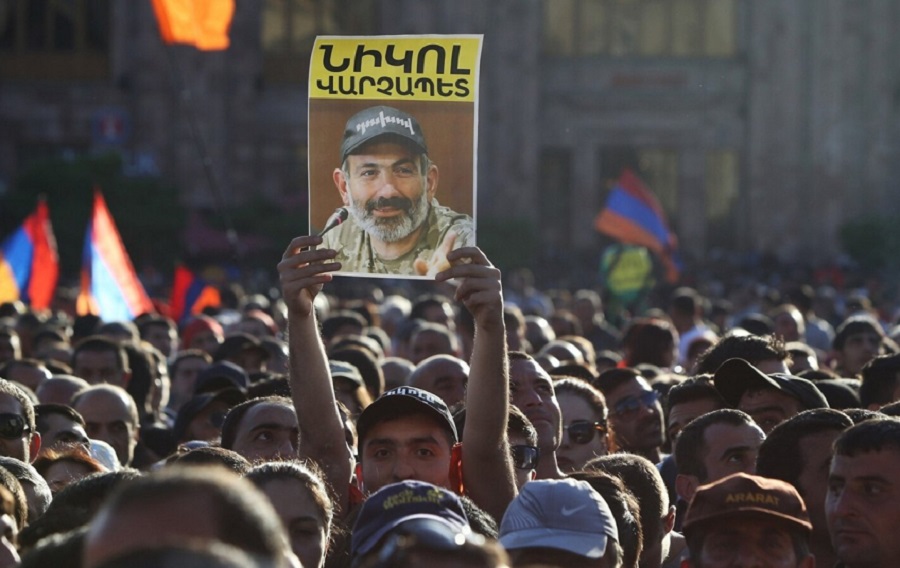
“ACNIS ReView from Yerevan”. For nearly eight years, the Republic of Armenia has been governed by “Civil Contract,” a new-fledged political party whose leadership has often been difficult to comprehend, at least for an average citizen. The leader of the ruling political force himself candidly admitted that they were, in essence, a “government of ignoramuses,” having “remained in the same grade for seven years.” However candid this explanation may sound, such a self-assessment demands interpretation: how did it happen that a group of “incompetents,” led by Nikol Pashinyan, a former tabloid editor, grassroots activist, and opposition figure, came to power directly from the streets in the spring of 2018?
The subsequent years have demonstrated that Nikol Pashinyan is not an accidental phenomenon; rather, he is the product of a society that has grown fundamentally weary of responsibility. Nikol represents the materialization of a psychology of defeat. His image emerged from an inner complex whereby people do not dare to admire strength, do not trust intelligence, and even disparage beauty. Such a society psychologically chooses someone who resembles itself rather than its ideal. That choice becomes an act of self-preservation. It is easier to believe in someone who justifies weakness than in someone whose leadership demands growth and progress.
The Nikol phenomenon became possible not because of political charisma, but because of a crisis of self-awareness within society. As a collapse of mass identity, this phenomenon is described in sociological theory developed in the early twentieth century, which highlights the erosion of communal, traditional, and religious bonds, resulting in a society of alienated, individualistic, and easily manipulated persons. The crowd has no memory; it lives only in the present moment. Its behavior is driven by emotion rather than values. Consequently, its leader is not the most capable or deserving representative of meritocracy, but the most comprehensible and least demanding value-laden figure. Thus, Nikol becomes a symbol of psychological “comfort,” while in reality embodying cowardice, mediocrity, and weakness.
The crowd resents the strong because strength reminds it of its own fragility. It resents intelligence because intelligence demands thought. It resents beauty because beauty calls for harmony, while it exists in inner chaos. That is why Nikol is embraced: he does not disturb that chaos but adapts to it, like eyes accustomed to darkness. In this sense, he became a psychological justification for mediocrity and, from this perspective, a sign of spiritual regression. The phenomenon of Nikol Pashinyan should therefore be viewed not as an individual story, but as an expression of the collective subconscious. He is a symptom of the illness, not its cause.
Read also
The Nikol phenomenon is something we must examine deeply. Even after we rid ourselves of the individual “Nikol,”and that time may be near, we will not be free of the “Nikol” phenomenon for a long time, as new Nikols are already waiting in line. As long as Armenian statehood endures, such figures will continue to emerge. In this regard, the Austrian neurologist and founder of psychoanalysis, Sigmund Freud, proposed that healing psychological distress requires bringing repressed, unconscious thoughts, memories, and desires into conscious awareness. By confronting these hidden, often childhood-rooted conflicts, a cathartic release of pent-up psychic energy becomes possible, enabling recovery. Only then can liberation occur. In other words, we must recognize, understand, and expel the underlying mental disturbance, the collective psychosis.
So what are Nikol and Nikolism? In contemporary literature, cinema, and now politics, this phenomenon has a name: the trickster. In Armenian, the term translates roughly as deceiver, conjurer, or sly manipulator. In cultural studies, the concept was introduced by the American anthropologist Paul Radin, who pioneered the academic study of the trickster figure through his analysis of Winnebago (Ho-Chunk) Native American mythology. His 1956 work, “The Trickster: A Study in American Indian Mythology,” identified this character as a “wise fool” and a persistent archetype in folklore. From that point onward, the trickster archetype became firmly established in modern scholarship and cultural theory, where it is regarded as one of the central figures of human culture.
From ancient Greek and Norse mythology to medieval and modern literature, numerous trickster figures have appeared, among them “Nazar the Brave” by Hovhannes Tumanyan. Some modern-day “Nazar the Braves” even find their way into politics. Armenia offers a vivid example, and, it seems, not the last.