




























by Arpi Sarafian
Hachig Kazarian’s Western Armenian Music: From Asia Minor To The United States (The Press at California State University, Fresno, 2023) is a valuable contribution to the debate over the notion of “authenticity” in ethnic music. The book is largely a response to allegations that the folk and dance music performed by Armenian immigrants to the United States from Historic Armenia/Asia Minor following the Hamidian Massacres of 1894-1896 and the 1915 Armenian Genocide — disparagingly referred to as deghatsis — is not authentic Armenian music. At the heart of the massive undertaking is Kazarian’s profound love of his people and their traditions. Without proper documentation and printed scholarship material, avers Kazarian, this music is “destined to be lost forever.”
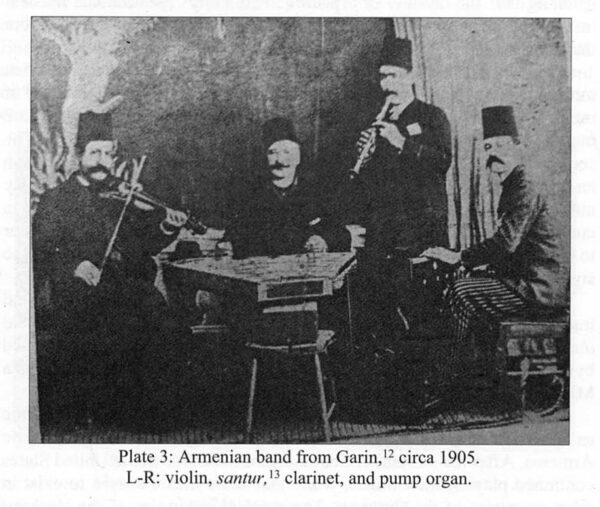
Historic Armenia has ceased to exist and what is dismissed as deghatsi music — which is different from much of the electronically generated music that imitates the Western pop/rock genre and sounds the same globally — is indeed the only surviving authentic Armenian folk music in the diaspora, notes Kazarian. The survivors who landed in the United States formed bands that played the traditional acoustic musical instruments, such as the oud, kanon and dumbek — considered to be key indicators of authenticity — of their villages. The music these bands performed helped preserve a whole tradition of folk dance and music that would otherwise have been lost, writes Kazarian.
Read also

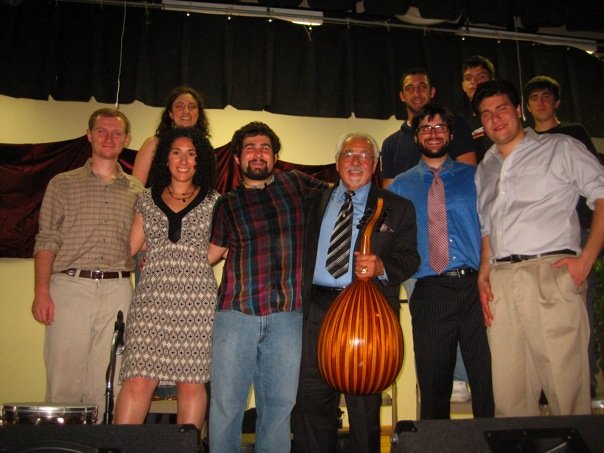
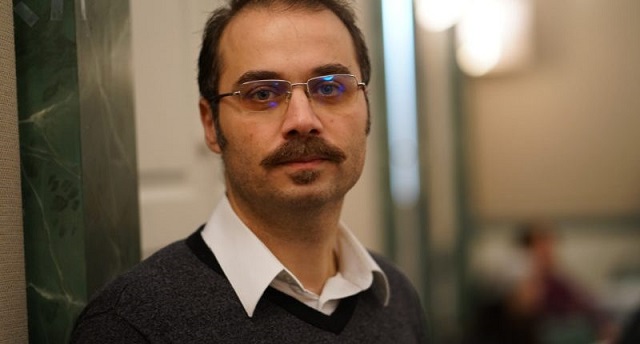
Yet, the explicitly Middle Eastern character of this music — still performed today — prompts critics with the colonial mindset of privileging everything Western and European to characterize it as inauthentic. While Kazarian concedes the detractors’ overpowering desire “to separate their musical culture from the music of their oppressors” — Turkish lyrics played a part in fueling the opposition — “this music is absolutely not Turkish,” he states emphatically. It was Armenian music that was appropriated by the Seljuk Turks, not the other way round, he argues. Denying the Armenian roots of this music would throw it into the hands of other ethnicities, specifically Turkic ethnic groups, and rob Armenian culture and traditions of a key component of its riches, he avers.
Kazarian reproduces over a hundred folk songs and melodies with his own notations and explanatory notes as evidence of the distinctly monodic nature of the music of the rural villages of Historic Armenia. And while he does not deny the profound respect for Armenian folk and dance music of Gomidas (Komitas) Vartabed Soghomonian, hailed by all — Kazarian not excepting — as the “founding father of Armenian music,” he wonders why the esteemed ethnomusicologist “never commented on the vast difference between folk music and his polyphonic compositions.” That Gomidas’s music is folk music is “a misconception,” he asserts.
To further argue his point, Kazarian quotes the Hungarian composer Bela Bartok who collected his native folk songs and “raised them,” in his own words, “to the level of art songs by providing them with the best possible piano accompaniments.” Gomidas “never called his music art music; he always referred to his music as Armenian folk song or music,” deplores Kazarian. Because of his Western training the Vartabed preferred Western polyphonic/harmonic music over monodic Oriental music, he adds. Surely aware of the odds (and perhaps apologetically?) Kazarian notes that he chose “traditionalism” over “modernization” — synonymous for many with Westernization — because of his desire to be faithful to “the true persona of Armenian music.”
Which is not to say that Kazarian denies the important role Gomidas played in the preservation of thousands of Armenian folk songs. Indeed, the spirit of Gomidas looms large over the volume. “Gomidas writes…” inevitably precedes his “author’s notes.” Kazarian may, however, have gone a trifle too far in his insistence on neat definitions of the styles of music, reducing a constantly shifting reality to a static phenomenon.
While helpful, definitions can also be limiting as they deny the inevitable criss-crossing of cultures, especially in an area like Asia Minor where histories and traditions have co-existed and overlapped for centuries. Moreover, if, as most musicologists contend, “authenticity” means being true to the spirit of the culture, Gomidas’s music cannot be said to be inauthentic.
Gomidas was born in Kutahya in Ottoman Turkey, a town with a significant Armenian community, and was immersed in “the cultural context” of the songs he was singing. Soghomon Soghomonian had an exceptionally beautiful voice as he was growing up. In fact, in an article on “Armenian Folk Dance,” published in Tadron yev Yerazhshdutiun in 1908 — translated into English by Kazarian and quoted in full — Gomidas writes: “Spirit is the most important ingredient of the dance steps . . . and the melody that provides the tone and temperament of the dance.”
Gomidas travelled throughout Historic Armenia, touring the remotest villages, and collected and rearranged monophonic village folk songs into polyphonic compositions, always focused on retaining the unique character of Armenian folk music. One could in fact argue that Gomidas’ tireless efforts to modernize our music may have contributed to its survival. A culture stays alive because of its ability to evolve. Integrating the inevitable influences that surround it is part of the process of that evolution.
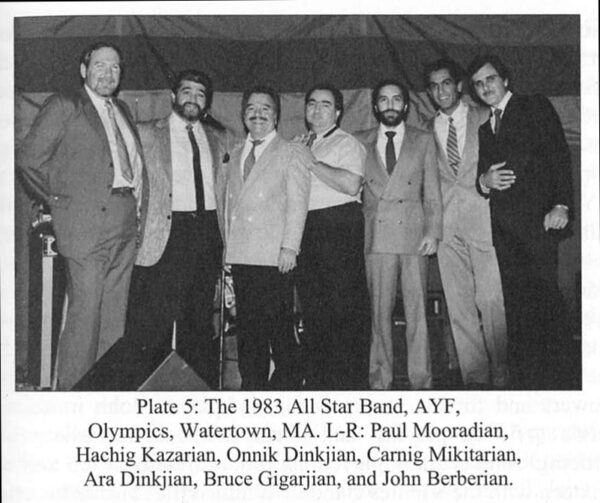
Western Armenian Music: From Asia Minor To The United States is in its second printing (2024). Kazarian’s meticulous research and serious scholarship, combined with his sixty-five years’ experience performing as a professional musician — Kazarian holds a Bachelor of Science and a Master of Arts degree in clarinet performance from the prestigious Juilliard School of Music — contribute in important ways to documenting Western Armenian music. The enthusiastic musician provides documented background information on each of the American-born Armenian bands — such as the legendary Kef Time Band and the All-Star Band — in the United States. The detailed descriptions he offers of the bands he played with, his fellow musicians, the concerts and the venues are always engaging and add the credible voice of a good storyteller to his argument. The numerous photographs scattered throughout further enhance the documentation.
There will always be controversy regarding the definition of “authentic.” Maintaining “purity” is well-nigh impossible, especially in the context of a globalized world where the integration of “others’” lifestyles, mannerisms and mores is an unavoidable truth. Kazarian himself attests to Western Armenian music not being “pure.” “It is difficult to separate the elements of the ‘Armenianness’ and ‘Turkishness’ of the music . . . when you take into consideration the centuries of co-existing together,” he writes.
Kazarian’s hypothesis will inevitably stimulate further research into Western Armenian music. I also like to think that the book contributes to our ongoing efforts, both in the homeland and the diaspora, to preserve our cultural heritage in the face of threats to land and to sovereignty. By starting bands that played the traditional folk and dance music with the traditional instruments they had used in their villages, the early immigrants from Historic Armenia — the deghatsis — helped keep the culture of their ancestral homeland alive in their new home, the United States. “Western Armenian music is now an Armenian American phenomenon, states Kazarian with absolute confidence.