
















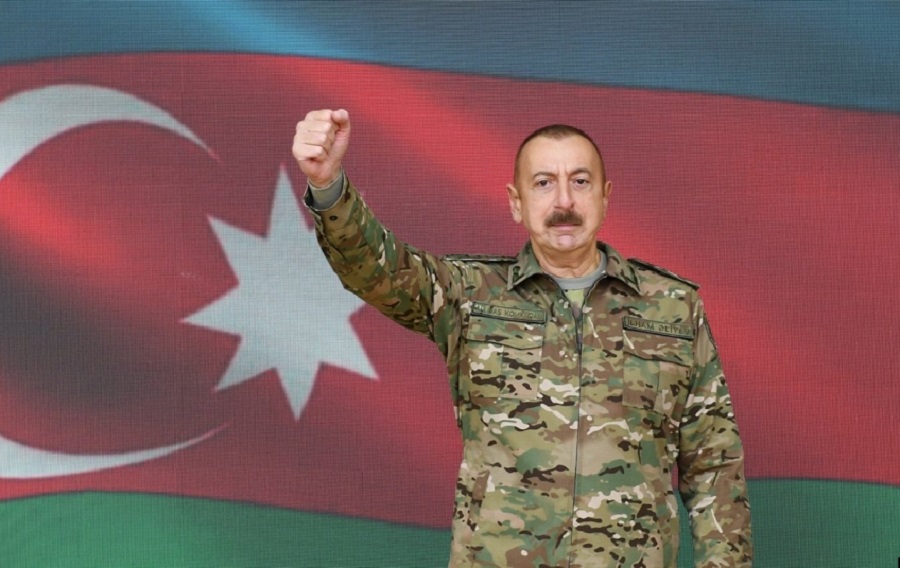
“ACNIS ReView from Yerevan”. If such formidable talent as that of the renowned Russian futurist poet were available, a parody of his famous epic 1924–1925 poem could be composed, drawing upon a modern-day counterpart: the image of Azerbaijan’s president, Ilham Aliyev, and the theme of his evident affinity with fascism. Ilham and fascism are portrayed as twin brothers; we say Ilham and mean fascism, we say fascism and mean Ilham. Such allusions, according to various opinions and assessments, occasionally appear in the Armenian press.
Now to the point. Azerbaijan is truly a fascist state and, as such, is posing serious dangers both to its immediate neighbors and to the South Caucasus region as a whole. However, such claims require substantiation; otherwise, they risk sounding like mere empty rhetoric. The judgments expressed by “Hayatsk Yerevanits” are not groundless but are based on historical and political experience. In particular, reference is made to the time-tested examples of Fascist Italy and Nazi Germany, which provide a framework for comparison.
If we place present-day Azerbaijan alongside the Italy and Germany of the 1930s–1940s in terms of political systems and defining characteristics, certain parallels apparently emerge. Fascism and radical nationalism historically share identifiable features or criteria which, according to this exploration, are also visible in contemporary Azerbaijan. It is asserted that the regime restricts civil society, suppresses political opposition, and conducts elections that function largely as formalities intended to preserve a “democratic facade.” The government is described as maintaining tight control over media and limiting fundamental freedoms, creating one of the most restrictive environments for free expression. International observers have characterized Azerbaijan as a consolidated authoritarian system marked by highly centralized, personalized rule. Following the 44-day Artsakh war, its leader was elevated to the status of a national hero.
Features commonly associated with Italian fascism and German Nazism — including suppression of free speech and a free press, nationalist propaganda, a cult of leadership, glorification of force and militarization, hostility toward ethnic groups, repression, and state censorship — are typical of present day Azerbaijan under its incumbent leader Ilham Aliyev. From this viewpoint, a person who, in his entirety, is the embodiment of fascism, and who has turned his country into a den of Armenophobia and Nazism, regularly directs accusations of fascism against Armenia. In other words, he wants to cleanse himself of his own filth at the cost of unjustly smearing someone else.
Read also
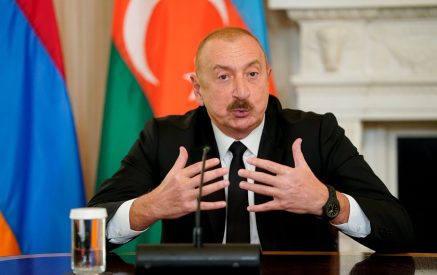
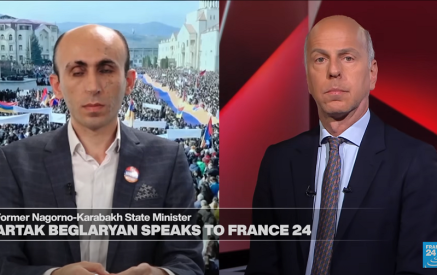
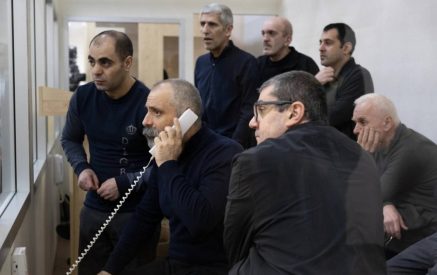
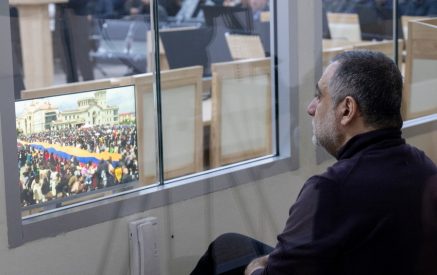
During the 62nd Munich Security Conference, held from 13 to 15 February 2026 (which, incidentally, was not attended by Pashinyan or any other official representative from Armenia), in an interview with France 24, Ilham Aliyev once again brought false accusations onto the international stage. He categorically ruled out granting clemency to former Artsakh military-political leaders, who were captured in October 2023 and sentenced in Baku to life imprisonment or long prison terms, facing serious charges, including alleged war crimes despite declaring that “peace is achieved” with Armenia. Moreover, he compared their trial to the Nuremberg Trials, stating: “They committed serious crimes against humanity — crimes worse than those committed by the Nazis during World War II.” It is clear that he is lying and critics reject this comparison as unfounded.
All, especially the Armenian authorities, are aware that Aliyev is lying and otherwise distorting, yet, they remain silent, fearing disruption of the fragile peace process. In reality, there is no peace process at all: Aliyev has not abandoned his aggressive rhetoric, and Azerbaijan continues significant military development. The share of military expenditures in the state budget has significantly increased, and the number of military exercises has grown more frequent. Against whom is such meticulous preparation being made? Certainly not against Turkey, Iran, or Russia. Who remains? Poor Armenia, which in the perception of the Erdogan–Aliyev duo, is a cursed wedge on the road to “Turan,” a wedge that must be removed in pursuit of strategic goals, this is the duo’s objective.
Finally, critics point to the telling case of the Azerbaijani officer who axed his sleeping Armenian counterpart during a 2004 NATO training program in Budapest. After being extradited from Hungary instead of serving life sentence in a Hungarian jail and pardoned upon his return to Azerbaijan, he was publicly honored, a decision that remains a source of deep tension and is cited as evidence of the glorification of violence and the institutionalization of hostility toward Armenians and everything Armenian among the younger generation.