



















by Raffi Elliott
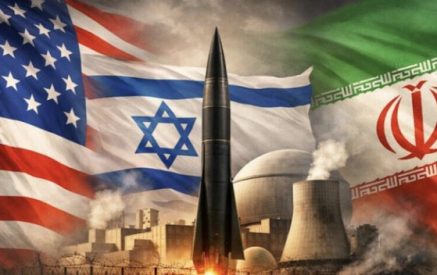
YEREVAN – Protesters gathered in front of the Islamic Republic embassy in Yerevan’s Arabkir neighborhood on Sunday, March 1, following official confirmation from Iranian regime news sources that Ayatollah Khamenei, Shia cleric and Supreme Leader of Iran since the 1980s, had been killed in an Israeli air strike on his compound in Teheran. Chants of “Pahlavi will return” could be heard emanating from the crowd, in reference to Iranians historical Pahlavi royal dynasty which had been deposed during the 1979 Iranian Revolution. Several protesters were seen waving the old “Lion-and-sun” version of the Iranian flag, including some adorned with the images of Mohammad Reza Shah, and his son Reza Pahlavi.
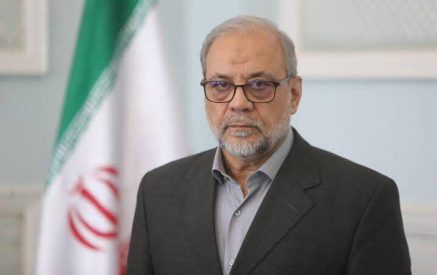
Demonstrations of this sort, gathering mostly Iranian expats as well as sympathetic Armenians and repatriated Iranian-Armenians, have been taking place on a semi-regular basis in the Armenian capital since a popular uprising was apparently crushed in a bloody crackdown by Islamic Regime officials in early January. Some of those demonstrations ended with scuffles with Armenian police, as the Iranian ambassador to Yerevan strongly criticized Armenian authorities for allowing near-continuous demonstrations to take place in the park facing embassy grounds. Ambassador Khalil Shirgholami accused Armenia of becoming “a serious center for the actions of forces hostile to Iran” in a January 14 statement. This was a charge denied by Prime Minister Nikol Pashinyan at the time, who insisted that Armenia “will not take steps against Iran’s state security.”
Read also
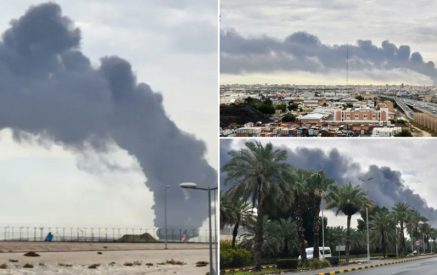
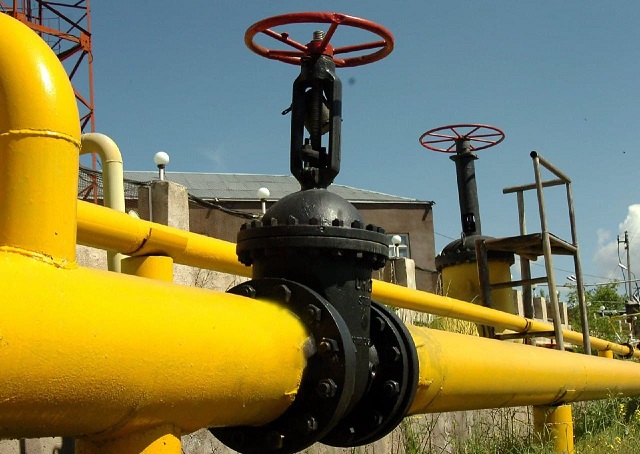
Still, as Israeli and American strikes continue to pummel military and regime targets across Iran, Armenia has begun experiencing disruptions to its airspace and trade routes in the region, as the country braces for the potential impact of this conflict domestically. Bilateral commerce between Armenia and Iran reached approximately $1 billion as of late 2025, with projections showing it reaching a total of $3 billion in the near future. Armenia imports key commodities such as natural gas, raw iron bars, petroleum coke, plastics, and agricultural products like dairy and fruits, while exporting electricity, meat products, and minerals. Armenia, as a founding member of the Moscow-lead Eurasian Customs Union, spearheaded a free-trade agreement between the trade bloc and Iran several years ago, and both countries have worked jointly on the expansion of the Meghri customs check point, as well as major infrastructure projects including the southern section of Armenia’s North-South highway passing through Syunik Province.
Despite the widespread collateral destruction on Iranian government assets throughout the country, trade disruptions have so far remained quite minimal, with truck traffic at the Meghri customs checkpoint flowing as normal. This was confirmed by Iran’s Ambassador Shirgholami who insisted that transit on the border was operating normally.
Armenia has been earmarked as a safe evacuation route for embassy staff and nationals from various countries, including Canadians, British, Chinese and Russian citizens. A small but notable increase of civilian traffic entering Armenia from Iran has been noted, though very few have reportedly stayed in the Syunik region. Many have continued on to Yerevan or even directly to Zvartnots international airport intending to catch flights destined for continental Europe.
Meanwhile all flights from Yerevan to the beleaguered Iranian capital have been suspended for the foreseeable future, while scheduled connections to other popular destinations in the Middle-East and the Gulf have experienced significant delays or cancelled outright, leaving many stranded across the region. Armenia’s Foreign Ministry has stated that it remains in constant contact with stranded passengers as well as expats residing in the Emirates, Iran and Israel, asking them to stand by as they organize evacuations.
While Armenia’s Prime Minister Pashinyan was subject to some ridicule when a video of him along with the Speaker of the Armenian Parliament Alen Simonyan eating piroshki (a fried bread-and-potato snack) surfaced on the internet, coinciding with the news of the first strikes on Iranian targets. These images were meant to be part of his party’s newly launched parliamentary election campaign, but instead garnered accusations that the prime minister wasn’t taking the risk of regional war seriously enough given Armenia’s proximity to the ongoing conflict. However the prime minister chaired a meeting of Armenia’s Security Council that day, and both the Ministries of Foreign Affairs and Emergency Situations issued statements later that same day.
With Armenia continuing to walk the delicate tightrope between its newfound partnership with the United States, exemplified in the construction of the upcoming Trump Route For International Peace and Prosperity (TRIPP), and long time commitment to maintaining relations with neighboring Iran, authorities in Yerevan both called for the easing of tensions in the reason and expressed delayed condolences for the death of Ayatollah Khamenei.
See also the following Polish television interview of this Mirror-Spectator correspondent: https://bit.ly/4u1Jthr