











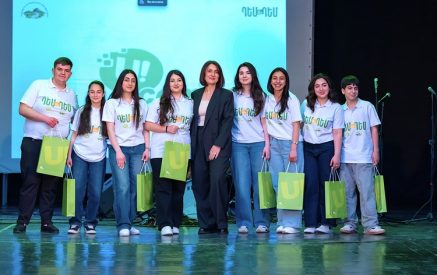








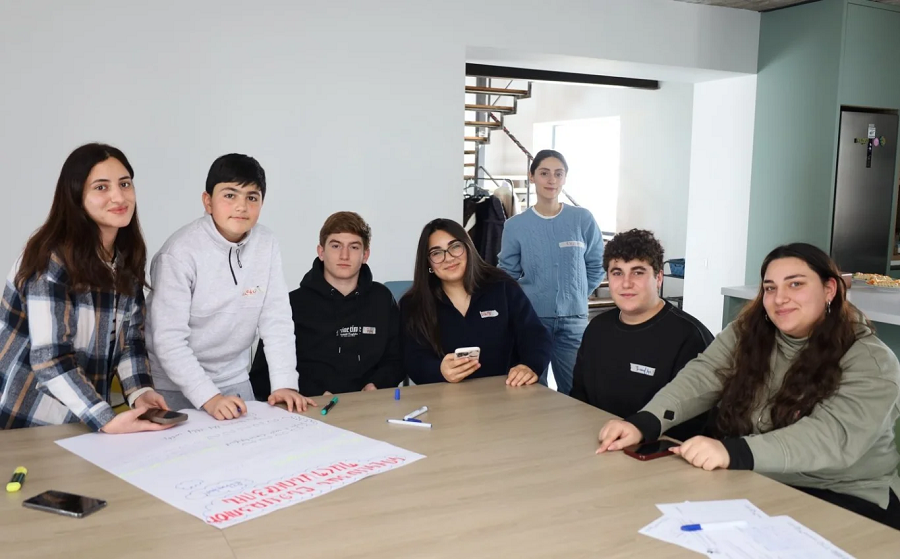
EU NEIGHBOURS east. Are you young and eager to lead eco-change in your small community, but unsure where to begin? You’re not alone. Anna, Lusine and twenty young people from villages in Aragatsotn region of Armenia shared a common ambition: to make their communities a better place to live − whether by tackling illegal dumping, championing recycling among peers or organizing local clean-ups. Thanks to guidance from ‘Uniting Bridge’ Social NGO, a local organization supported by the European Union and Konrad-Adenauer-Stiftung, their ideas are now turning into real action. The organization equips rural youth with practical skills and participatory tools, giving them a voice in local decision-making and transforming ambition into tangible change.
In rural communities across Aragatsotn region of Armenia, young people are often the first to point to daily environmental problems: poorly managed waste, informal dumping sites on village outskirts, limited recycling or water contamination. Many note the absence of green public spaces, a gap between environmental regulations and their practical application. Yet their concerns rarely translate into action.
“Young people often don’t understand how environmental decisions are made at the municipal level or how they can formally engage local authorities. Meanwhile, institutions lack youth-centered approaches to ensure participation is systematic rather than occasional,” – explains Evelina Arakelyan, Vice President of ‘Uniting Bridge’ Social NGO. Geographical isolation and a shortage of youth leadership role models exacerbate the issue. “Many young people are eager to participate in community life, but they lack practical skills, confidence and accessible tools to do so”, − she adds.
From concerns to competencies
Since 2014, Uniting Bridge − first as a grassroots youth initiative and since 2019 as a youth NGO − has spent more than a decade to create civic, educational and leadership opportunities for young people living beyond the capital of Armenia. Based in Oshakan village of the Ashtarak enlarged community, the NGO works with surrounding rural settlements, engaging local youth, schools and municipal authorities.
Their initiative CreARTive School for Rural Youth Eco-Leadership, co-funded by the EU and the Konrad-Adenauer-Stiftung, addresses the identified gap. Rather than a one-off training, it offers a structured learning model combining civic education, environmental governance and creative advocacy. 20 young people, strongly interested in environmental issues and community engagement, joined the CreARTive School in 2026 to learn more about environmental self-governance and decision-making, citizen participation and eco-activism.
“Our sessions blended theory with young people’s own experiences of living in rural communities”, – says Razmik Mnatsakanyan, the NGO’s head. Indeed, one of the participants’ most memorable moments was a simulation of a municipal council meeting, where they debated budget priorities and environmental measures affecting their own villages. For many, it was the first time local governance felt tangible.
Discussions on civic activism often began with skepticism: “If we raise an issue, will anything actually change?”. When trainers introduced strategic advocacy tools, stakeholder mapping and community engagement methods, the conversations shifted from doubt and mistrust to problem-solving thinking.
Perhaps the most profound transformation happened during sessions on eco-leadership and personal responsibility. Through guided reflections, participants moved from seeing environmental protection as solely the government’s responsibility to recognizing their own capacity to influence behaviors, raise awareness and initiate small-scale change.
When learning meets practice
Training did not remain theoretical. New knowledge was shortly translated into concrete advocacy products – short eco-storytelling videos and an interactive board game. The videos focus on real issues in Ashtarak, Talin and Aparan enlarged communities – from improper waste management to recycling and responsible consumption, highlighting practical eco-solutions for peers. The board game, designed around real-life scenarios from community life, challenges players to make sustainable decisions and community-level solutions.
“Designing an educational eco-game was especially inspiring, – shares Anna Aleksanyan (21), a trainee from Ohanavan village, – “It transformed our learning into a practical tool that sparks awareness and real conversations about protecting the environment.”
Outside the classroom, participants become Green Ambassadors, organizing and leading eco-advocacy initiatives across rural settlements in Aragatsotn. They run sessions in schools, youth centers and community spaces, presenting eco-storytelling videos, facilitating the board game and leading discussions on waste management, pollution and responsible consumption. “These initiatives build confidence and leadership, transforming trainees into active facilitators and advocates”, – emphasizes Razmik Mnatsakanyan.
Bridging learning, skills and real governance, five most active trainees continued with internships at the Municipality of Ashtarak. There, they observed how municipal departments operate, how decisions are prepared and implemented and how issues – such as waste management and community planning – are handled in reality. Lusine Manukyan (21) shares: “I learned to analyze community resources and how they can be distributed and managed effectively. This experience gave me valuable professional exposure.”
A lasting shift
“Probably the most significant achievement has been the mindset change, when youth moved from passive concern to proactive action,” – underlines NGO’s head. – “Youth now approach environmental challenges with initiative and ownership, not waiting for adults or institutions to act”. This is very true for Lusine, who – inspired by the NGO’s activities – started her own tree-planting initiative in Bazmaghbyur village, which has become a joyful spring tradition involving friends, students, and local residents. “I now see myself as an active citizen who can contribute to positive change”, – says the girl.
Sustainability is embedded into the CreARTive School model. Its curriculum, training modules and board game are replicable for other rural communities. Meanwhile, the Green Ambassadors network ensures that youth-led eco-actions continue independently.
Uniting Bridge is one of hundreds of civil society organizations across Armenia working to empower young citizens. Through initiatives such as EU4Youth or Youth in Action, the EU’s youth policy supports their efforts – strengthening organizations’ work, developing professional skills in the regions and encouraging civil society participation in youth policymaking – in line with Armenia’s recent legal reforms on youth development. If you’re ready to drive change, they can help make it happen.