




JAMnews. Top stories in local media.
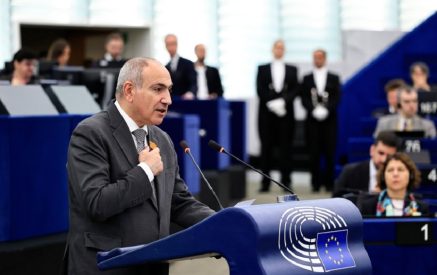
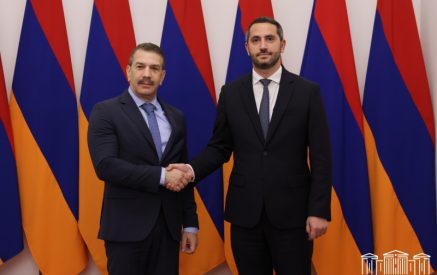
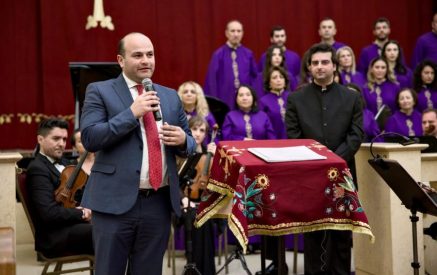
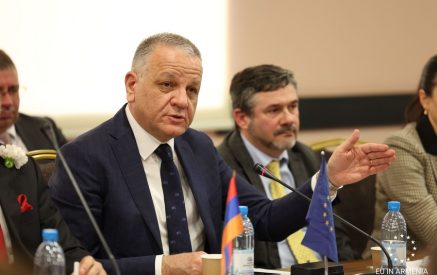
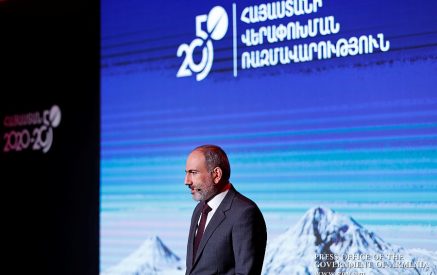
Thursday, 12 March, Armenia. Prime Minister Nikol Pashinyan spoke at the European Parliament in Strasbourg
● Prime Minister Nikol Pashinyan spoke at the European Parliament in Strasbourg. Among other things, he stated:
“The frozen state of the political dialogue between the EU and Georgia is the biggest problem on Armenia’s path toward integration into the European Union. We adopted a law to begin the process of Armenia’s accession to the EU after Georgia received candidate status for membership in the Union. This made the prospect of Armenia joining the EU more tangible. A constructive process between the EU and Georgia is just as important for Armenia as it is for Georgia.”
The prime minister spoke about the possibility of Armenia joining the EU and stressed that the country now faces the task of continuing reforms in order to meet the membership criteria.
Read also
“Conflicts and hostility are a virus that blinds us and makes our independence and statehood vulnerable. The realization of the strategic interdependence of our destinies is another important factor that made peace between Armenia and Azerbaijan possible.”
“Some clergymen have taken on the leadership of the party of war, gathering around themselves former presidents of Armenia, forces connected with them, and certain Russian and pro-Belarusian oligarchs, and they are trying to sacrifice Armenia’s independence in the interests of third countries.”
“Our Karabakh brothers and sisters must obtain Armenian citizenship and settle in the country permanently. We have already launched a resettlement program, and so far 4,886 families have become its beneficiaries.”
More details about Nikol Pashinyan’s speech in the European Parliament can be found here.
● In the context of developments around Iran, Armenia is acting as an important humanitarian corridor for the evacuation of citizens of European Union countries, European Parliament President Roberta Metsola said at a joint briefing with Nikol Pashinyan in Strasbourg.
● Roberta Metsola highlighted Armenia’s role as an important partner and spoke about significant achievements in relations between Yerevan and Brussels, including the agreement on a strategic cooperation agenda and the progress in the visa liberalization process.
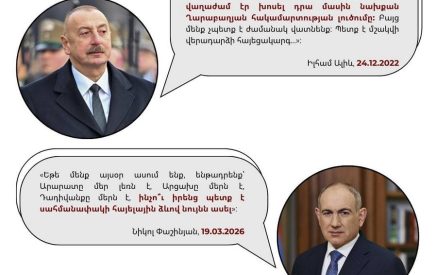
● “A long-term peace has already been established between Azerbaijan and Armenia, and the agreements reached have not remained only on paper — the sides are demonstrating political will,” Armenian media quoted Azerbaijani President Ilham Aliyev as saying during his joint press statement with President of the European Council António Costa, who paid a visit to Baku. “We are already living in conditions of long-term peace. Over the past seven months we have begun supplying petroleum products to Armenia. We have lifted all restrictions on the transit of goods from other countries to Armenia through our territory. This once again demonstrates our strong political will,” Aliyev said.
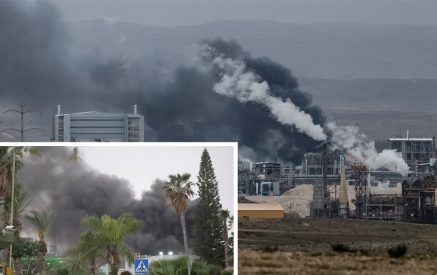
● Since the beginning of the escalation in the Middle East region, 196 Russian citizens have returned from Iran to Russia through the territory of Armenia. Most of them were employees of Iran’s Bushehr nuclear power plant who were evacuated on March 11. This was reported in a statement by the Russian Embassy in Armenia.
● The geographical coverage of those evacuated from Iran through Armenia has expanded and now includes citizens of 46 countries, according to a statement by Armenia’s Ministry of Foreign Affairs.
● A court has acquitted the leader of the opposition Prosperous Armenia party, Gagik Tsarukyan, who had been charged with bribing voters ahead of the parliamentary elections scheduled for June 7. Much of Armenia’s opposition is widely regarded as having a pro-Russian reputation.
● Turkish Airlines has begun operating flights on the Istanbul–Yerevan–Istanbul route. For now, the flights will operate daily. Starting from May 14, the frequency will increase to 10 flights per week, and from June 15 to 14 flights per week.
● “Many trees in Yerevan have already reached the age of 70–80 years, and we cannot rejuvenate them or make them immortal,” said Armen Begoyan, director of the state non-commercial organization Greening and Environmental Protection, commenting on complaints from citizens and specialists about the mass cutting of trees in the capital. According to him, the trees being cut down on Proshyan Street will be replaced with Japanese sophora trees costing up to 91,000 drams (about $240).
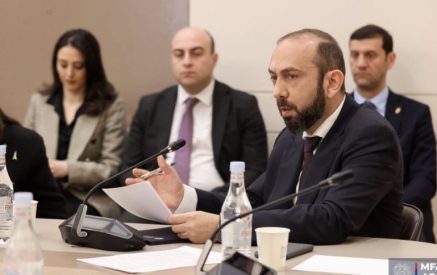
● During a working visit to Paris, Foreign Minister Ararat Mirzoyan familiarized himself with renovation works at the new building of the Armenian Embassy.
● Defence Minister Suren Papikyan took part in the ceremonial opening of the building of the women’s battalion.
Thursday, 12 March, Azerbaijan. President of the European Council António Costa visited Baku
● President of the European Council António Costa paid a one-day visit to Baku, where he met with President Ilham Aliyev. During an official lunch, the leaders also held an expanded meeting with their delegations. Following the talks, a briefing for journalists was held and a joint statement was adopted.
The strategic nature of the partnership between Azerbaijan and the European Union was emphasized, and the sides expressed their intention to swiftly finalize negotiations on a new comprehensive bilateral agreement.
Both sides also highlighted plans to expand cooperation in the fields of security, energy, transport and digital technologies.
Costa described Azerbaijan as a key partner of the EU and expressed solidarity following the Iranian drone attack on Azerbaijani territory on March 5. He also reiterated that Azerbaijan will host the European Political Community summit in 2028 and invited Ilham Aliyev to visit Brussels.
The leaders also noted the historic momentum in the peace process between Azerbaijan and Armenia, referring to the results of the Washington summit of August 8, 2025, held with the participation of Donald Trump.
António Costa reaffirmed the EU’s full support for the peace efforts of the two countries. The importance of the large-scale reconstruction process and Azerbaijan’s efforts to develop the Karabakh and East Zangezur regions was also highlighted.
Both leaders called for increased international support to accelerate mine clearance efforts in these regions.
They also emphasized Azerbaijan’s key role in strengthening transport, trade, energy and digital links between the Black Sea region, the South Caucasus and Central Asia, particularly through the Middle Corridor.
The European Union reaffirmed its support for the modernization of railways in the Nakhchivan Autonomous Republic of Azerbaijan and for efforts to implement the TRIPP transit project.
The importance of the Southern Gas Corridor Advisory Council and the Green Energy Advisory Council meetings was also highlighted, along with the need to deepen cooperation in defense and security.
● During the briefing, António Costa and Ilham Aliyev said that Azerbaijan is a reliable partner in ensuring Europe’s energy security, currently supplying gas to 10 European countries. Aliyev noted that 50% of Azerbaijan’s foreign trade in January was with the EU, making it the country’s largest trading partner.
● António Costa later posted on X thanking Azerbaijan for the warm welcome in Baku. He wrote that he looks forward to continuing work on a new framework for closer EU–Azerbaijan cooperation reflecting their shared vision for the future. He also said that at a time of growing global tensions and instability, strengthening ties is more important than ever, and expressed full solidarity with Azerbaijan and its people as the dangerous military escalation in Iran and the Middle East risks having a direct impact on the country.
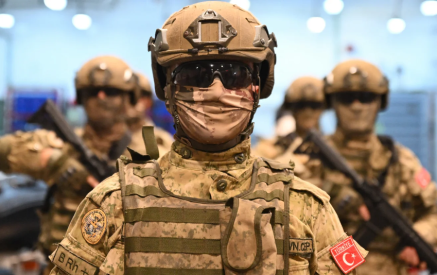
● A delegation led by the commander of the Turkish Land Forces visited Azerbaijan’s Nakhchivan Autonomous Republic. A meeting was held at the headquarters of the Separate Combined Arms Army with the participation of its commander. It was stated that Turkey always stands alongside Azerbaijan in strengthening regional stability and ensuring full security, and in accordance with the provisions of the Shusha Declaration is ready to provide any military assistance if necessary.
The visit followed the drone attack on Nakhchivan on March 5, which injured four people. Azerbaijani authorities blamed Iran for the attack, while Iranian officials denied involvement.
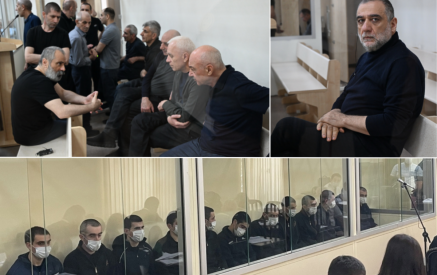
● A new verdict has been issued in the criminal “NGO case,” under which more than ten leaders of local and international organizations have been arrested on financial crime charges. Social worker Zamin Zaki was sentenced to 7 years and 6 months in prison on charges of money laundering and fraud. The case mainly concerned the failure to register grant funds received for training and civil rights protection. Zaki, like the other detainees in the case, denies the charges.
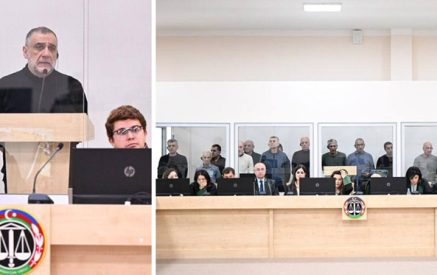
● Azer Gasimli, director of the Institute of Political Management and a political analyst, has been sentenced to 12 years in prison after being found guilty of extortion through threats. It is alleged that he threatened Gurbanali Yusibov, including threats to kidnap his son and kill his father while demanding money. In his final statement, Gasimli said the accusations were false and claimed he had been arrested on politically motivated charges for criticizing the authorities.
● Since February 28, more than 2,500 people have been evacuated from Iran to Azerbaijan, including 383 Azerbaijani citizens and citizens of 72 other countries.
● The 13th Global Baku Forum, organized by the Nizami Ganjavi International Center, is taking place from March 12 to 14. Dozens of international political figures are participating, with discussions focused on global challenges, multilateral cooperation and international security.
● Another freight train of 11 wagons carrying Russian grain has been sent in transit from Azerbaijan to Armenia, also passing through Georgia. According to official data, more than 22,000 tons of grain (320 wagons) and 610 tons of fertilizers (9 wagons) have been transported from Russia to Armenia via Azerbaijan.
Thursday, 12 March, Georgia. The popular opposition TV channel Pirveli is asking for help
● The popular opposition TV channel Pirveli has announced the suspension of its satellite broadcasting from March 11 due to financial debts. The broadcaster has called on viewers to provide financial support and has also published a bank account number for those willing to help: Account number: GE07TB7272236020100006.
● A representative of the ruling party, Irakli Kirtskhalia, accused the German ambassador to Georgia, Peter Fischer, of violating diplomatic norms and said the ambassador had “breached” the Vienna Convention. According to Kirtskhalia, the ambassador is attempting to interfere in Georgian politics.
● Parliament Speaker Shalva Papuashvili said there is no real opposition in the country and that the government’s main opponents today are the European Union and “Brussels,” which, according to him, are trying to exert pressure on Georgian politics.
● The European Commission stated that the Georgian authorities and the Azerbaijani state oil and gas company SOCAR, which operates the Georgian oil terminal in Kulevi on the Black Sea, have committed to no longer allowing tankers from the so-called Russian “shadow fleet” to enter Georgian ports. Only under this condition was Kulevi excluded from the EU’s 20th sanctions package against Russia. More details here.
● After visiting Georgia, a delegation of the OSCE Parliamentary Assembly said the country remains highly polarized. Assembly President Pere Joan Pons Sampietro called on all sides to engage in direct dialogue and constructive interaction. More details here.
● The Special Penitentiary Service has denied reports about a hunger strike by activists arrested for blocking a road during pro-European protests that have been ongoing in Tbilisi for more than a year and a half. The service released a video showing the named activists receiving food. The statement also denies claims that one of them, Zurab Menteshashvili, is being held in solitary confinement. According to the service, the activist is being held in a so-called quarantine cell with all conditions observed.
● ISFED reports that after the United Kingdom imposed sanctions, pro-government TV channels Imedi and POSTV were banned from placing advertisements on Meta platforms. However, according to ISFED, the broadcasters are attempting to place ads by creating new pages on Facebook. More details here.
● Prime Minister Irakli Kobakhidze met with the Israeli ambassador to Georgia, Walid Abu Haya. It was reported that current developments in the Middle East and Georgian-Israeli relations were discussed.
● The Ministry of Internal Affairs reported that as a result of operations conducted across the country, dozens of illegal firearms, ammunition and explosive materials were seized, and 51 people were detained.