

























Red flag alert – Israel in Lebanon
The Lemkin Institute for Genocide Prevention and Human Security is horrified by the recent spike in the number of civilian casualties in Lebanon due to ongoing Israeli strikes, as well as the expansion of Israel’s target area within Lebanon. In our last RFA on Lebanon, the death toll stood at 394, including 83 children. In the span of only two weeks, the figures have surged to over 1,0094 people killed, including 121 children and 81 women, and more than 3,119 others wounded, with children accounting for at least 365 of those injured. According to UNICEF, the equivalent of an entire classroom of children is killed or injured every day in Lebanon.
These numbers can be expected to increase as Israel continues its attacks on densely populated areas. The Lemkin Institute reiterates its plea from its first RFA for Israel in Lebanon, released on 8 March, for “the Security Council of the United Nations, the European Union, NATO, the Arab League, the Organization of Islamic Cooperation, and other regional bodies to place maximum pressure on Israel to ensure that no part of Lebanon becomes another Gaza.”
In the past weeks, Israel has intensified its strikes in civilian areas, particularly in the heart of the Lebanese capital. On 12 March, at around 1:30 a.m., without warning, the Israeli military carried out a double drone strike on a car parked by the seafront in Ramlet Al-Baida, killing 12 people and injuring 28. Ramlet Al-Baida is an area with no notable Hezbollah presence, located far from Beirut’s southern suburbs. This neighborhood had become a refuge for many displaced people who had set up tents, believing it to be safer. A witness to the attack said that the force of the blast flung two children into the air: “It was just like what we see in Gaza. I can’t erase what I saw.” These attacks have instilled deep fear and widespread panic among displaced communities, who are sheltering in overcrowded facilities or in tents.
Read also
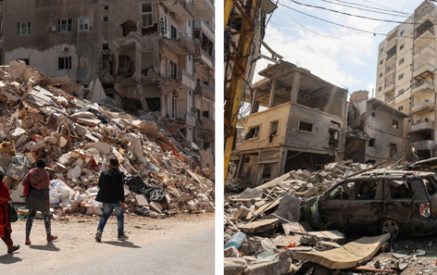
The situation mirrors what occurred in Gaza, where civilians were targeted in their shelters. Many fear that a similar scenario where displaced people are hunted down and killed in their tents and shelters is now repeating itself in Beirut. On 18 March, the Israeli government escalated its attacks on Beirut, targeting two buildings in the heart of the city near the Lebanese government’s headquarters. One of these attacks completely destroyed a 10-storey residential building which was until then home to hundreds of people. Many residents said that the building had no connection to Hezbollah and that they lost homes they had purchased with their life savings.
According to the New York Times, Israel has been striking civilian neighbourhoods in the middle of the night and without warning. When it has given warnings in the form of “evacuation orders,” these have been entirely insufficient. They have usually been given at the last minute in the middle of the night when everyone is asleep. Moreover, given the large areas such “evacuation orders” cover – entire neighbourhoods or regions home to thousands or hundreds of thousands of people – these orders can be better described as forced displacement with long-term implications for the sovereignty and demography of the territory. On 16 March Israeli Defense Minister Israel Katz confirmed that civilians will be barred from returning home “indefinitely.”
Evacuation orders are only lawful under international law when they are feasible and temporary in nature and where no military alternative to evacuation exists — that is, when the presence of people in the area is an obstacle to imperative military objectives. A belligerent party cannot order the evacuation of entire swathes of a country in order to attack non-military objectives. As of 13 March, the evacuation orders made by Israeli authorities had already targeted 15 percent of the territory of Lebanon. Israel has given further evacuation orders every day since then. Al-Jazeera reported on 17 March that 20 percent of the Lebanese population – more than a million people – had been displaced already.
These orders have created dire humanitarian conditions as civilians lack safe corridors for evacuation and adequate shelter. At the same time as it has been calling for the entire south of the country to evacuate, Israel has been destroying important transportation infrastructure, including bridges on the Litani river, which runs across the southern part of the country and extends vertically for about two thirds of Lebanon’s territory, close to its eastern border with Syria. The destruction of bridges effectively cuts Lebanon in two, preventing civilians in the south and east from “evacuating” to purportedly safer areas of the country, though Israel is bombing everywhere.
Due to the traffic caused by immediate evacuation orders for hundreds of thousands of people and the destruction of many paths to safer areas, trips that usually take 2 hours have been taking 24. Given the urgency of the orders and the timing, many left their homes without basic supplies. Many others, including the elderly, the ill, and pregnant people, went days without necessary medical care. Due to inadequate shelter space, many families have been forced to sleep out in the open or in their cars following their evacuation. As with the evacuation orders it used in Gaza to displace hundreds of thousands of people, Israel’s “evacuation orders” in Lebanon flout international law. It is unimaginable that such large numbers of people would be able to feasibly evacuate quickly in the middle of the night from densely populated areas.
The Israeli strikes have created significant fear among residents hosting displaced communities, who worry that simply being near someone who is displaced could make them a target for Israeli attacks. This has heightened tensions in a country already grappling with fragile sectarian divisions. The Lemkin Institute believes that these attacks represent a deliberate strategy by Israel to sow discord and exploit vulnerabilities within Lebanese society, as chaos serves only to benefit Israel. We call on the Lebanese people to remain united in the face of these provocations.
Additionally, Israel has also carried out at least five double-tap strikes in Lebanon, a tactic in which an initial strike is followed by a pause, allowing medical workers to arrive before the area is bombed for a second time. Double tap strikes have been routinely used by Israel to target rescue workers in Gaza and the Occupied Territories. The United States appears to have used a double tap strike against the elementary school in Iran.
As in Gaza, medical workers in Lebanon are on the frontlines of Israeli attacks. Since the war began on 2 March, Israel has struck at least 128 medical facilities and ambulances across Lebanon, killing 42 healthcare workers and wounding 107. According to the Lebanese Health Minister, Israeli strikes on the healthcare system are severely impeding the country’s ability to treat thousands of wounded. A number of hospitals have been attacked or remain under threat, and five are now out of service. On 14 March an Israeli strike on an Islamic Health Authority (IHA) medical center in Burj Qalaouiyah, in southern Lebanon’s Bint Jbeil District, killed 12 people, including on-duty doctors, paramedics, nurses, and three patients. On 19 March, an Israeli strike hit a building next to Sheikh Ragheb Harb University Hospital in Toul (Nabatiyeh) causing significant damage to several of its departments, including the intensive care unit. The hospital reported that several patients and staff suffered from asphyxiation. Such incidents highlight the mounting strain on critical services and the heightened risks faced by medical personnel attempting to provide life-saving care. Medical facilities are protected under international humanitarian law, and targeted attacks on them constitute war crimes.
The Israeli military’s Arabic spokesperson, Avichay Adraee, warned that the army would strike ambulances and medical facilities it claimed were being used unlawfully by Hezbollah in Lebanon “for military purposes,” though no evidence was provided to support this claim. We urge the Israeli army to adhere, at a minimum, to the standards it invokes. We know from Israel’s genocide in Gaza and previous wars against Lebanon that allegations like Avicahy Adraee’s are usually not true and serve the purpose of justifying war crimes. Amnesty International’s study of the 2024 war against Lebanon, for example, found no evidence that the healthcare facilities struck by Israel using the same pretense had any military purpose whatsoever. We are seeing the Gaza doctrine – destroy everything without any consideration for human life – in operation now in Lebanon. As we mentioned in our previous RFA on this subject, this was the plan, as announced by Israeli Finance Minister Bezalel Smotrich.
Ironically, the Israeli military itself has been accused of using ambulances in military operations in Lebanon. During the night of 6-7 March 2026 in an attempt to recover the remains of Israeli pilot Ron Arad, who went missing in 1986, Israel carried out a massacre in the town of Nabi Chit in eastern Lebanon’s Bekaa Valley. Members of its military killed 41 people, many of them children, and injured 40 others. The Lebanese Army subsequently accused Israeli commandos of moving through the area using ambulances marked with the insignia of the Islamic Health Authority (IHA).
By deliberately disguising themselves as medical personnel the Israeli army committed an act of perfidy. Perfidy refers to acts that invite the confidence of an adversary by falsely claiming protected status, such as that of medical personnel or vehicles, with the intent to betray that trust. Medical units and ambulances are granted special protection precisely because they are meant to provide care to the wounded and must remain neutral. Using them as a cover for military operations not only violates this protection but also endangers civilians and undermines trust in humanitarian services, putting medical personnel and patients at even greater risk.
In recent weeks, Israel has mobilized thousands of soldiers at the border with Lebanon and intensified its attacks on civilian infrastructure, destroying at least seven bridges. The Israeli army claimed that these bridges were being used by Hezbollah to facilitate movement between northern and southern Lebanon; however, the military has provided no evidence to substantiate this claim. The repeated targeting of such infrastructure raises serious concerns regarding the proportionality and intent of these strikes. Israeli Defence Minister Israel Katz said that these attacks are “a message to the Lebanese state.” The message that emerges most clearly is that Israel is actively preparing the ground for the invasion of southern Lebanon.
The pattern of destruction indeed indicates a deliberate effort to fragment territorial connectivity within the south and to isolate it from the rest of the country. This strategy is not new. Historically, Israeli invasions of Lebanon have been preceded by the systematic destruction of civilian infrastructure. The latest bridge to have been destroyed, the Qasimia Bridge, is one of the main routes linking Tyre (Sour) to other parts of southern and central Lebanon. Its destruction has effectively cut off Tyre and surrounding villages from the Zahrani area and from Saida further north. Destroying civilian infrastructures without military necessity is wanton destruction, and a war crime.
The destruction of this key route is further proof that Israel’s so-called “evacuation orders” are in fact, displacement orders. By rendering return routes unusable and obstructing humanitarian access, these attacks appear designed not only to force civilians to leave but also to prevent their return and deny humanitarian and medical assistance to those who remain. The Lemkin Institute expresses grave concern for the approximately 30,000 brave people of the Sour district who refused to leave their land and who may now find themselves trapped in southern Lebanon under increasingly precarious conditions. Given that Israel has killed more than 70,000 people in Gaza, their fate is of serious concern, and we call for their immediate protection.
In a harbinger of the planned escalation of its actions in the area, Israel has already unlawfully released chemical agents on Lebanese civilians and civilian objects in Southern Lebanon. According to a recent report by Human Rights Watch, on 3 March Israel dropped white phosphorus on residential areas in the southern Lebanese town of Yohmor. Previously Human Rights Watch documented Israel’s use of white phosphorus against border towns in Lebanon between October 2023 and May 2024. White phosphorus is particularly dangerous for civilians, as it can cause terrible burns. Exposure to just 10 percent of the body can prove fatal. It is a waxy substance that, when it comes in contact with oxygen, ignites to a temperature as high as 815°C. White phosphorus is prohibited under Protocol III to the Convention on Certain Conventional Weapons, which Israel has not ratified. In customary international law, the use of white phosphorus is permitted where states take all feasible precautions to avoid harm to civilians. Releasing it on civilians is very clearly a violation of this requirement.
Israel’s recent chemical warfare in Lebanon dates back to before the dawn of this newest war. The Lebanese Ministry of Agriculture and Environment confirmed that Israel sprayed highly toxic chemical herbicides on approximately 8.5 square kilometres of agricultural land, grazing areas, and forests on 1 February 2026. The spray contained glyphosate, which was classified by the World Health Organization in 2015 as “probably carcinogenic to humans.” Such an attack has clear consequences for food security, as well as detrimental environmental and health consequences. The Lemkin Institute believes it is reasonable to conclude that Israel committed this war crime on February 1 in an attempt to force the farming population from the region to ease the entry of a planned land invasion.
The mass atrocity crimes perpetrated in Gaza are now being exported to Lebanon. This is not a conclusion of the Lemkin Institute; Israeli officials themselves have drawn these parallels and have not attempted to conceal them. The destruction of the Qasimia Bridge followed orders from Israel Katz directing the military to destroy all crossings over the Litani River and demolish homes near the border “in accordance with the model of Beit Hanoun and Rafah,” explicitly referencing Israel’s prior razing of towns in Gaza. On 13 March Israeli aircraft even dropped flyers over Beirut threatening to inflict damage on Lebanon similar to the devastation the military wrought on Gaza. The flyer read: “In light of the great success in Gaza, the new reality arrives to Lebanon.” It must be made clear what the “great success” touted by the Israeli army refers to the killing of hundreds of thousands of people, the majority of them women and children; the maiming and injury of tens of thousands more; the forced displacement of an entire population; and the reduction of Gaza to rubble. This is the so-called “success” Israel is now openly boasting about replicating in Lebanon.
If Israel today has the audacity to boast about its crimes, it is precisely because no accountability has been demanded. This failure rests directly with the international community, which has financed, armed, and politically shielded the Israeli government. The international community is equally complicit in the exportation of this model of mass atrocity, which we fear will not stop at the borders of the Middle East.
Three weeks into Israel’s war on Lebanon, Finance Minister Bezalel Smotrich is now calling for the annexation of southern Lebanon. “The war,” he said, “must end with a new reality: Israel’s border must be the Litani.” Defense Minister Katz previously said that the Lebanese state must be ready to face “territorial losses” and “infrastructure damage” for not disarming Hezbollah. These statements are not only confessions of planned war crimes but further evidence that this plan has been long in the making. Israel is rejecting attempts at negotiations by the Lebanese government and the international community, because Israel does not seek peace with Lebanon—it wants part of Lebanon and is willing to cause death and destruction until Greater Israel is imposed on the Lebanese people. Again, this is not an assumption of the Lemkin Institute; these are direct declarations from the highest levels of the Israeli government. In a public address discussing how Israel is reshaping the Middle East through its wars, Benjamin Netanyahu said that Israel will “reach the kingdom” and bring about the “Messiah’s return.” This religious discourse is deeply alarming, as it demonstrates that the leaders of the Israeli government are not constrained by rational limits and are prepared to pursue their genocidal expansionist objectives at any cost.
Within all of this carnage, there also seems to be an effort to remove international observers, as was done in Gaza and is being done in the Occupied Territories. On March 19 the Israeli Air Force fired a rocket at two RT journalists, Steve Sweeney and his cameraman Ali Reida, in southern Lebanon, despite the fact that they were wearing press vests. Such attacks send a clear message and recall Israel’s murder of over 210 Gazan journalists, its ongoing prevention of access to Gaza by foreign journalists, and its murder of international humanitarian workers, including 7 members of World Central Kitchen in April 2024.
Finally, the Lemkin Institute wishes to share its deep concern regarding the United Nations Security Council Resolution ending the mandate of the United Nations Interim Force in Lebanon (UNIFIL), which has been responsible for peacekeeping in the country since 1978. UNIFIL’s founding mandate was to ensure that Israel withdraws from Lebanon, to restore security, to assist the Lebanese government, and to support humanitarian access. Since 1 March 2026, UNIFIL has been one of the most important independent sources for information about Israel’s war against Lebanon. It has reported some 4,120 trajectories and 323 air attacks by the Israel Defense Forces as well as an attack on its own base. Resolution 2790, which was unanimously passed by the UNSC in August 2025, terminated UNIFIL’s mandate after extending it one final time until December 2026. The resolution to end UNIFIL’s presence was backed by the U.S. and Israel. The success of the small extension is considered a victory in humanitarian circles. Naturally removing international peace keepers at a time when Lebanon faces existential threats from Israel can only be understood as an attempt to grant Israel greater impunity in the region.
As the world as seen in Gaza, the laws of war apparently do not apply to Israel. It is unsurprising that Israel, which has enjoyed complete impunity for the regular commission of war crimes over the past 21 months in Gaza, would begin to flagrantly violate international humanitarian law elsewhere.
The Lemkin Institute for Genocide Prevention and Human Security reiterates its call for effective international action to stop Israel’s attacks on Lebanon. Israel is heading down the same road of total destruction that it paved in Gaza and is paving in the Occupied Territories. It is time for world powers to show courage and act on principle. Even if IHL no longer exists, as many powerholders say, the morality and ethics reflected in IHL still do. Without them, the world is lost.