














































Caucasus Heritage Watch. CHW’s new method in heritage forensics helps pinpoint when sites are damaged or destroyed. Using two tiers of Planet satellite imagery, we narrowed the timing of an Armenian church’s destruction in Azerbaijan from months to weeks. See how it works:
Advances in heritage forensics pinpoint when Azerbaijan moved from denying to destroying an Armenian church
>Storymaps.arcgis. In April 2024, CHW reported the destruction of St. John the Baptist Church, a 19 th century Armenian religious center and cultural landmark that had stood in the historic city of Shusha for 177 years.
Using a new method of satellite analysis, CHW has been able to narrow the timing of the destruction from several months to under two weeks.
Read also

Precise dating of cultural heritage destruction is crucial: it supports accountability efforts and fact-based journalism, challenges potential misinformation, and creates an accurate historical record of heritage loss. But refining chronologies of impacts is a significant challenge in heritage forensics as a result of both the irregularity of satellite image capture and limits on pixel resolution.
To achieve a more precise date for the church’s destruction, CHW, in collaboration with our partners at Planet , developed a dual satellite monitoring approach. This method, which CHW first tested in our analysis of the “Red Cross” Church of Bina/Tumi , entails harnessing the complementary monitoring capabilities of two tiers of satellite imagery.
CHW’s established methodology tasks Planet’s SkySat constellation to provide imagery with high spatial resolution to detect impacts to cultural heritage sites. But these image sets have relatively low temporal resolution, typically with several months elapsing in between captures.
Thus, in the case of the St. John the Baptist Church in Shusha, our initial analysis and reporting used Planet’s SkySat imagery in combination with an Airbus image on GoogleEarth to date the destruction event between December 28, 2023, and April 4, 2024, a roughly three-month timespan.
To refine the chronology of the destruction, we added an additional step to our methodology, utilizing the medium resolution of Planet’s PlanetScope platform. PlanetScope offers a much higher temporal resolution thanks to an almost daily revisit rate, depending on location. Despite the lower spatial resolution, our study of the demolition of St. John the Baptist Church demonstrates that a methodology that combines high spatial resolution with high temporal resolution can provide forensic evidence that is both clear enough to establish impacts and delimited enough to define when they took place.
The PlanetScope imagery archive allowed CHW to establish that the destruction of the church in fact took place in a much narrower time frame, between February 14, 2024, and February 27, 2024. The church is clearly visible in the PlanetScope image from February 14, 2024 (below, left), a sizable three-dimensional structure that throws a small shadow to the northwest on a late winter morning. PlanetScope satellites revisited the area seven times over the next two weeks, but the view was obscured by extensive cloud cover.
PlanetScope satellites got their next clear view of Shusha on February 27, 2024 and by that time changes to the site were highly visible, even in the medium resolution image: a medium brown smear now occupies the part of the frame where the church once stood (above, center). No shadow is visible and a heap of disturbed building materials and earth spreads across the site. Examining the site pixel by pixel, it is clear that no element of the former structure remained intact between the two image dates. Two days later, when the PlanetScope satellite revisited again, the erasure of St. John the Baptist Church was complete (above, right). No structure remained, only an empty lot whose color contours—a brown ellipse surrounded by a penumbra of light tan—now resemble the Airbus image showing the structure’s demolition.
The refined dating afforded by the dual use of both SkySat and PlanetScope imagery lends new significance to the destruction of St. John the Baptist Church. It was precisely during this period, on February 17, 2024, that Armenian Prime Minister Nikol Pashinyan and Azerbaijani President Ilham Aliyev met on the sidelines of the Munich Security Conference. Thus, the destruction of the Armenian church took place amidst the first formal efforts to normalize relations between the two countries since Azerbaijan’s September 2023 military takeover of Nagorno-Karabakh.
Institutional Contradictions: Protection, Restoration, Destruction
Azerbaijan’s official approach to St. John the Baptist Church as a site of both religious and cultural heritage presents a series of baffling contradictions.
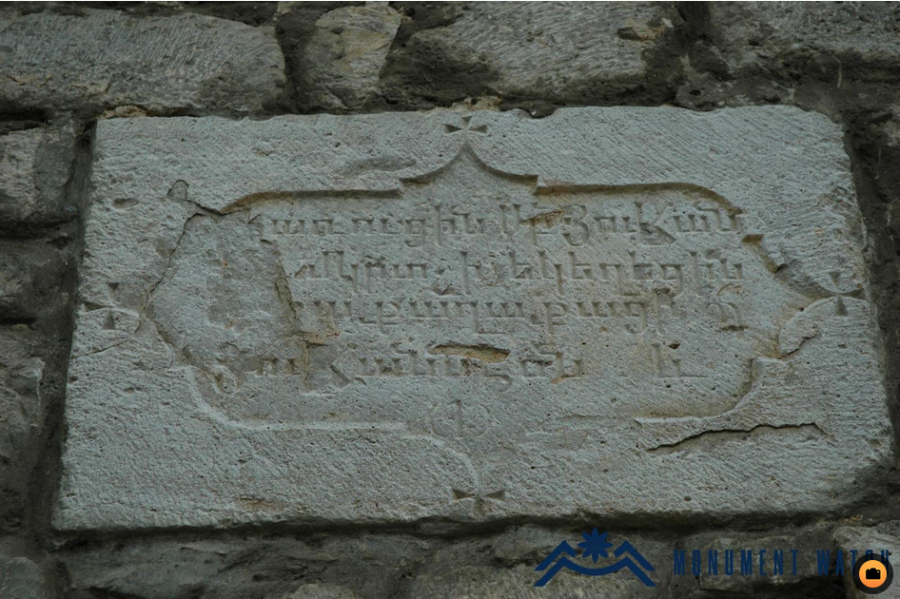
Despite clear evidence of its Armenian origins – including building inscriptions from 1847 that name its Armenian builders and purpose – Azerbaijan has denied this affiliation.