








Several years ago, the well-known Russian writer Boris Akunin wrote a post about “ruining one’s obituary.” He cited the classic examples best known in his field.
The prolific Russian writer Maxim Gorky, author of remarkable works, lived, on the whole, a dignified life until the late 1920s. But in 1929 he traveled to the Stalinist Solovki camp — essentially a death camp — to observe how prisoners were being “re-educated.” About a year later he published an article justifying terror, with the notorious line: “If the enemy does not surrender, he is destroyed.” As a result, he was granted a luxurious mansion, and the city of Nizhny Novgorod was renamed Gorky in his honor during his lifetime. He forfeited the possibility of having an entirely positive obituary.
The same happened to the no less talented Norwegian writer Knut Hamsun. At 80 he was a living classic; ten years later he became an object of widespread disgrace for supporting the Nazis. He praised Adolf Hitler and even presented his Nobel medal to Joseph Goebbels (a familiar scenario, isn’t it?).
Not only figures of that magnitude, but also artists, scholars — and, even more so, clergy and human rights advocates of more modest achievement — should avoid falling into a toxic environment. The most toxic environment, of course, is power, especially dictatorial power. But it is advisable, at the very least, to keep one’s distance from any власти. So to speak, for safety’s sake.
Read also

Otherwise, everything you have created and achieved may collapse, and a single line in your obituary — “From such-and-such year to such-and-such year he was part of such-and-such an institution and spoke in defense of the ruling regime” — can cast a shadow over your entire biography, no matter how fine a poet, priest, or bishop you may once have been.
…As for Akunin himself (born Grigory Chkhartishvili), in 2024 he was designated a “foreign agent” by the Putin regime for spreading what authorities called “undesirable information” about the war. The writer, who now lives in London, faces multiple criminal cases in his homeland. In July 2025, a Moscow military court sentenced him in absentia to 14 years in prison on charges including justifying terrorism and assisting terrorist activities; later rulings increased this to a total of fifteen years.
Aram ABRAHAMYAN
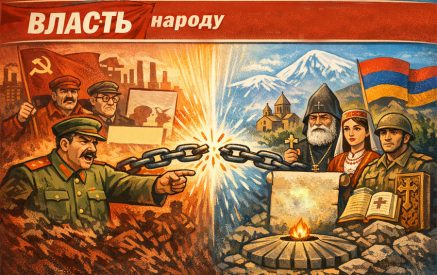
The image was created using artificial intelligence