
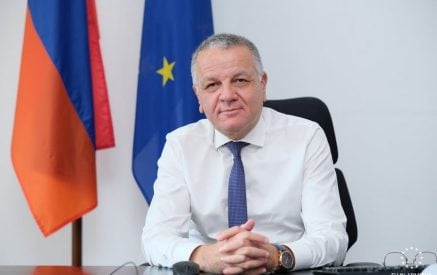







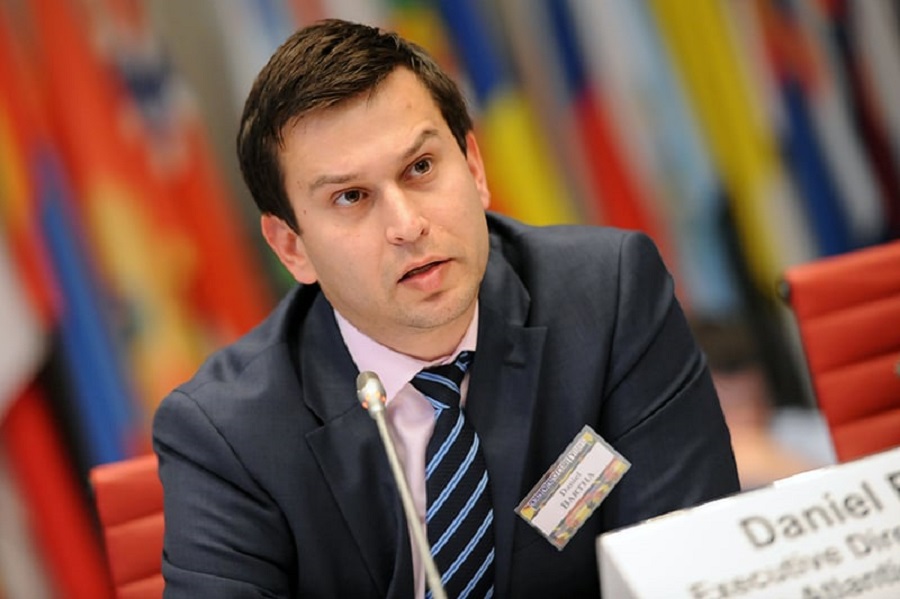
“Ideally, the Russian threat should not be used as a pretext to restrict certain political parties”, says Hungarian expert Dániel Bartha
“Aravot” daily interview with Dániel Bartha, President and Director of the Budapest-based non-profit and non-partisan think tank Centre for Euro-Atlantic Integration and Democracy
– Prime Minister of Hungary Viktor Orbán has framed the upcoming April elections as a choice between “war and peace,” arguing that his political opponents would drag the country into the war raging in Ukraine. The opposition has also been facing other accusations. At the same time, the European Commission and other bodies have been sharply criticized by the government’s representatives and sympathetic media. How would you assess the political landscape on the eve of the April elections?
– The elections to be held on April 12 are fundamentally a two-player contest. Everything revolves around the battle between the currently governing Fidesz–KDNP and the TISZA Party, and at this point only the far-right Mi Hazánk (Our Homeland) realistically has a chance of entering Parliament at all.
Read also
Over the past 16 years, the ruling party has shaped everything to secure its own advantage. As a result, it is not enough for the opposition to win more votes; it needs a significant majority even to achieve a change of government.
Beyond tailoring the legal framework, those in power make use of every available tool: the public media spreads false information supporting the government, and unimaginable sums of public money are spent on propaganda backing the ruling party.
Based on the above, it is no coincidence that the opposition frames the election as a decision once again about whether we want to remain part of the European Union or drift eastward toward a Belarus-style model.
– Prime Minister Orbán has also accused Ukraine of allegedly planning to disrupt Hungary’s energy system, and ordered the deployment of troops and equipment to protect critical infrastructure. Hungary’s position has been evident in its repeated obstruction of successive EU sanction packages against Russia. At the same time, the EU intends to phase out Russian natural gas entirely by 2027. Which developments can be expected in this context?
– Once again, propaganda and reality are two very different things. Clearly, Ukraine does not intend to attack Hungary, but the government needs an enemy image. In recent elections, the focus has consistently been on presenting security threats. Scaremongering about war and spreading fear is a well-known tactic, as they want to suggest that only they are capable of protecting Hungarians from being dragged into a war.
Viktor Orbán has even explicitly stated that, in his view, Moscow does not pose a threat, and he did not protest when the Russian security services made it clear that they were prepared to interfere in the elections.
Today, even the opposition believes that in the event of possible Russian interference, the state would not protect the elections; rather, it would be more likely to encourage the Russians to assist them.
As for Russian gas, Hungary’s current government signed a long-term gas supply contract until 2035 in an extremely irresponsible manner, despite well-known geopolitical risks and repeated warnings from experts. The details regarding the termination clauses of this contract are not publicly known.
At the same time, diversification has already begun. The European gas market is well developed. Russian gas can be replaced, and the alternatives are not—or not significantly—more expensive. These are the facts.
Naturally, government propaganda presents a very different narrative about this as well.
– At Yerevan’s request, Brussels is reportedly preparing to help Armenia safeguard its June parliamentary elections against potential Russian interference. The EU intends to deploy a “hybrid rapid response team” to Armenia. According to diplomatic notes circulated in Brussels, “the support offered to Armenia should be clearly aimed at reducing and mitigating Russia’s destabilizing activities.” Armenia’s opposition views this as interference, while the government presents it as assistance. According to some reports, Armenia has also requested assistance from Moldova.
Several pro-Russian analysts compare the situation to the developments in Georgia, when the government of Mikheil Saakashvili escalated tensions with Russia, arguing that Georgia ultimately failed to secure significant gains and instead suffered territorial losses. In turn, the current Georgian government has also engaged in the use of the “war and peace” rhetoric. In your view, what Armenia may potentially gain, and what are the risks?
– Armenia can learn a great deal from the Hungarian example. At the same time, the two countries face different levels of exposure due to Armenia’s geographical proximity, stronger Russian cultural presence, until recently active political ties, and widespread knowledge of the Russian language. I have no illusions that Moscow will attempt to undermine pro-Western forces.
Ideally, the Russian threat should not be used as a pretext to restrict certain political parties. Rather, any assistance should focus strictly on countering Russian narratives in the media, cyberattacks, and direct Russian financing.
It is also worth emphasizing that the Hungarian opposition does not accept any direct Western support. As long as elections remain formally free—even if they are not fully fair—it is ultimately up to the Hungarian people to decide what kind of government they envision for their country’s future.
Emma GABRIELYAN
The interview was organized by the invitation and with support of the Center for Policy Studies.