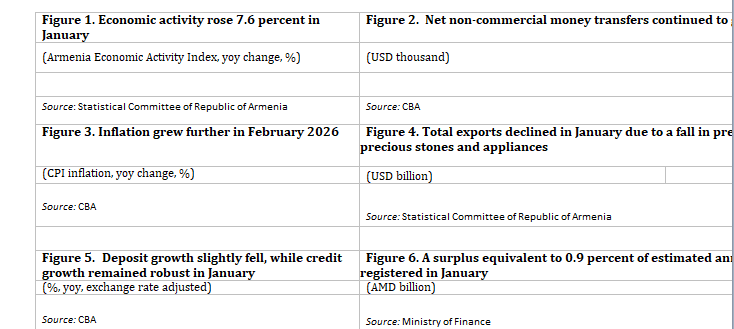








































- Economic activity grew by 7.6 percent (yoy) in January, with high growth in construction and mining.
- Net non-commercial money transfers expanded by 43.7 percent (yoy), mainly from Russia.
- Inflation grew further to 4.3 percent in February, mostly driven by food prices.
- In January, both exports and imports registered double-digit declines mainly due to the phasing out of precious stones and metal re-exports.
- A budget surplus equivalent to 0.9 percent of projected annual GDP was recorded in January.
Economic activity in January remained robust at 7.6 percent (yoy) and broadly in line with the 7.3 percent (yoy) recorded in January of the previous year. Growth was primarily supported by construction (18.7 percent, yoy) and industry (10.6 percent, yoy), mostly driven by growth in mining activities (25.2 percent) and electricity and energy production (17 percent, yoy). Manufacturing growth in January was modest at 4.3 percent (yoy) with major manufacturing products, such as food and base metals having a flat and 2.2 percent growth, respectively. Growth in non-trade services and retail stood at 7.4 and 7.9 percent (yoy), respectively. The number of registered businesses fell by 13.8 percent (yoy) in January, driven mainly by an 18.6 percent fall in individual entrepreneurs.
In February, inflation rose to 4.3 percent (yoy) from 3.8 percent (yoy) in January. The largest contribution continued to come from food and non-alcoholic beverages, where inflation increased 6.5 percent (yoy) and contributed about 59 percent of overall inflation. Prices of alcoholic beverages and health rose 10.3 and 4.5 percent (yoy), respectively, each contributing 11 percent to overall inflation, while inflation also increased in transport (3.6 percent, yoy) and education (8.3 percent, yoy).
In January, exports and imports fell by 13.5 percent (yoy) and 11.2 percent (yoy), respectively, following robust growth in the last two months of 2025. Exports fell 13.5 percent (yoy) owing to a 45.1 percent (yoy) fall in precious and semi-precious stones, as well as a 69.1 percent (yoy) fall in appliances, due to a decline in re-exports. Other commodity exports such as ready food products (down by 16 percent) and products of animal origin (down by 23.8 percent) also contracted. The main positive contribution came from minerals, where exports increased 43 percent (yoy). Meanwhile, imports fell 11.2 percent (yoy), also due to a 63.3 percent (yoy) fall in precious and semi-precious stones, a 42.7 percent fall in appliances, as well as a 25.7 percent drop in imports of means of transport. In January, excluding the trade in precious metals and stones and appliances, exports rose by 8 percent (yoy), while imports were flat (yoy). Tourist arrivals in January surged by 28.6 percent (yoy), reflecting a continuation of the strong growth in tourism registered in the second half of last year.
In January, net non-commercial money transfers grew by 43.7 percent (yoy). This was driven by a 43 percent (yoy) increase in net inflows from Russia (accounting for 52 percent of total net inflows) alongside a 7.6 percent (yoy) expansion of inflows from the United States (accounting for 38 percent of total net inflows). Notably, growth in January was significantly stronger than the 17.3 percent (yoy) increase recorded in January 2025.
Read also
In February, the AMD appreciated by 0.7 percent (mom) against the USD while it depreciated by 0.2 percent (mom) against the EUR. The AMD appreciated 4.6 percent (yoy) against the USD on average in February, while it depreciated against the EUR and RUB by 8.4 percent (yoy) and 14.2 percent (yoy), respectively. Gross reserves expanded to USD 5.5 billion at end-February, equivalent to 4.1 months of imports.
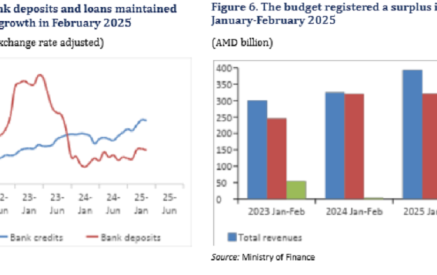
In January, commercial bank deposits fell 0.3 percent (mom) while credit expanded 1.1 percent (mom). Exchange rate-adjusted annual growth remained stable, at 19.3 percent (yoy) for total deposits and at 24.1 percent (yoy) for credit. Financial system indicators remained sound: the Capital Adequacy Ratio stood at 20.3 percent, and Non-Performing Loans stabilized at 1.3 percent.
In January, an overall budget surplus equivalent to 0.9 percent of estimated annual GDP was recorded, consistent with patterns seen in previous Januarys. In January, total revenues and grants grew 7.5 percent (yoy) in nominal terms. Tax revenues (including mortgage-related income tax) increased by 7.8 percent (yoy), mostly driven by a 19 percent (yoy) rise in income tax collections and a 6.8 percent increase in VAT collection. Total expenditure grew 9.3 percent (yoy), driven by the 21.2 percent (yoy) current expenditure increase, while capital expenditures shrunk by 67.3 percent (yoy), reflecting a 64.8 percent (yoy) decline in capital defense spending from a high base in 2025. Current health spending almost tripled in January (yoy), due to the introduction of public health insurance.