

















On the Importance of Aesthetic and Moral Qualities
“The devil begins with the foam on the lips of an angel who has entered the fight for a sacred and just cause. Everything turns to dust—both people and systems. But the spirit of hatred in the struggle for a just cause is eternal. And thanks to it, evil on Earth has no end. Since I understood this, I have come to believe that the style of a debate is more important than its subject.”
These are widely quoted words by the Russian philosopher and cultural theorist Grigory Pomerants.
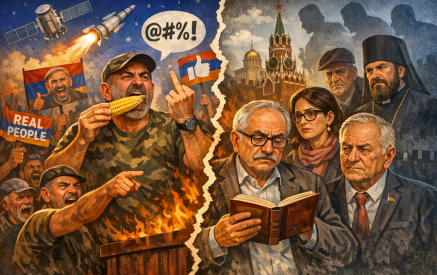
Over time, I too have come to realize that, as in art—and indeed everywhere in social and political life—style and form carry their own content. The style prevalent on social media is not merely a style: it is a sign of intellectual shallowness, a limited horizon, and moral bluntness. Yet it is often presented as a struggle for a just cause, for ideals.
Read also
In his novel Resurrection, Tolstoy writes about a revolutionary named Novodvorov: “Although he liked to support his views with grand arguments, Nekhlyudov (the novel’s protagonist — A.A.) explained his activity by ambition, by the desire to be first.” He further notes: “Lacking moral and aesthetic qualities, he doubted nothing and was convinced that he was never wrong.”
Do moral and aesthetic qualities shape only style? Of course, they shape style as well. But “style is the man himself” (“Le style c’est l’homme même”), as the French naturalist and writer Georges Buffon wrote in the mid-18th century. He was referring, of course, to literary style. But his observation applies to all spheres of human activity.
Aesthetic—let alone moral—manifestations matter. The way a person eats, the vocabulary they use, how a politician or a businessperson (an oligarch) communicates with journalists—all of this goes beyond mere “stylistic features.”
Recently, I watched footage from Levon Ter-Petrosyan’s press conference on September 26, 1997, where the first president, in his calm, academic manner, explains the difference between package and step-by-step approaches to resolving the Karabakh issue. I will not go into whether he was right or wrong—the point here is style. I compare the speaker’s style with that of a user who “counters” him: “so why did he say on October 27 ‘rally around Kocharyan’—ugh.” Once again, we see that style is at least as important as the topic under discussion, and it reflects the debaters’ ability to think and reason.
I am often “countered” in the same style. Suppose I write about yet another unlawful act by Pashinyan. The usual response is: “Why don’t you write about ‘October 27’ and ‘March 1’?” This style of debate leads us into a dead end.
In short, just as content shapes form, form shapes content. If the goal is to earn street-level approval—the kind that praises “keeping one’s foot on the gas”—then, for that sake, one might, for example, threaten Russia with leaving the EAEU and the CSTO. In rural areas, there will surely be elderly people who take this as a display of “boldness.”
Aram ABRAHAMYAN
“Aravot” daily
07.04.2026