































PART 2
In the first part of the article, we discussed that the positions of subjects capable of restoring the world’s order and the logic of a new international law remain open—and that Armenians have a place there, because it is precisely by adhering to that order that they have been subjected to suffering since 2018.
However, that place can only be claimed by overcoming national egocentrism and transforming into a nationally universal essence.
What is national egocentrism? To understand this, let us first recall personal egocentrism.
Read also
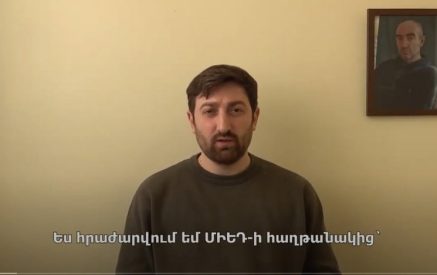

Armenian nationalism criticizes the individual who does not accept the idea of protecting the collective and is guided solely by personal interest—someone who, as they say, “thinks with their stomach” or tries only to save their own skin. This is personal egocentrism.
There is also communal egocentrism: “As long as the enemy hasn’t reached our village, there’s no need to fight,” or “Artsakh is a burden for Armenia.”
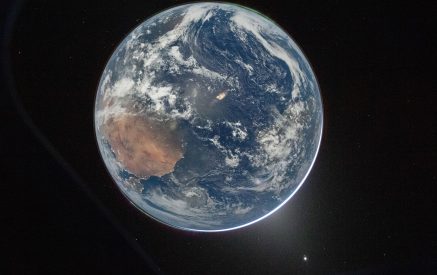
The same trap can also capture nationalism when it limits itself to a purely national dream and fails to connect national belonging with an infinite usefulness to the world. In that case, identity becomes enclosed, ceases to perceive itself on a cosmic scale as part of the Earth, and remains confined within the boundaries of Ararat and Amaras.
What are you doing on planet Earth if your mission is not connected to it?
Thus, the structure of personal and national egocentrism is the same: in one case, everything is only for myself; in the other, everything is only for my nation.
The current government of Armenia exists outside this broader, cosmic perception. Moreover, it is harmful, because it prioritizes “peace”—understood as stagnation—over development. It is engaged not in strengthening Armenian identity so that it may contribute to the Earth, but in weakening it, and therefore also restricting freedom. The limitation of Armenians’ freedom and justice is a harm to the Earth itself; consequently, Armenia’s current government is causing harm to the planet.
The current Armenian resistance has a nationalist character. That which is suppressed resists: identity is suppressed, and nationalism resists.
Today, Armenian national resistance is largely grounded in historical memory and justice and implies the restoration of historical territories. Beyond those boundaries, its imagination rarely extends.
However, Armenian nationalist resistance needs an expansion of meaning—so that it ceases to demand justice only for itself and begins to create justice.
It still lacks a complete understanding of cosmic consciousness, of belonging to the Earth, and of responsibility toward it. Its imagination often fails to overcome the egocentric limits of personal or national victory.
An Armenian nationalist may dream of returning to Western Armenia, yet this return is rarely considered within the context of humanity’s future, planetary development, or a broader cosmic horizon.
But what if we do return? Will we then stop—settle into “peace” and stand still? The Earth will continue to spin, the solar system will continue its motion. Which means that the Armenian return cannot be an endpoint—it must be connected to a broader cosmic horizon, serving the needs of the Earth.
Thus:
- nationalism is necessary for the preservation of identity,
- but it is not sufficient for the expansion of meaning.
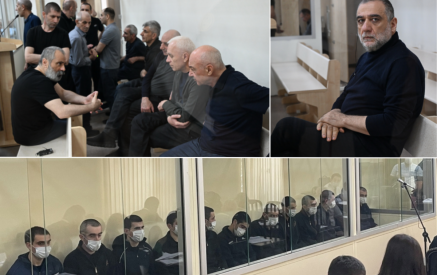
In itself, it does not provide a complete—cosmic—understanding of life’s meaning. Yet at this historical stage, it is precisely through it that such an expansion can be achieved. As noted in the first part of the article, Armenian political and military figures and entrepreneurs from Artsakh are suffering in Azerbaijani prisons not only for the defense of Armenian identity, but also for the freedom of nations, democracy, and the world order.
For this reason, the Armenian question is no longer solely Armenian. It is a universal human question through which Armenians can help restore order to the world—contributing to the Earth and spreading justice.
In the next parts of the article, we will examine what kind of mindset, behavior, and way of life are required to turn this mission from an idea into a reality.
Hovhannes ISHKHANYAN