




























Recently, it was announced that the winning design for the Hamburg State Opera in Germany was submitted by the internationally renowned architectural firm Bjarke Ingels Group (BIG), with Sarkis Sarkisyan as one of its co-authors. International media praised the project for its bold, contemporary, and innovative architectural solutions.
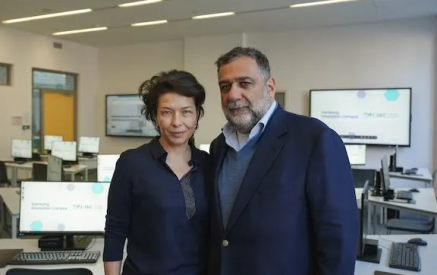
Sarkisyan is also active in Armenia. Together with the team at the Proforma architectural bureau, he is the creator of the concept for Dilijan Terraces (Mountain Village), a modern and innovative residential complex under construction in Dilijan. The initiative is led by Ruben Vardanyan and Veronika Zonabend, who are also the founders of the Dilijan International School and have consistently emphasized bringing the best international technologies and expertise to Armenia.
In an interview with Aravot, architect Sarkis Sarkisyan discusses his achievements, his distinctive approach to architecture, his motivation for working in Dilijan, and more.
Congratulations on your victory in the international competition. Before we dive further into that, could you tell our readers a little about yourself?
Read also
My initial profession was completely different. I became interested in architecture when I visited an exhibition by the renowned British architect Norman Foster at the Pushkin Museum. I was deeply impressed and inspired. I realized that architecture is a truly powerful and fascinating field, one that allows you to create something from nothing — structures where people live. In a way, you are shaping people’s living environments.
At first, I studied at the Moscow Architectural Institute, and later, I felt the desire to explore Western architectural schools, as well, because I wanted to experience their approaches firsthand. I was accepted to Harvard University, where I continued my specialization in architecture. After Harvard, I worked for several years in the United States, and that eventually led me to join Bjarke Ingels Group (BIG). As a team, we won the international competition to design the Hamburg State Opera building.
So, it turns out that the opera house in one of Europe’s major cities will be built according to the design you and your colleagues submitted. Surely, there must have been no shortage of competitors in such an international, high-profile competition. What was the secret to your project’s success, or what features helped it stand out?
Without a doubt, we have the utmost respect for all our competitors. I can speak about the distinctive features of our project. The opera house will be built in a truly unique location — almost in the center of Hamburg, in an industrial area, on a small peninsula. The aim was to create something exceptional in this area.
When we began our work, we realized that the site was truly special, and that simply building an opera house would not be enough. Opera houses are typically prominent, monumental structures. The question was how to preserve that significance while creating a unique building that harmonizes with its surroundings, giving the impression that it “grew” out of the site rather than being placed there. In fact, that is exactly how the project turned out: the building appears to have naturally “grown” from its location.
It can almost be considered a building embedded within a park. When we presented the project, our message was that it is not only for opera-goers, but for all residents of Hamburg.
In other words, people will be able to visit at any time of day, stroll through the surrounding park, and climb the terraces to enjoy the beautiful views, without any restrictions. For the residents of Hamburg, this will truly become a unique, living public space — one that functions continuously and is not solely defined by opera performances.
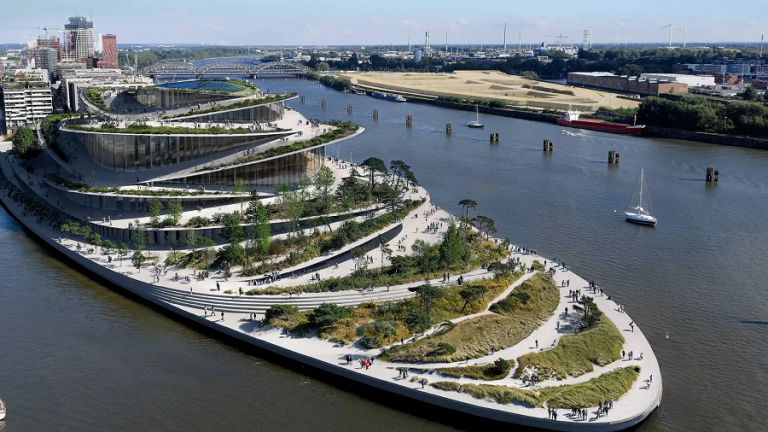
General view of the future building of the Hamburg State Opera
You are also active in Armenia, which is certainly good news. One of your projects here is the Dilijan Terraces, or Mountain Village, residential complex. How did it happen that, while living outside Armenia, you became involved in this project?
I already knew Ruben Vardanyan and his wife, Veronika Zonabend, who are essentially the initiators of this project. They were aware that I had experience in Western architectural practice, and since they had launched the restoration of Dilijan’s central park, they approached me for assistance on certain aspects of the work. Together with my colleagues, we quickly reviewed the project and made several strategic recommendations concerning landscaping and improving the park’s circulation.
Later, the idea of collaborating on additional projects emerged. I was truly inspired by what Ruben and Veronika were doing, without expecting anything in return, simply for the benefit of the people. They were doing everything they could to make Dilijan a better place, and that was highly motivational. I also became interested in contributing something meaningful to the city, and so I agreed. That’s how it all came about.
In Dilijan, as well, just as in Hamburg, you have taken the landscape and local features into account…
Yes, that is the foundation of our approach. In our practice, it is impossible to simply take a project designed for one place and transplant it somewhere else. What matters is that the building feels as if it truly belongs to its site, as if it has grown out of the land itself.
We do not create designs that imitate historical buildings. Today, you cannot design a structure that only pretends to look historical. That would be, frankly, architectural parody. Two or three hundred years ago, the world, the technology, the construction materials, and the cultural context were completely different. Every building has its own cultural “passport.” Contemporary architecture reflects the world we live in today. It is true that many buildings now resemble one another, because the world is more interconnected, but there are still nuances that make each place distinct.
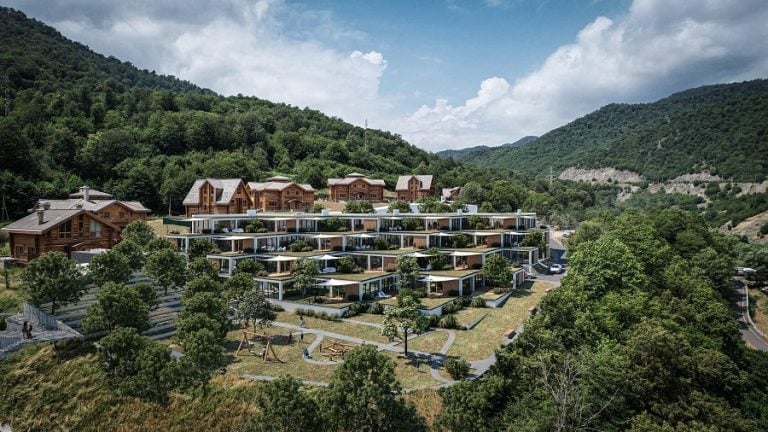
General view of the Dilijan Terraces (Mountain Village) complex
The same applies to Dilijan. Before starting, we thought carefully about how to reflect the character of the place in the design. We tried to understand the “DNA” of this site — and, speaking honestly as a professional, that was not easy to decipher. In our view, the best solution was to treat Dilijan’s magnificent landscape with deep respect and to make the buildings as harmonious with it as possible.
In other words, we proposed arranging the buildings in terraced layers, like a woven carpet stretching across the slope. And despite their distinctive architectural expression, the buildings remain rational, practical, and functional.
If you look at the complex, from one side it appears almost like a natural hillside, while from another angle, you see only a single level visible above ground. It is as if the buildings emerge from the terrain, creating the impression of a carpet unfurling down the slope. And this, in our view, is the project’s core achievement: maximizing integration with the landscape, preserving the best possible views, and, at the same time, ensuring sufficient usable space. It was quite challenging at first, but with certain creative methods, we were able to solve the problem, and the result turned out very successfully.
Have you incorporated elements of Dilijan’s traditional architectural style?
There are aspects of the design that, so to speak, pay homage to Dilijan’s traditional architectural language, though not in a literal or imitative way. The project primarily uses concrete and wood. Wooden inserts are placed within the spatial concrete frames to enclose areas and form walls. In this way, we preserve the local tradition of wooden infill within stone structures, which is characteristic of Dilijan’s historic architecture. The style of the balconies is also inspired by typical Dilijan motifs.
So is it fair to say that a complex with truly unique architectural solutions is being built in Dilijan? What will its significance be for the city itself?
The complex is not far from UWC Dilijan, and together, they form a natural architectural and urban axis. This means it will not only preserve a beautiful panorama for the city, but will also, without question, give a new impulse to Dilijan’s development by demonstrating how the city can move forward and create distinctive, exceptional architectural works.
Let me put it this way. Without any exaggeration, I believe that, from an architectural standpoint, this project is of very high caliber. It is, quite honestly, one of the best projects I have ever worked on.
I believe that Dilijan will gain not just a project that is unique for Dilijan, but one that is unique for Armenia, and perhaps even for the world. I am not aware of any similar project elsewhere built in exactly this way. It is truly singular. There are, of course, many terraced buildings around the world, but this complex can be considered one of the distinct evolutionary peaks of terraced architecture.
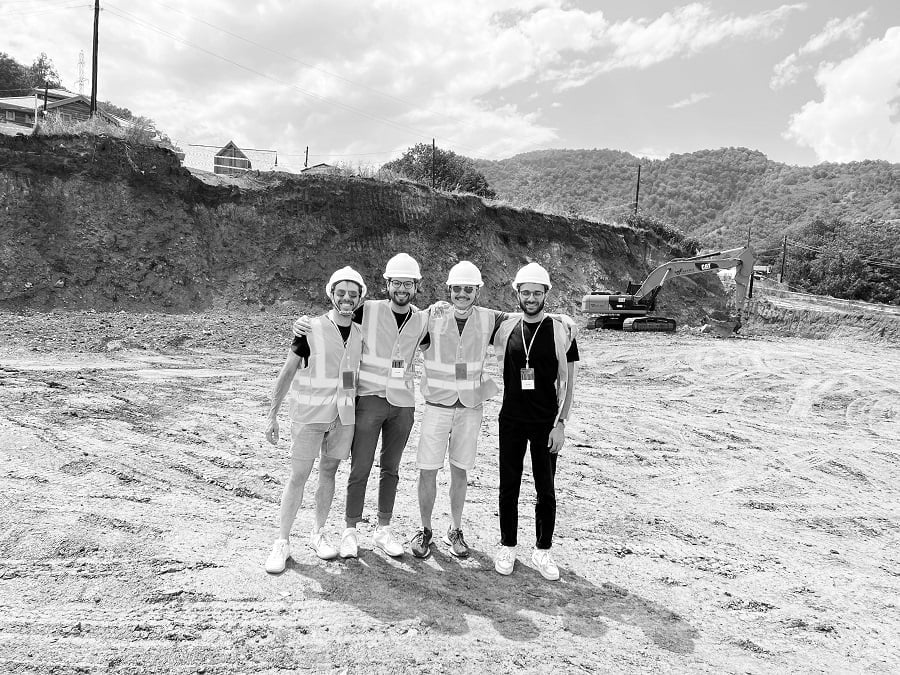
Main photo; Sarkis Sarkisyan with the Proforma team in Dilijan