









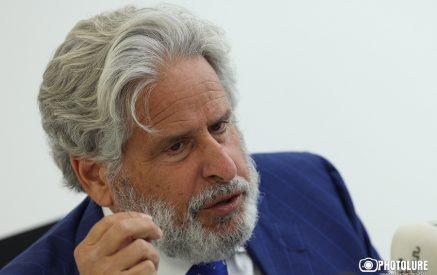


YEREVAN/ZURICH — Joel Veldkamp (born in 1988 in Iowa) is the director for Public Advocacy at Christian Solidarity International (CSI), a Switzerland-based human rights organization advocating for religious freedom and the protection of persecuted communities worldwide. He holds a PhD in international history from the Geneva Graduate Institute, an MA in Middle Eastern studies from the University of Chicago, and a BA from Dordt University (Iowa). Veldkamp’s academic research has focused on the modern history of the Middle East, including the experience of Christian communities in Syria. Through his work with CSI, he has traveled extensively across the broader Middle East and North Africa, documenting humanitarian conditions and engaging in international advocacy. He has addressed forums such as the United Nations Human Rights Council on issues including religious persecution, economic sanctions, and the protection of vulnerable minorities.
Joel, as an Armenian living in Armenia my first question is: in your opinion, how do geopolitical dynamics shape humanitarian policies in our region?
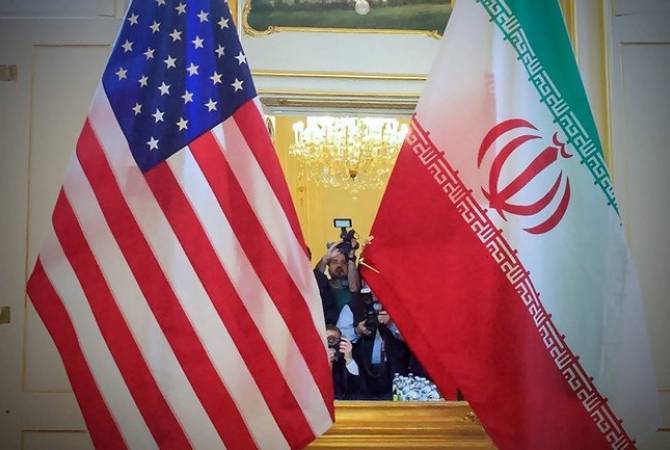
Unfortunately, the South Caucasus is at the center of a new “great game” for influence being played between Russia and the United States. In such a situation, humanitarian and human rights considerations will always take a back seat to the hard interests of the great powers. Nearly 30 years ago, the influential American statesman Zbigniew Brzezinski described Azerbaijan as a “geopolitical pivot” that would be crucial for the U.S.’s efforts to contain Russian power. This is essentially how the U.S. still sees the region. Russia has also clearly decided that it needs the goodwill of Turkey and Azerbaijan to preserve its influence in its near abroad. Both sides need Azerbaijan, and so Azerbaijan is mostly allowed to do what it wants – including ethnic cleansing.
Read also
What role does international advocacy play in protecting human dignity and religious freedom?
The realities of hard power severely limit what international advocacy can accomplish, of course. But we should not give in to despair. Even when the great powers are not responsive, advocacy can shape public opinion in ways that exert pressure over the long-term.
One good example is that only 20 years ago, there was still considerable reluctance in academia and among governments to speak the words “Armenian Genocide.” Now it is broadly accepted as historical reality, and only marginal scholars and states contest it. There was no political calculus behind this shift. This victory is owed completely to the thankless labor of thousands of Armenians over the past century.
Advocacy can also help us prepare for the day when the geopolitical situation in the region changes — as it must. I personally believe that the U.S. and Russia have both miscalculated. It is not in either of their interests for Armenia to be completely deprived of its sovereignty, and for Turkey and Azerbaijan to call all the shots in the region. Yet that is precisely where U.S. and Russian policy have brought us. Eventually, Azerbaijan — which, despite all its PR efforts, remains a paranoid, ultra nationalistic, aggressive dictatorship — will become too difficult to manage, and both superpowers will be looking for ways to restrain it. When that day comes, we want the right of return of Artsakh Armenians to be squarely on the agenda.
We have seen this happen before. CSI was raising the alarm about genocide and slavery in Sudan for seven years before the U.S. finally decided to intervene to negotiate an end of Sudan’s civil war in 2002. We could not control the geopolitical changes that led to this policy initiative, but when those changes came, our advocacy helped to shape the policy.
Do you really believe that, in today’s globalized world, we can still talk about Christian solidarity? Even in Europe — what the Swiss-Israeli author Bat Ye’or calls “Eurabia”—authentic Christian values seem to be fading.
Christian solidarity is certainly not a geopolitical reality in today’s world. Christians facing persecution or deprivation count for almost nothing in the foreign policies of Western states. It is a far cry from the late 19th and early 20th centuries, when the suffering of Christians in the Ottoman Empire was a central theme in American and European politics. We do not expect this to change anytime soon.
For CSI, Christian solidarity is rather a spiritual calling. Our mission is to unite Christians across the world to support persecuted Christians and other persecuted peoples, like Yazidis in Iraq or Rohingya Muslims in Myanmar. Very few of our supporters are rich or politically powerful, but together, we can help persecuted communities survive, and sometimes even change their situation completely. We may live in a world dominated by empires, superpowers and nation-states, but in Jesus Christ, God has united us, through baptism and through the Holy Spirit, with billions of people across the world, transcending divisions of race, language, gender, and class. Together, we are the Body of Christ in the world. Christian solidarity is a tool He has given to us to withstand oppression and persecution. We should use it.
I guess that you first became acquainted with Armenians while studying Christian communities in Syria. The 21st century has been especially difficult for Armenian communities in the Middle East, with their numbers declining rapidly. What would you say are the biggest challenges facing Christian communities in the Middle East today? Do you see a future for Christians there, or do you share the more pessimistic view that they may vanish?
The Middle East’s transition from the world of empires to a world of nation-states has been deeply traumatic for Middle East Christians. Traditionally, Christians were held in a protected second-class status, as dhimmis, in the Islamic empires. Ironically, the abolition of the dhimmi system ended up being a lose-lose for Christians — it left them exposed to attacks from religious extremists and Turkish and Arab nationalists alike, while efforts to promote Christians as equal citizens were largely rejected by the societies they lived in. Today, after nearly a quarter-century of continuous warfare in the Middle East, Turkey seems poised to become the dominant power in the region. This is very bad news for Christians — for 103 years, wherever the Republic of Turkey has extended its influence, from Antioch to Cyprus, historic Christian communities have disappeared.
Christianity certainly may vanish from the Middle East. We should not accept this as an inevitability however. If any place in the Middle East could be called hopeless for Christians, it is Syria — ravaged by 15 years of civil war and economic sanctions and ruled by a regime composed of jihadists. But what we see in Syria is that a great many Christians, including Armenians, remain devoted to their homeland and their countrymen and determined to remain and live as fellow citizens with their Muslim neighbors. They deserve our full support.
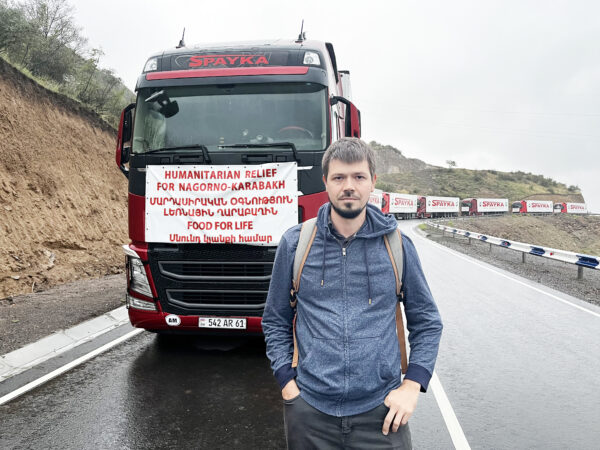
Joel Veldkamp at the Lachin Corridor on September 12, 2023
You are one of the few non-Armenians who writes consistently about the ethnic cleansing in Artsakh. How important is Armenia to your research and public work?
It has been an enormous privilege for me to spend so much time in Armenia. I first traveled to Armenia in 2017 to study the Armenian language during my PhD program. I wanted to write about the Christians of Aleppo, and I belatedly realized how many of them were Armenians! It was a good lesson for me to learn — Armenians are an essential part of the story of Christianity, not just in Syria but in the Middle East and the whole world.
That is why CSI devotes so much energy to this cause. Armenia is the first Christian nation. Its culture, theological tradition and collective memory is an indispensable part of the common heritage of the global body of Christ. The Armenian people have survived war, statelessness, genocide, communist totalitarianism, and more, and are still holding the light of the gospel in an increasingly hostile part of the world. The West is on the verge of bartering all of this away for a bowl of stew. If Armenia is lost, all of our future battles will be much harder.
Every time I come to Armenia, I leave inspired. Not by the dismal political situation, of course, but by the bravery of our many Armenian colleagues who continue to fight the good fight under very difficult conditions. The human rights activists who keep speaking the truth in the face of gathering authoritarianism; the refugees from Artsakh who have lost everything and still work every day to help their countrymen and keep hope alive. When you meet people like that, how can you not want to work even harder to help them?
Let’s talk about the most recent developments in Armenia. Many people welcome TRIPP, while others see it as a trap. What’s your perspective on this?
I am probably not the most qualified person to speak about this; I look up to experts like Philippe Kalfayan and Tigran Grigoryan, whose analysis of these developments I find helpful. In principle, it could be a very good thing for Armenia to become a node for commerce between Europe and Asia, and to work closely with the U.S. on that, so long as it maintains sovereignty over its own territory and borders.
What I find troubling is when I hear other advocates for Armenia speaking as though TRIPP will, on its own, act as a deterrent against an Azerbaijani invasion. The theory seems to be that, if the U.S. is highly invested in this project, Azerbaijan will be reluctant to attack southern Armenia. I do not find this convincing at all. American politics is chaotic and fickle. The one constant in U.S. policy in the South Caucasus since the 1990s has been to prioritize cooperation with Azerbaijan above all else. Baku believes that so long as it helps Washington meet its energy and security objectives, all of its attacks on Armenians will be forgiven and quickly forgotten. That is the lesson it has learned from 2016, 2020, 2022 and 2023.
If the U.S. wishes to deter future Azerbaijani aggression, it should hold Azerbaijan accountable for its past aggressions, and demand remedies. Armenians should not be reassured by anything less than that.
You said you learned Armenian. How was your experience in studying our rather difficult language?
Humbling! I have studied French, German, and Arabic and Armenian was harder than any of them. I eventually learned enough to read Armenian sources from the 1920s, and I can speak (poorly) about basic topics, but it is still not a language I am comfortable in. Thankfully, my Armenian friends and teachers are always very patient with me. I still take online lessons from a teacher who lives in Armenia every week (Hi Gevorg!), and I want to improve, but I think this will be a lifelong challenge.
Finally, thank you for all your work — especially your advocacy for Armenians. Raising the voice of truth is rare these days, and your efforts are particularly meaningful in our world today
Thank you for your encouragement. My colleagues and I have been commissioned to do this by thousands of ordinary Christians across Europe and the United States who donate to make our work possible. Our thanks is due to them. For CSI, this truth-telling is our mission and our duty. If we did not speak out about persecution in ways that dissent from the prevailing narrative, we would have no reason for existing.