












Part 10 is here
Part 11
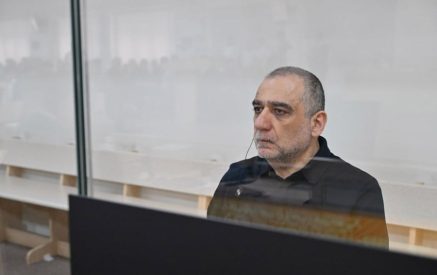
Pastinfo continues its series of publications titled “‘Justice’ According to Azerbaijan,” analyzing the indictment and verdict in the case of Ruben Vardanyan. For professional legal analysis, we have engaged Taron Simonyan, an international law expert and a founding partner of the ELL PARTNERSHIP law firm.
Today, we analyze the charges under the category of “Terrorism and Financing of Terrorism.”
Read also
V. TERRORISM AND FINANCING OF TERRORISM
Article 214.2.1, .3, .4 — Terrorism committed by an organized group or criminal enterprise, involving the use of firearms, and recklessly causing death
Alleged Act: 308 acts of terrorism (1988–2023), resulting in 449 fatalities; 285 landmine explosions (1990–2024).
Evidence Underlying the Charge: None of the 308 acts contain evidence proving Ruben Vardanyan’s involvement. The court presented only a general list of incidents, data from the mine clearance agency, and the search record of the Stepanakert office, dated October 3, 2023. No connection is established between the results of that search and 308 incidents spanning 35 years.
Imposed Penalty: Twenty years of imprisonment, a single aggregate sentence handed down for all three sub-clauses.
Taron Simonyan’s Analysis: Terrorism is a specific act committed for a specific purpose. The 308 “incidents” listed by the court refer to combat operations conducted by armed forces during a 35-year armed conflict, which are governed by International Humanitarian Law (IHL). International conventions on counter-terrorism explicitly exclude such actions from the scope of terrorism, reserving them for IHL.
The only physical evidence presented consists of a few grenades and rounds of ammunition found in a cupboard. These are the subject of a separate charge (Article 228.2.1) and do not, in themselves, constitute terrorism. Inferring participation in 308 acts of terrorism over 35 years from those few items amounts to building a charge on evidence unrelated to the elements of the crime. Furthermore, the majority of the incidents predate December 2020, while the count of mine explosions continues through 2024, a period during which Vardanyan was already in custody.
Article 214.1 — Financing of terrorism
Alleged Act: In May 2023, the We Are Our Mountains Development Agency raised 212,000 USD (360,400 AZN) and transferred it to the Artsakh Security and Development Front NGO. Attempted procurement of UAVs and electronic warfare (EW) systems; conducting the Davit Bek Sports and Tactical Games (May–August 2023).
Evidence Underlying the Charge: The prosecution presented facts that actually refute the charge. Bank documentation demonstrates that the 212,000 USD was raised from the Ruben Vardanyan Foundation, Dilijan Community Center, Aznavour Foundation, and IDeA Charitable Foundation. As for the Davit Bek program, the court itself describes it as a six-month competition for 16-to-18-year-old high school students in Armenia’s provinces.
Imposed Penalty: Thirteen years of imprisonment.
Taron Simonyan’s Analysis: To establish liability under this article, the defendant must have intent or at least be aware that the funds are directed toward terrorism. This is precisely where the verdict contradicts itself: the prosecution’s own evidence describes a competition for schoolchildren in Armenia, reconnaissance-grade UAVs, and an unfulfilled procurement inquiry.
The financing method is equally telling. The funds originated from public, accountable foundations and were processed through official accounts across three reputable banks. Terrorism is not financed this way, as the core objective of terrorist financing is to conceal the source and destination of funds.
Ultimately, the court’s reasoning forms a logical fallacy: the”Front is deemed a terrorist organization because Ruben Vardanyan financed it, and the financing is deemed criminal because the Front is a terrorist organization.
Article 214.2 — Public calls to terrorism
Alleged Act: No specific act is formulated anywhere in the verdict. The article appears exactly once in the entire document, only in the list of sentences.
Evidence Underlying the Charge: No evidence exists, as no charge was ever formally brought under this article and no investigation was conducted. If the court was referring to Vardanyan’s public speeches, those pertain to expert reports No. 3-16-16/2-4/717-4/730 and No. 3-16-16/2-4/703-4/712 (both dated November 26, 2024), whose concluding sections are virtually identical word-for-word.
Imposed Penalty: Fourteen years of imprisonment, handed down without prior charge or formal finding of guilt. Furthermore, the maximum penalty prescribed by this article is five years.
Taron Simonyan’s Analysis: This is among the most shocking violations in the verdict. Ruben Vardanyan was never charged under this article, it was not examined in court, and it was absent from the list of charges. Consequently, he was never afforded the opportunity to defend himself against a charge for which he ultimately received a 14-year sentence.
Compounding this issue is the statutory violation regarding the sentence length: the maximum penalty under this article is five years, yet the court imposed 14 years, nearly three times the legal maximum.
Even assuming the charge refers to his public statements, the statute requires a call to commit a specific act of terrorism. Nothing in the statements cited by the court, such as “I will not submit to Azerbaijan’s terms” or “Integration is out of the question,” contains any call for explosions, arson, murder, or violence. Classifying a political stance as an incitement to terrorism distorts the legal definition of the offense and violates freedom of expression.