





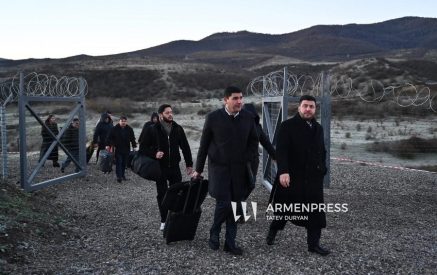








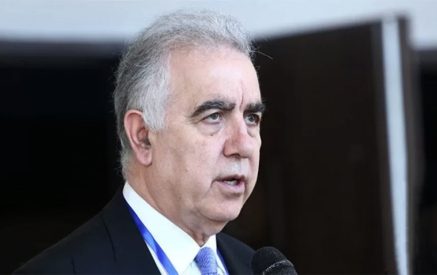
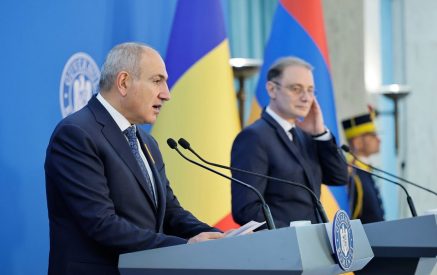









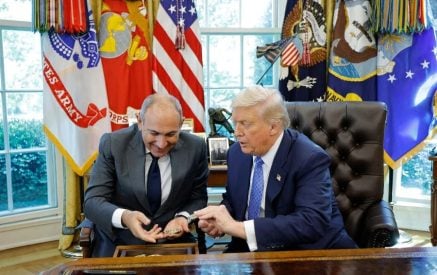



“So where were they born, then?” says the man addressing Artsakh Armenians protesting against the inclusion of Azerbaijan as their place of birth in their Armenian passports. This is the same man who, just seven or eight years ago, came to power in Nikol Pashinyan’s wake and posed in Aghdam with current Defence Minister Suren Papikyan, a pomegranate in his palm, captioning the photograph: “Aghdam is my homeland.” The two were mocking Armenia’s third president, Serzh Sargsyan, over his well-known 2005 statement.
Now, stepping out of the government building, Alen Simonyan, who holds the post of Secretary of the Security Council, is mocking our compatriots from Artsakh. This is truly a bitter and deeply painful irony of fate, directed at society and Armenian statehood as a whole. And the issue is by no means that Simonyan himself, or his political leader and the others in their camp, should have taken up arms and gone to liberate everything we lost during their own political rule. What happened and the losses we suffered are, of course, a separate matter, one that warrants serious discussion and perhaps even an investigation.
But when a man who once smiled for the camera and captioned his photograph “Aghdam is my homeland” now laughs at the protests of Artsakh Armenians who have lost their homeland and do not want Azerbaijan listed in their Armenian passports, this is no longer a question of political pragmatism. It is a question of basic human morality. Those who, in full view of the world, now insist—with the same, if not even more brazen, self-assurance—on the exact opposite of what they were saying and on the basis of which they came to power less than a decade ago are not merely politically bankrupt; they are morally bankrupt as well. And this is where we must acknowledge something extremely dangerous that has happened to Armenia: the country’s state policy has become detached from human morality.
There is a widespread stereotype that politics and morality are incompatible. Politics and morality are not one and the same, but they cannot be entirely devoid of common ground. Politics is strong when it is underpinned by morality. In every state, that morality is, of course, different and may even be unacceptable to another state. But a state’s policy must have its own human morality. Armenia’s policy is imbued with Azerbaijan’s morality.
Read also
Hakob BADALYAN