






















ANC-I welcomes the ICJ’s first-ever ruling holding a State responsible as a perpetrator of genocide
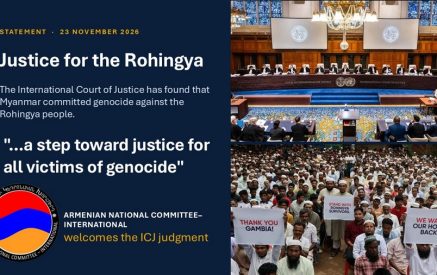
Yerevan, 23 November 2026 — The Armenian National Committee–International (ANC–I) has issued a statement welcoming the 19 November 2026 judgment of the International Court of Justice (ICJ) finding that Myanmar committed genocide against the Rohingya people in northern Rakhine State during the 2017 “clearance operations.”
The ANC-I calls the ruling a historic milestone: the first to hold a State responsible as a perpetrator of genocide. It highlights that the Court went beyond accountability, ordering Myanmar to provide restitution, including the safe, voluntary, and dignified return of displaced Rohingya and the reunification of families, as well as compensation. In the statement’s words, the Court has affirmed that “justice for the victims means not only accountability but also return and reparation.”
The statement recalls that the Armenian Genocide of 1915–1923, which claimed 1.5 million lives, has never been addressed by an international court and remains denied by Turkey. It also cites the 2023 forced displacement of the entire Armenian population of Nagorno-Karabakh (Artsakh), 120,000 people, an act characterized as genocidal by the International Association of Genocide Scholars and the Lemkin Institute. That same month, the UN Special Adviser on the Prevention of Genocide placed the plight of Nagorno-Karabakh’s Armenians alongside that of the Rohingya.
Read also
Expressing solidarity with the Rohingya people, the ANC-I calls the ruling the most consequential development in the fight against genocide this century, and urges a broad global effort “for truth against denial, for memory against forgetting, for reparations against impunity, and for life against death.”
The full statement in English is below and here
ANC–International: Justice for the Rohingya Is a Step Toward Justice for All Victims of Genocide
The Armenian National Committee–International (ANC–I) welcomes and supports the 19 November 2026, ruling of the International Court of Justice (ICJ) finding that Myanmar committed genocide against the Rohingya people in northern Rakhine State during the 2017 “clearance operations.”
The ruling is the first to hold a State responsible as a perpetrator of the crime of genocide and thus sets a fundamental precedent. It constitutes a historic milestone that deserves the full support of the international community.
The Rohingya people suffered severe atrocities, ranging from discrimination and persecution to killings, destruction, looting, rape, and forced displacement with genocidal intent. The ICJ’s ruling therefore represents a landmark against impunity and restores the meaning, value, and scope of international law, international humanitarian law, and the commitment to human rights. Beyond ordering Myanmar to prosecute those responsible and guarantee non-repetition, the Court ordered restitution, including the safe, voluntary, and dignified return of the displaced Rohingya to their places of residence and the reunification of families, as well as compensation for the damage caused. The Court has thus affirmed that justice for the victims means not only accountability but also return and reparation. The ruling also stands as an expression of resolve against efforts, driven by power interests, to undermine international law and the multilateral bodies that address genocide, war crimes, and other atrocity crimes.
The Armenian people suffered one of the first genocides of the twentieth century, between 1915 and 1923, before the crime had been defined in law—a case that led jurist Raphael Lemkin to cite the destruction of the Armenians as a historical example when he coined the term.
The Armenian Genocide, committed by Ottoman Turkey, claimed the lives of 1.5 million Armenians, forcibly deported and dispersed hundreds of thousands more, and dispossessed the Armenian people of a large part of their ancestral homeland.
Turkey continues to deny the Armenian Genocide, even though it is not only the continuing state of the Ottoman Empire, which planned and carried out the main phase of the crime, but also itself continued that crime during its formative years. After World War I, the 1919–1920 Istanbul Special Military Tribunals prosecuted senior leaders of the Committee of Union and Progress (CUP), the ruling party of the Ottoman Empire during the Genocide, for orchestrating the mass deportation and annihilation of the Empire’s Armenian population, but their verdicts were largely overturned with the rise of the Turkish nationalist movement, which led to the establishment of the Republic of Turkey.
Despite numerous recognitions—including those enshrined in law—achieved first through the global mobilization of the Diaspora beginning with the fiftieth anniversary of the Genocide in 1965, and later also pursued by the Republic of Armenia, no international court has yet addressed the issue in its proper legal dimension so as to restore historical truth, deliver justice, and strengthen the international commitment to genocide prevention. While temporal limits and the non-retroactivity of Article IX jurisdiction under the 1948 Genocide Convention are routinely invoked to foreclose ICJ adjudication of pre-Convention atrocities, that jurisdictional bar does not erase historical or moral accountability—especially given that as early as May 1915, the Allied Powers denounced the massacres of Armenians as “crimes against humanity and civilization” and warned that those responsible would be held personally accountable. Where treaty courts face temporal limits, meaningful redress still requires sustained diplomatic, judicial, and restitutionary measures—alongside guarantees of non-repetition and full historical truth.
Furthermore, Azerbaijan, which had launched the 44-Day War (27 September – 9 November 2020) against Nagorno-Karabakh—the mountainous region of the historic Armenian territory of Artsakh—amid a global pandemic and with the explicit participation of Turkey, completed that war’s objectives with a final offensive on 19 September 2023. The offensive forced the displacement of the region’s entire Armenian population of 120,000 people from their indigenous homeland, an act characterized as genocidal in nature by the International Association of Genocide Scholars (IAGS), the Lemkin Institute for Genocide Prevention, and several international legal scholars. Notably, on 22 September 2023—marking the 75th anniversary of the Convention on the Prevention and Punishment of the Crime of Genocide—then-UN Special Adviser on the Prevention of Genocide Alice Wairimu Nderitu warned of the danger posed by six ongoing situations of genocide risk, explicitly placing the plight of the Armenians in Nagorno-Karabakh alongside that of the Rohingya in Myanmar.
Having twice been victims of the crime of genocide, Armenians in Armenia and the Diaspora have a particular stake in welcoming such affirmations of international law.
The Armenian National Committee–International expresses its solidarity with the Rohingya people and welcomes the ruling of the International Court of Justice, which brings them closer to justice. We are witnessing the most consequential development in the fight against genocide in the twenty-first century, one that encourages vulnerable peoples to build broad global cooperation against perpetrators and to fight for truth against denial, for memory against forgetting, for reparations against impunity, and for life against death.
Armenian National Committee–International