





































Why the future of Armenia and the continuity of the Armenian nation require different—but complementary—commitments
Every generation inherits something from those who came before it. But it also inherits a responsibility: to decide what must be carried forward and what must be built for those who follow.
For Armenians today, that responsibility has two closely connected dimensions.
The Republic of Armenia, as a sovereign state, must secure its independence, strengthen its institutions, develop its economy, and establish sustainable relationships with the countries around it. These are essential requirements of statehood. At the same time, the Armenian nation extends far beyond the borders of the Republic. Its continuity depends on whether Armenians throughout the world can maintain a meaningful connection to their shared history, culture, and identity as generations change.
Read also



These two responsibilities lead to a fundamental idea:
The Armenian state must prepare to survive and prosper in the future. The Armenian nation must prepare to remain a nation in the future.
Neither objective should be taken for granted.
Two responsibilities, one Armenian future
Armenia must make decisions according to the realities of being an independent state. Its security, economic development, and international relationships require pragmatism and a clear understanding of regional and global developments. These responsibilities are legitimate and indispensable.
But the continuity of a nation involves more than the existence of a state.
Armenians live throughout the world, in societies where they have built successful lives, raised families, and contributed to their countries of residence. They speak different languages and experience their Armenian identity in different ways. Yet they remain connected to a shared historical and cultural inheritance.
Our forefathers, particularly those who rebuilt Armenian community life after the Genocide, worked extraordinarily hard to pass that inheritance to us. They established schools, churches, cultural organizations, publications, and community institutions. They did so while rebuilding their lives in unfamiliar countries and confronting the pressures of integration and assimilation.
We are the beneficiaries of their determination.
But we should not assume that what they managed to preserve will automatically continue. Integration into the societies where Armenians live is natural and desirable. It brings opportunity and participation in the wider world. The challenge is to ensure that integration does not gradually weaken the historical understanding and cultural connections that give Armenian identity its meaning.
Nor should we assume that the existence of an independent Armenia alone guarantees the continuity of Armenian identity throughout the world. A sovereign state is an essential anchor for the Armenian people, but the intellectual and cultural life of a worldwide nation also requires institutions and commitments that extend beyond state borders.
The future of Armenia and the future of the Armenian nation are therefore not competing causes. They are complementary responsibilities.
Why knowledge matters
We live in a period of extraordinary technological change. Information is increasingly accessible, artificial intelligence is transforming how people learn and communicate, and younger generations are growing up in a world very different from that of their parents and grandparents.
Yet access to information is not the same as knowledge.
Knowledge requires research, evidence, context, and critical thinking. It requires the ability to distinguish reliable understanding from misinformation and simplistic interpretations. A society needs these qualities to make sound decisions. A nation needs them to understand its own experience and transmit that understanding to future generations.
Young Armenians should not be expected simply to inherit an identity without understanding it. They deserve the opportunity to explore its origins, historical transformations, achievements, challenges, and relationship to the wider world.
This requires serious scholarship and independent institutions capable of examining evidence, asking difficult questions, and encouraging informed discussion.
Zoryan Institute: an intellectual resource for the Armenian people
For more than four decades, Zoryan Institute has devoted itself to research, documentation, scholarship, and education concerning Armenian history and contemporary experience, diaspora-homeland relations, and human rights.
Zoryan has studied the Armenian case in a comparative and global context, drawing parallels with the experiences of other peoples to show its universal character.One particularly significant achievement was the establishment in 1991 of Diaspora: A Journal of Transnational Studies. Founded by Zoryan, the journal has helped shape the international field of diaspora studies. Its research examines how communities dispersed across countries maintain relationships, negotiate identity, adapt to new circumstances, and sustain a sense of collective belonging.
This is not simply an academic subject of interest to Armenians. It is a question of growing importance throughout the world.
Zoryan’s work also includes publications, oral history and documentation initiatives, educational programs, scholarly conferences, and international academic relationships. Its presence in Armenia and its collaboration with Armenian academic institutions reflect its commitment to connecting scholarship in the homeland with the worldwide Armenian community.
Zoryan does not exist to prescribe political policy or promote a particular political position. Its value lies in its commitment to independent scholarship. It provides a place where Armenian history and contemporary experience can be examined critically and within a wider international context.
This independence is important. Governments must respond to immediate political and economic realities. Scholarly institutions must also be able to examine longer historical processes, preserve knowledge, and ask questions that may extend beyond today’s political priorities.
Armenia needs strong universities, innovative educational institutions, and young people equipped with the skills to succeed. Institutions such as the American University of Armenia and TUMO make important contributions to that future. Zoryan serves a complementary purpose: it helps develop the historical knowledge and intellectual understanding through which Armenians can comprehend their collective experience and their place in the world.
What will we leave to the next generation?
This is not an argument for preserving Armenian identity unchanged. Every generation must interpret its inheritance in the circumstances of its own time. Armenian identity, like every living culture, will continue to evolve.
The question is whether future generations will have the knowledge, institutions, and intellectual resources to make that evolution meaningful.
Previous generations accepted responsibility for passing their heritage to us. They built institutions, maintained communities, educated their children, and created opportunities for Armenian life to continue.
We now face our own responsibility.
We must support the development of Armenia as a secure and prosperous sovereign state. At the same time, we must recognize that the continuity of the Armenian nation across the world requires sustained investment in research, education, scholarship, and institutions capable of serving generations to come.
A permanent endowment for Zoryan Institute would give this work a more secure and lasting foundation, enabling the Institute to sustain its mission and serve future generations of scholars, students, and Armenians everywhere.
This is more than an investment in an organization. It is an investment in the intellectual capacity and continuity of the Armenian people.
Our forefathers worked hard to ensure that we would inherit an Armenian identity and heritage. The question before us is whether we will accept the responsibility of passing that inheritance forward—not merely as memories, but as knowledge, understanding, and a living tradition.
The Armenian state must prepare to prosper. The Armenian nation must prepare to continue. Our responsibility is to help make both possible.
The Armenian state must prepare to survive and prosper in the future. The Armenian nation must prepare to remain a nation in the future.
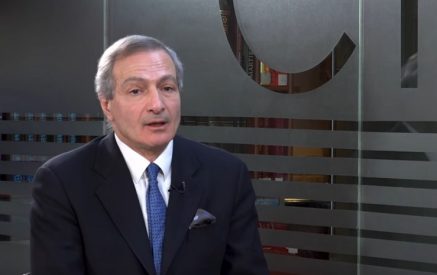
Greg M. Sarkissian
Zoryan Institute is committed to serving both dimensions of the Armenian future through scholarship, knowledge, and independent intellectual inquiry.