









































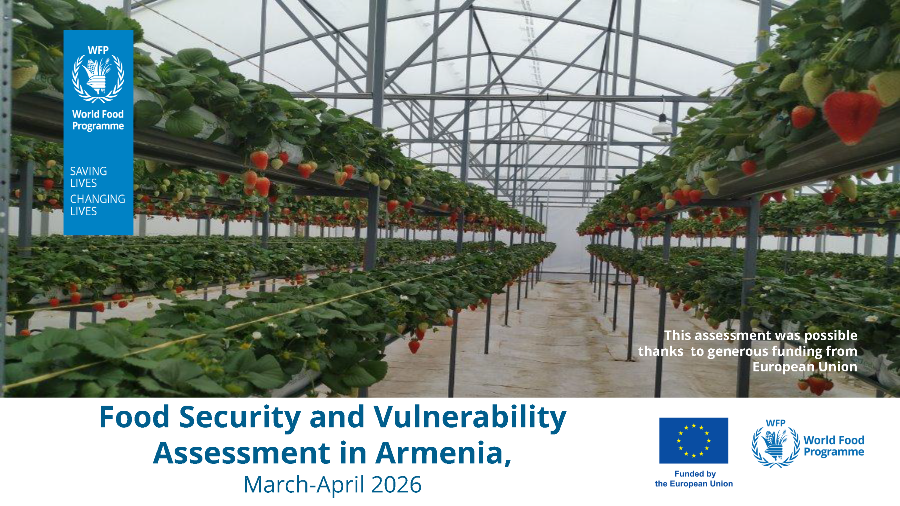
Household food security across Armenia is on an upward trajectory, according to the latest 2026 Food Security and Vulnerability Assessment (FSVA) report released today by the United Nations World Food Programme (WFP). The nationwide study reveals encouraging improvements while identifying critical areas where targeted efforts can help consolidate progress.
The FSVA was conducted among 4,210 households in Yerevan and all the regions of Armenia, to comprehensively analyze the food security situation among local population and displaced Armenians from Karabakh, its drivers and tendencies, as well as to identify food insecure populations and their profiles.
Key findings demonstrate positive economic and social shifts since the previous 2024 assessment. Food-secure households rose sharply from 26% to 33%, while the number of food-insecure households dropped from 20% down to 18%. Marginally food secure households also recorded an improvement as more families achieved long-term stability. Additionally, food insecurity among female-headed households fell from 23% to 21%, signaling vital headway for vulnerable demographics and underscoring the measurable impact of ongoing efforts to stabilize and reduce food insecurity. “These findings show that Armenia is moving in a positive direction, with stronger household food security and encouraging signs of recovery,” said Leila Meliouh, WFP Representative and Country Director in Armenia. “At the same time, the FSVA provides important evidence to help partners focus work where it can have the greatest impact – especially for households that are still building resilience to economic pressures and future shocks.”
Despite overall progress, approximately 550,000 people in Armenia remain food insecure, and the marginally food secure population remains at risk of becoming food insecure in the event of shocks.
Read also

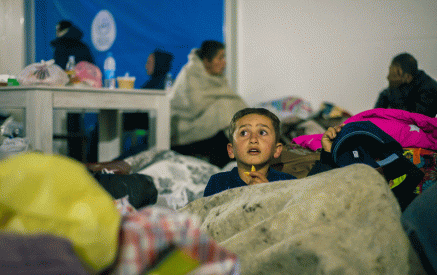
The 2026 FSVA shows a powerful trend toward long-term socio-economic integration among displaced populations. 83% of displaced respondents plan to remain in Armenia, a steep climb from 63% in 2024. In the meantime, 76% of displaced households now have at least one employed member, up from 47.6% two years ago.
These figures underscore a promising transition toward self-reliance; while signaling that continued social protection and economic support is essential to secure permanent household stability. Continuous, gender-sensitive monitoring remains a top priority to map how female-led households access steady income, social safety nets, and food.
Since 2020, WFP’s assessments have served as the data foundation for the Government of Armenia, international donors, and development partners. In a major step towards capacity transfer and national ownership, WFP is actively deepening its alliance with the Statistical Committee of Armenia to fully transfer FSVA tools, methodologies, and technical expertise to national institutions by 2028.
The United Nations World Food Programme has been present in Armenia since 1993. Today, it focuses on strengthening national food security, building resilience against emergencies, and supporting the government in achieving Zero Hunger by 2030. Globally, the World Food Programme is the leading humanitarian organization implementing and supporting school meal programs. These initiatives are now recognized as one of the world’s most effective social safety nets, providing a critical lifeline for millions of children. As of 2024, approximately 466 million children worldwide receive school meals, an increase of 80 million since 2020. In 2024, WFP directly provided meals, take-home rations, or cash transfers to 20 million schoolchildren across 61 countries. WFP supports governments in 74 countries to reach an additional 139 million children through national programs.
Press Release