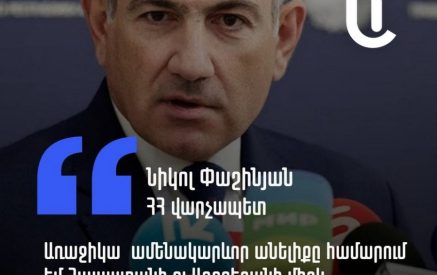















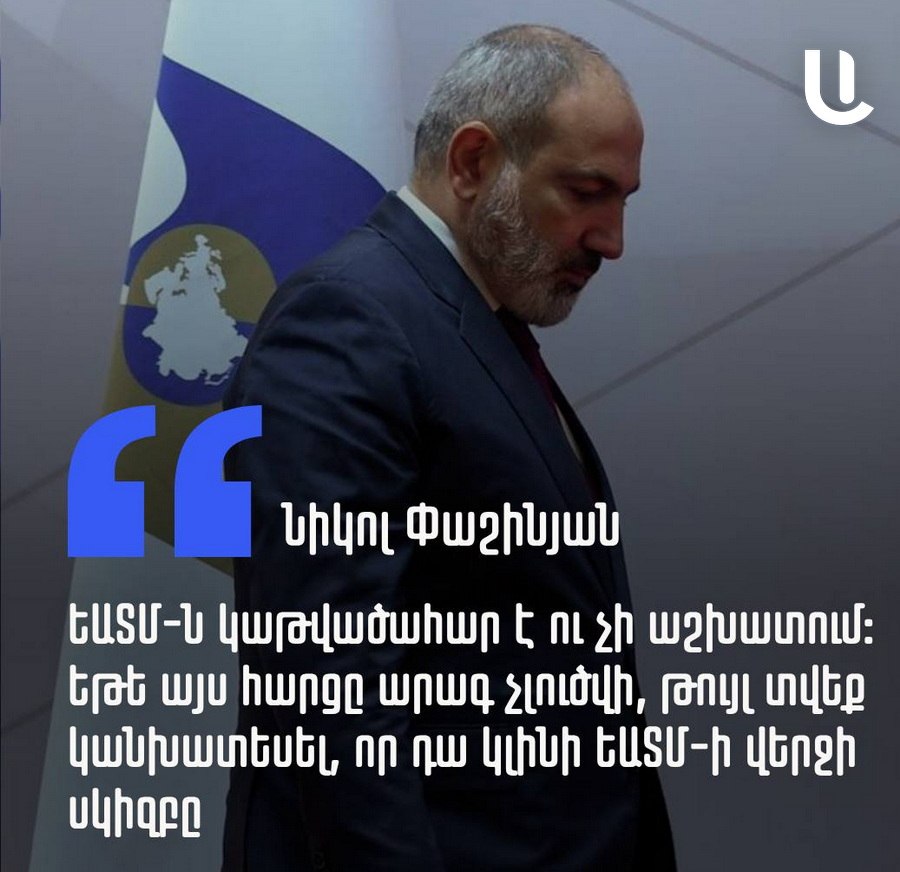
For the past two days, Nikol Pashinyan has been saying that the Eurasian Economic Union (EAEU) has de facto fallen apart and is no longer functioning. He has also stated that if the issue of exporting Armenian agricultural products is not resolved, it will mark the beginning of the end of the EAEU. Yet when asked whether Armenia will leave the EAEU, Pashinyan says that he has no such plan.
So how can this be the “beginning of the end” if Armenia has no plan to withdraw? After all, if Armenia’s issue is not resolved, it is hardly Kazakhstan or Kyrgyzstan that will be the ones to leave and set that beginning of the end in motion. On the other hand, it has long seemed clear that subjecting Nikol Pashinyan’s public statements to serious scrutiny is a thankless task. Nevertheless, declarations that the EAEU has met such a fate—that it has effectively fallen apart—are too serious to have been made merely to occupy the public’s attention.
This is precisely what makes it noteworthy that Armenia’s prime minister voiced these categorical assessments after a telephone conversation with Putin. For example, Pashinyan was not nearly as categorical during or after his meeting with Mikhail Mishustin in Yekaterinburg on July 6. If he had placed his hopes in Putin, only to be disappointed by Putin as well, logic would suggest that Pashinyan would at least have hinted at an intention to leave the EAEU—if only as a sign of desperation. But there was no such hint, which may mean that his conversation with Putin had a different nature and followed a different logic.
More broadly, Armenia’s issue appears to have a considerably deeper subtext than is apparent on the surface. At the very least, we should not forget that it was Putin himself who brought the issue to the EAEU table, and he is unlikely to have done so merely to make his words to Pashinyan more forceful. This may mean that, for the Russian president, Armenia’s issue is an opportunity to “advance” more fundamental matters within the EAEU—a possibility that may also be reflected in Nikol Pashinyan’s categorical assessments.
Read also
Against this backdrop, whether or not the EAEU has de facto fallen apart is one question. But the far greater problem today is that Armenia’s economy is itself being de facto dismantled, sacrificed on the altar of broad political agendas.
Hakob BADALYAN