























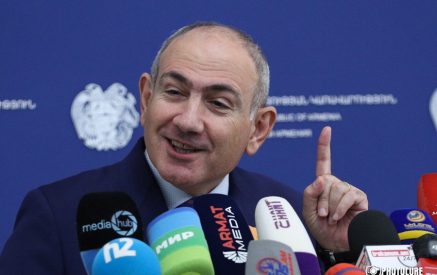





Russia says that if Yerevan raises the issue of revising the railway management rights through arbitration, Moscow will seek compensation for its investments. This is how Moscow has responded to the Armenian prime minister’s latest statement. Last week, Nikol Pashinyan said that revising Russia’s trust management rights over Armenia’s railway remains on Armenia’s agenda. He added that Armenia wants to resolve the issue amicably but is also prepared to take it to arbitration.
This issue has already been on the agenda, or at least Yerevan has been raising it publicly, for nearly eight months. In February, Nikol Pashinyan stated that there are countries that “are dissatisfied that Armenia’s railway is managed by the Russians, and therefore do not want eastbound freight transit to pass through Armenia.” However, to this day, Pashinyan has not specified which countries he was referring to. Moreover, for Pashinyan, who presents himself as a “staunch defender of sovereignty,” the demand to replace the trust manager apparently does not diminish that image in any way.
If the Russian side is indeed obstructing the development of Armenia’s railway system, then Armenia unquestionably has the legitimate right to raise the issue and even seek a revision of the management arrangement. Yet Pashinyan has presented no clear or concrete facts or arguments beyond the alleged “dissatisfaction of certain countries.” This creates the impression that the underlying issue is not Armenia’s interests, but rather that Armenia has simply become a testing ground for servicing various external “dissatisfactions.” At present, this “testing ground” is political and diplomatic in nature, but if this logic continues, it could take on a different character.
Official Yerevan, it appears, has neither the desire nor the competence to change this alignment of circumstances and the logic behind it. The situation should instead be changed by society and by those political forces that are genuinely interested in returning Armenia to the path of sovereign agency. At the very least, this requires asking the government very specific questions: Who exactly is dissatisfied with Russian management of the railway? In what way is Russia obstructing any Armenian initiative or project? Armenian society must clearly understand the price of this issue so that it does not end up paying the price for solving problems that concern others.
Read also
Hakob BADALYAN