












The current government’s failure in foreign policy was laid bare by its inability to secure a peaceful settlement of the Nagorno-Karabakh conflict and prevent its transition to a military phase. Although the military balance had already been shifting in Azerbaijan’s favour by the time of the change of power, negotiations under the international mediation of the OSCE Minsk Group were still underway, and the mechanisms restraining a full-scale war, however imperfectly, remained in operation. Having seized power in 2018, the government of the Civil Contract party (CCP) neither possessed a consistent negotiating position from the outset nor subsequently managed to develop one, preserve the existing mechanisms, or align its public rhetoric with the actual balance of power. Azerbaijan exploited the contradictions between the political statements of Armenia’s chief negotiator, the country’s diplomatic capabilities, and the condition of its security system; with Turkey’s support and participation, it unleashed a war and emerged victorious.
Following the military and then diplomatic defeat, the government embarked on a radical revision of the official interpretation of the Nagorno-Karabakh conflict. Instead of conducting a sober assessment of its own policy, it placed the entire blame on Armenia’s former leaders. Moreover, in the interpretation advanced by the ruling regime, Azerbaijan’s responsibility for choosing a military solution to the conflict and for the subsequent mass expulsion of Artsakh’s indigenous Armenian population was pushed into the background. Part of the responsibility for the national catastrophe was also assigned to Russia and the CSTO, which, according to Armenia’s leadership, failed to ensure the country’s security and did not fulfil their allied obligations.
What followed was not the ordinary deterioration in bilateral ties familiar in international relations, but a revision of the very model of Armenian-Russian alliance. The dismantling of the allied framework in the security sphere soon extended to economic relations as well.
It is no coincidence that immediately after the latest parliamentary elections, Pashinyan twice attempted to return Armenian-Russian economic relations to their customary course: first, during his meeting with Mikhail Mishustin in Yekaterinburg on 6 July, and then during his telephone conversation with Vladimir Putin on 27 July. Yet both initiatives were doomed to failure from the outset, because the head of the Armenian government continued to present Russia’s trade restrictions as an exclusively economic-policy issue involving compliance with EAEU rules. The Kremlin, meanwhile, had repeatedly stated that Russia did not intend to consider economic relations in isolation from Yerevan’s foreign-policy strategy and linked the future terms of cooperation to Armenia’s choice between the EAEU and the EU.
Read also
Under the circumstances, Armenia has three principal strategic options.
- Abandoning the course towards European integration
Under the threat of intensified economic pressure, and in an effort to avoid its consequences, the Armenian government abandons its course towards EU membership.
- An unmanaged rupture
Despite the absence of alternative markets, energy sources, and financial compensation mechanisms, Armenia continues its course of distancing itself from Russia and the EAEU. Such a scenario would entail a sharp decline in exports, higher prices for energy and consumer goods, job losses, a reduction in remittances and household incomes, and increased pressure on the state budget and the national currency. Taken together, these consequences would most likely trigger a full-scale socioeconomic crisis, accompanied by domestic political destabilisation and a further erosion of the incumbent government’s legitimacy.
- A managed transition from Eurasian to European integration
Armenia seeks, to the greatest extent possible, to preserve political dialogue and economic cooperation with Russia in those areas where this remains feasible, while continuing to build viable alternatives. Implementing such a course would require the development and agreement of a comprehensive transition package with the EU and other Western partners. That package would need to finance the structural adaptation of the economy, compensate the principal losses incurred by the state, businesses, and households, and provide macro-financial assistance should pressure intensify on the budget, banking system, or national currency. Otherwise, partnership with the West would acquire a dangerously asymmetric character: Armenia would assume the risks of transition, while the commitments of its Western partners to facilitate the country’s exit from the Russian sphere of influence would remain limited and non-binding. At the same time, the Armenian government would need to undertake far-reaching systemic reforms that would allow external assistance to be directed towards the structural transformation of the economy rather than merely compensating current losses. This would require improving the quality of public administration, protecting property rights and competition, strengthening the judicial and legal system, developing export-oriented production, and reducing energy dependence on Russia.
The combination of guaranteed and sufficient external support with consistent domestic reforms would not make the transition painless. It could, however, keep the process relatively manageable, spread its costs over time, and reduce the risk that foreign-policy reorientation might develop into a large-scale socioeconomic and political crisis.
Each of the scenarios outlined above carries its own price, while the feasibility of each depends on the presence of the necessary internal and external conditions. Abandoning a course towards European integration that has already been institutionally formalised would restrict Armenia’s freedom of foreign-policy choice and cause serious reputational damage both at home and abroad. An unmanaged rupture with Russia and the EAEU, by contrast, would be fraught with socioeconomic shock and domestic upheaval.
A managed path towards eurointegration will require the creation of viable economic, energy, and institutional alternatives. Its implementation will be possible only through a combination of substantial and long-term commitments from Western partners; the readiness of Russia and other EAEU member states to honour their treaty obligations throughout an agreed transition period; the fullest possible intellectual, organisational, and political mobilisation of the Armenian state; and a high degree of social cohesion around clearly defined transition objectives.
The results of the latest elections and the domestic political developments that followed provide no basis for expecting the level of state capacity, political maturity among the country’s actors, and social cohesion required to manage a transition from Eurasian to European integration. Present international conditions also raise justified doubts as to whether our Western partners are prepared to undertake the long-term and resource-intensive commitments necessary to compensate the principal costs of such a transition. Under the circumstances, no shock-free solution exists. The policy of the Armenian government has confronted the country not with a choice between favourable and unfavourable options, but between scenarios, each of which entails substantial economic, social, political, and strategic costs.
The author of these lines and other experts have repeatedly emphasised that Armenia’s so-called European integration process was proclaimed long before the material, political, and intellectual preconditions for such a transformation had been established. The limitations on the possibility of a sharp foreign-policy turn were recognised in 2013 by Armenia’s third president, Serzh Sargsyan, who – whether under compulsion or based on his own convictions – unexpectedly abandoned the signing of the Association Agreement and the Deep and Comprehensive Free Trade Area agreement with the EU in favour of Eurasian integration. That decision undermined confidence in the government both domestically and abroad and became one of the factors eroding its public legitimacy, a process that fully manifested itself in the spring of 2018.
Following Armenia’s defeat in the 2020 war and the subsequent surrender of Artsakh, the Civil Contract party set about revising the country’s strategic orientation without possessing a transition plan developed and agreed with the EU, guaranteed mechanisms for compensating potential losses, or viable alternatives for reducing critical dependence on Russia. The culmination of the political majority’s adventurism came on 26 March 2025, when the National Assembly adopted an entirely declaratory law on launching the process of Armenia’s accession to the EU. Although the bill had been submitted as a citizens’ initiative, the government unanimously endorsed it, and its passage was secured by the votes of the Civil Contract parliamentary faction. A decision of strategic significance was thus institutionalised without the development of a transition plan with the EU, an assessment of its socioeconomic consequences, or the creation of mechanisms to compensate potential losses.
The systemic flaw in the foreign policy of the Civil Contract government, now in office for more than eight years, is the absence of a strategy. Its declared objectives are not aligned with the country’s resources and potential; decisions are taken without the necessary sequencing or a proper assessment of alternative scenarios and their associated costs; and crisis-management mechanisms begin to be developed only after the scope for political manoeuvre has already been dangerously compressed.
Alongside its inability to prevent the loss of Artsakh, the premature initiation of a course towards EU membership risks becoming the Civil Contract government’s second historic mistake. Both cases demonstrate the substitution of the country’s foreign-policy strategy with a quasi-ideology and politically conditioned goal-setting. The opportunistic ideologisation of foreign policy makes it possible to use every crisis and challenge as a pretext for yet another strategic turn. The policy now being pursued does not contribute to the consistent strengthening of the state’s diplomatic, economic, and military-political positions. Instead, it compels the state to expend its scarce resources on crisis management of the unforeseen consequences of strategically undefended decisions. This, to a significant extent, has defined the substance of the Armenian government’s foreign policy over the past eight years.
Armen Martirosyan
Member of the Supreme Council and National Assembly of the Republic of Armenia (1990-1999)
Ambassador Extraordinary and Plenipotentiary of the Republic of Armenia
“Aravot” daily
01.08.2026
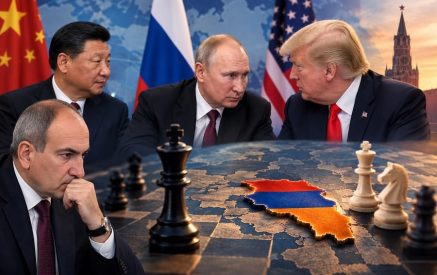
This illustration was created using artificial intelligence technology.