
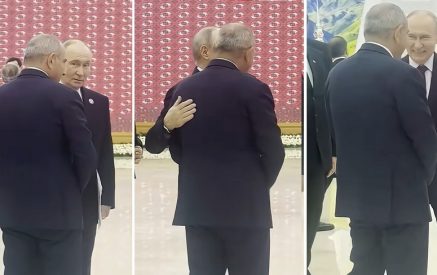


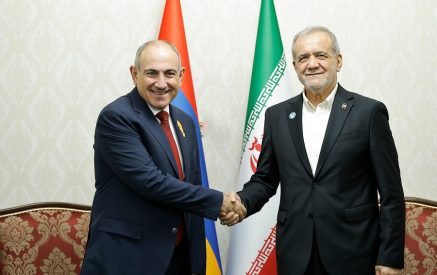


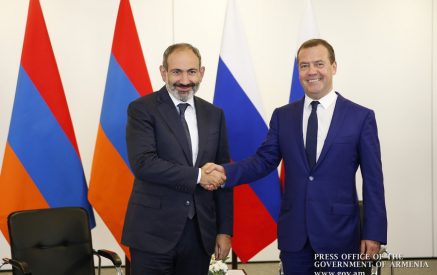










Nikol Pashinyan has traveled to Kyrgyzstan, where the meeting of the Eurasian Economic Union (EAEU) prime ministers is taking place. This is the very same EAEU that Pashinyan described just days ago as a disintegrating organization, saying that if the issue of Armenian exports was not resolved, it would mark the beginning of the end for the EAEU.
Has Pashinyan gone there to bring about the beginning of the EAEU’s end, or to secure solutions for Armenian producers? At any rate, judging by the statement made by Russian Deputy Prime Minister Alexey Overchuk ahead of the meeting, Moscow does not appear inclined to offer solutions, at least for now. Overchuk said that trade turnover between Armenia and Russia is declining “dramatically.” He recalled that in 2024 it had reached a record $12 billion, but has now fallen by more than 20 percent, and, according to him, the decline will continue. This suggests that Moscow does not seem particularly eager to find solutions to the current situation.
Moreover, it should not be ruled out that for Moscow this is not merely a matter of what Armenia’s economy is losing. It may even serve as a tool for addressing other, more important issues. By escalating problems involving Armenia—or, as the Russian saying goes, “beating one’s own to frighten outsiders”—Moscow may be trying to intimidate others. In this case, those “outsiders” are more likely the Central Asian countries, where Russia arguably faces much deeper challenges than it does in Armenia, despite its efforts to remain silent about them.
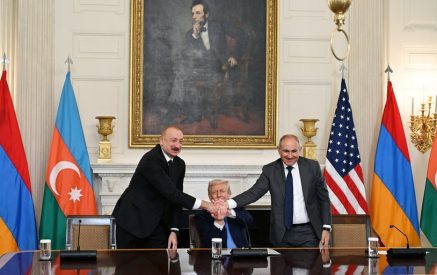
In this regard, it is noteworthy that just a few days before the EAEU prime ministers’ meeting in Kyrgyzstan, the Central Asian “Six” had gathered, including Azerbaijan, which has been a full participant in that format since November 2025, apparently under Washington’s patronage. This circumstance also appears to be closely linked to the Trump Route. From this perspective, it is worth noting that immediately after the meeting of the Central Asian “Six,” Kazakhstan’s President Tokayev called Nikol Pashinyan, and the following day in Yerevan, Pashinyan received the senior adviser to U.S. Special Envoy for Peace Affairs Steve Witkoff, who discussed the Trump Route with him.
Read also
In this larger turn of events, Armenia’s goods and its economy as a whole have perhaps found themselves in the role of small change that official Yerevan has placed on the “gaming table.” And the impression is that the end of a viable and healthy Armenian economy is much closer than the beginning of the end of the EAEU.
Hakob BADALYAN