





























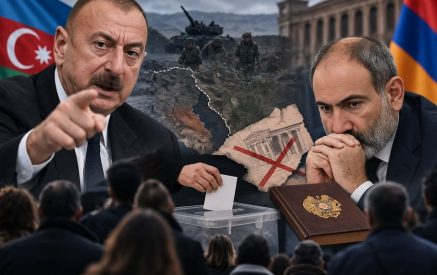


A few days ago, on Public Television, one of the ruling-party MPs participating in a discussion openly voiced a “suspicion” or “hypothesis” that the reference to the Declaration of Independence in the text of Armenia’s Constitution was the handiwork of the KGB and the GRU.
It is interesting, then, who was behind the 2019 statement, “Artsakh is Armenia, and that’s it”? Was the text delivered by Nikol Pashinyan written by the KGB or the GRU? Or are there no “theories” concerning that episode — apart, of course, from the theory of fervent patriotism that Pashinyan himself has put into circulation as a last refuge for evading responsibility?
Many people also have an equally compelling theory or hypothesis that in 2018 it was Turkey and Azerbaijan that brought Nikol Pashinyan and his so-called team to power in Armenia. But neither one theory nor the other can simply be proved beyond doubt. Therefore, it is far more productive to examine the steps that were taken on the basis of logic, facts, and their legal and political rationale.
From that perspective, the fact is that until Nikol Pashinyan’s capitulation following the defeat, Azerbaijan had not, in any international process or forum, pointed to Armenia’s Constitution or treated its reference to the Declaration of Independence as a claim against Azerbaijan’s territorial integrity. Moreover, Azerbaijan did not utter a word even when Armenian presidents visited the security zone around the former Nagorno-Karabakh Autonomous Oblast that was under the control of Armenian forces.
Read also
This was because Azerbaijan itself was involved in the negotiating peace process concerning those territories. It was itself discussing the terms for their return with the mediators and the Armenian side, while the Armenian side never questioned Azerbaijan’s right to those territories. It simply conducted, with diplomatic skill, an international negotiation based on the principle of the right of the people of Artsakh to self-determination and security. The OSCE Minsk Group’s published negotiating framework likewise combined the principles of territorial integrity and self-determination, including the return of the surrounding territories to Azerbaijani control and a future determination of Nagorno-Karabakh’s status through a legally binding expression of will.
People were not being fed conspiracy theories or fairy tales about the GRU and KGB. Instead, diplomacy was being pursued, with state and non-governmental mechanisms involved. Was that work ideal and flawless? Of course not. But it was sufficient to ensure, for three decades, the international legitimacy of Armenian statehood and the solidity of its legal and political foundations, as well as its dignity.
When there is no basic knowledge or competence regarding that work, people’s heads get filled with the KGB, the GRU… Of course, mostly those heads in which there is enough empty space to accommodate all of it.
Hakob BADALYAN