








































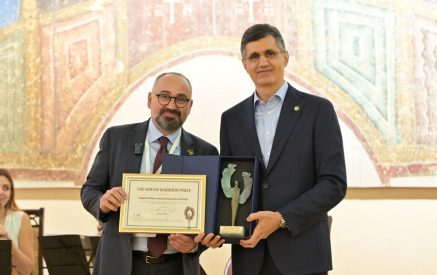




As it turns out, the process of handing the Hesse Peace Prize to Armenia’s prime minister Nikol Pashinyan on September 18, 2026, in Wiesbaden, Germany, was far from peaceful.
Leading up to the event, a number of German human rights organizations addressed a letter to the Hessian Landtag, state parliament, its spokesperson and to the Hessian Peace Prize committee, proposing that the awarding of the prize to Pashinyan be viewed as an opportunity to advocate for the return of forcibly displaced Armenians to Artsakh, the release of 19 hostages held in Baku, and for preserving Armenian historic, cultural, and spiritual values in Nagorno- Karabakh. According to the applicants’ demand, when awarding the prize, Landtag should not ignore the most heinous crimes committed against the affected population, as well as the ongoing destruction of the Armenian cultural heritage in Artsakh having a history spanning millennia.
The signatory organizations, while supporting the peace process established between Armenia and Azerbaijan, find that peace can be just and stable only on the condition that the rights of the Armenian population forcibly displaced from Nagorno-Karabakh are respected according to the internationally established human rights norms, in the spirit of the commitments arising from the UN Genocide Convention: “There cannot be lasting peace while the consequences of the displacement, the rights of those affected and the fate of Armenians held in captivity remain neglected,” – a local group of human rights defenders warned.
The authors of the letter did not spare even the prize recipient, probably making it clear that “he’s not a saint himself.” This time they address the issue from a domestic Armenian perspective, focusing on the awarding Nikol Pashinyan, a political figure, during whose governance the Armenian Apostolic Church faces persecution from the state, and the high-ranking clergy, including the archbishops, who are subjected to fabricated criminal prosecutions and whose visits abroad are restricted. According to the German human rights defenders, the government is interfering with the internal affairs of the church, over which it has no jurisdiction, and denigrates the Catholicos of All Armenians, demanding his resignation, a right it has even less authority to exercise.
Read also
“Hayatsk Yerevanits” Journal
ACNIS reView from Yerevan #36, 2026 of the Armenian Center for National and International Studies (ACNIS).