







































The Trajectory of Joyful and Sorrowful Dates
On February 27, 28 and 29, 1988, pogroms against Armenians were carried out in the city of Sumgait at the instigation of the authorities in Baku and, at the very least, with Moscow’s tacit acquiescence. At least 32 Armenians were killed and more than 400 wounded. During the first years of independent Armenia, February 27, although not officially designated as such, was a day of mourning. Since the early 2000s, the number of people who preserved memories of that tragic event and continued to feel its pain had been steadily declining, and today the tragedy that took place in Azerbaijan is remembered mainly by some human rights advocates.
This was a case in which no special state efforts were made to ensure its “forgetting.” The national trauma was simply overcome to some extent by the victory in the 1992–94 war. That victory, however, was not properly appreciated either; driven purely by political expediency, it was presented as the “years of cold and darkness.”
There are cases when the memory of a tragedy is deliberately kept alive for specific purposes. The clearest examples are “October 27” and, especially, “March 1.” Personally, I believe that Robert Kocharyan bears a large share of the responsibility for the killing of peaceful demonstrators. As for the terrorist attack in the National Assembly, I doubt that its organizers were in Armenia.
Read also
Events that cannot be “cancelled” are reinterpreted according to the same political expediency. April 24 is a vivid example. Since Armenia’s current regime has a problem with pleasing Azerbaijan and Turkey, the genocide organized by the Young Turk government is presented as the result of a Russian provocation and the “gullibility” of Armenians. And the memory of the Genocide is reduced to nothing more than a “KGB operation.”
But this is not only about tragic days. For now, the Pashinyan regime cannot declare September 21, the national holiday, to be merely “Ter-Petrosyan’s adventure” and announce that the foundation of the “Real Armenia” was laid on November 9, 2020. Although everything is still ahead, and the attack on the Declaration of Independence is its first step.
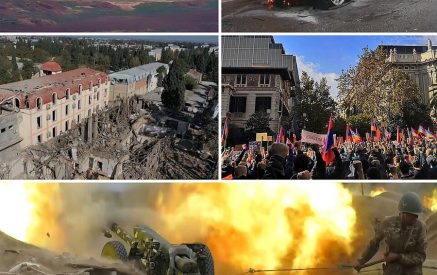
Now let us turn to several tragic days in September: September 13, when in 2022 Azerbaijan launched military operations against the sovereign territory of the Republic of Armenia, as a result of which hectares of Armenian territory remain under Azerbaijani control to this day and more than 200 people were killed; September 19, 2023, the beginning of the depopulation and ethnic cleansing of Artsakh’s Armenians, when more than 200 people were killed, in addition to the victims of the fuel depot explosion; and finally, September 27, the day when, having received the direct or tacit approval of the West and Russia, Aliyev attacked the Republic of Artsakh in 2020 and launched a bloody war, in which more than 4,000 people were killed. Today, all these dates are perceived as tragic. Will they be perceived with the same intensity 10 or 20 years from now? Not necessarily.
The pain will ease when Pashinyan, who led our state and our people into war and defeat, leaves office. That will be a step toward restoring our dignity. Today, we are in a crouched, humiliated state, and the current authorities are interested in ensuring that this state continues and deepens. Paradoxical as it may seem, this is aided by the claims of the Civil Contract leader that national humiliation and disgrace were in fact a magnificent historical event which helped us free ourselves from the rope around Armenia’s neck that was tied to the Artsakh issue.
National trauma—the psychological wound—will continue to be remembered with acute pain for as long as these cynical, sacrilegious and hateful narratives remain part of official propaganda and have not been pushed to the margins of public discourse. People will remember the beginning of the war with comparatively greater calm once the fighting that ended in 2020 is given a proper and adequate characterization: defeat. And that will happen after a change of regime.
As long as the outcome of the 44-day war is presented as a major achievement for our state and sovereignty, people’s memory will rebel against this shamelessness. The memory of human beings, not two-legged animals.
Aram ABRAHAMYAN