


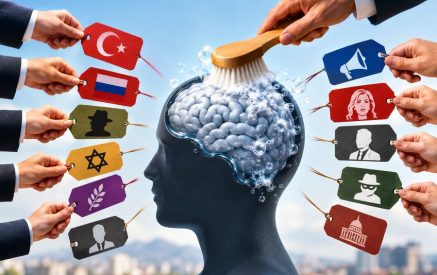







The targets of political labeling change, but the techniques used to brainwash people remain the same
When nationalist circles in Armenia and the Diaspora used the label “age-old foe” in the 1990s, referring to Turkey or the Turks, I found it deeply unacceptable, as did others who shared my views. I remain opposed to this kind of characterization. Normal relations between Armenia and Turkey—not warm or friendly ones, but normal ones—are possible, provided the neighboring country does not use Azerbaijan to force Armenia into taking steps that run counter to our national and state interests. That will happen when the person who led Armenia into war and defeat stops clinging to the power he has usurped in our country.
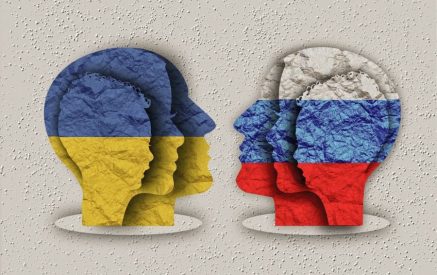
But the label “age-old enemy” has not disappeared from Armenia’s political discourse. Russia has taken the place of that enemy, and unlike in the 1990s, when the opposition circulated the notion of an “age-old foe,” the same thing is now being done by those in power, albeit sometimes in a somewhat more veiled form. In official statements, this “enemy image” is usually presented as a “hybrid threat,” while political or church figures who displease the authorities are portrayed as serving the interests of a “foreign state”—clearly, Russia—and as foreign agents. These euphemisms, however, serve as signals to Civil Contract’s pro-Western satellites, NGO activists and the “political scientists” who promote Pashinyan’s policies to the public. They identify the “enemy” in plain language.
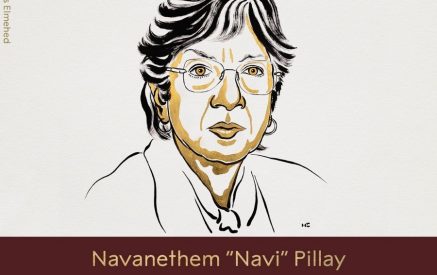
This phenomenon has long been studied in sociology and political science. In particular, in his 1977 book Political Language: Words That Succeed and Policies That Fail, American political scientist Murray Edelman shows how political language does not merely describe an already existing reality; it also shapes reality by directly influencing people’s perceptions. It assigns roles to the participants in a conflict, defining who deserves trust and who represents a mortal threat. This does not, of course, mean that political problems or events are entirely fabricated. Rather, they are assigned a “convenient” meaning, which is then presented to society. Edelman’s concept of categorization follows a simple formula: before passing judgment, you must first label.
Let me give a few examples that will be familiar to us. When Russian nationalists—and, under their influence, some Armenians as well—use words such as “Judeo-Mason” or “liberast,” they are not merely insulting Jews or liberals. They are attaching labels that lead directly to conspiracy theories. Such theories are convenient because, first, they offer simplistic explanations for complex processes and, second, they eliminate any need for argument or evidence. Labels switch off the brain.
Read also
The same thing happens “on the other side.” When US Secretary of State Marco Rubio talks about “communism” and “Marxism,” he does not mean those particular ideologies or doctrines. He is targeting his political opponents—the Democrats. Joe Biden, of course, is hardly a communist or a Marxist, but Rubio is referring to the entire “left-wing” mindset which, in his view, seeks to destroy and corrupt everything. Conspiracy once again.
The same can, of course, be said of names that acquire a stigmatizing, label-like function. From roughly the early 2000s until 2018, “Sashik” and “Lfik” in Armenia were not merely nicknames for specific individuals. They had become symbols embodying “plunder” and corruption. After the change of power, those stigmas lost their significance. But an authoritarian regime needs new labels, new conspiracies, and new internal and external enemies. Among those who have replaced these symbols are “Zakharova” and “Simonyan,” figures associated with propaganda for Putin’s regime. The names of the labels are not what matters. What matters is depriving people of their ability to think.
Want to smear any of Pashinyan’s opponents without bothering with arguments? Just link them to “Zakharova.”
Aram ABRAHAMYAN
The illustration was created using artificial intelligence technology.
Aravot Daily
13.10.2026