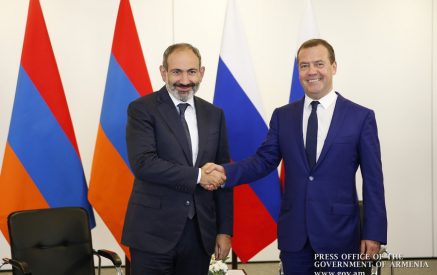







































Against the backdrop of a wave of protests unfolding in Azerbaijan, Prime Minister Nikol Pashinyan has released a video from Yerevan in which, speaking about “making history,” he declares that the focus must be on signing and ratifying the peace agreement with Azerbaijan. Moreover, he regards resolving this issue as the “cornerstone of Armenia’s continued existence.”
What does this amount to? Azerbaijan makes a change to Armenia’s Constitution and the removal of the reference to the Declaration of Independence from it a condition for signing the peace agreement. This is nothing less than a revision and annulment of the Republic of Armenia’s legal and political foundations—in effect, a reformulation from “point zero.” Azerbaijan is thus seeking to rid itself of a historical trajectory that poses considerable problems for it, because Azerbaijan, under Ilham Aliyev, negotiated with the leaders of that state for a peaceful settlement of the Artsakh issue within the framework of three principles of international law, including the right to self-determination and the non-use of force or the threat of force. In essence, Azerbaijan is not doing this to protect itself against Armenian claims—Aliyev knows better than anyone that neither the Constitution nor the Declaration contains any claims against Azerbaijan. Otherwise, Armenia could not have become a member of the UN and other international organizations on the basis of those documents, or Azerbaijan would at least have objected to that membership on one occasion. Aliyev wants to make Armenia’s legal and political history begin at “point zero.”
For any state, its founding document is a cornerstone. In the broader sense, it is a cornerstone of the logic of statehood. Nikol Pashinyan declares the “peace agreement” with another state to be the “cornerstone” for the Republic of Armenia. And this is a “peace agreement” whose text was drafted entirely by Azerbaijan, while Armenia merely agreed to it, point by point, over the course of a prolonged process. Moreover, Azerbaijan was so dominant in this process that it even rejected Yerevan’s proposal to issue a joint statement with Armenia announcing its conclusion. Armenia’s Foreign Ministry acknowledged this.
Thus, by declaring that the focus must be on signing and ratifying the peace agreement with Azerbaijan, and presenting this as the “cornerstone of Armenia’s continued existence,” Nikol Pashinyan is effectively proclaiming that the “foundation” of the Republic of Armenia’s legal and political subjecthood is not a state document of Armenia itself, but a bilateral Armenian-Azerbaijani “peace agreement” whose substance was drawn up by Azerbaijan. Consequently, if Azerbaijan’s demand for a constitutional amendment currently constitutes interference in Armenia’s internal affairs, the political and legal-political significance that Prime Minister Pashinyan attaches to the “peace agreement” will, in effect, give Azerbaijan, as one of the parties to the agreement, a “political right” to interfere in Armenia’s internal affairs on a permanent basis.
Read also
Hakob BADALYAN