

































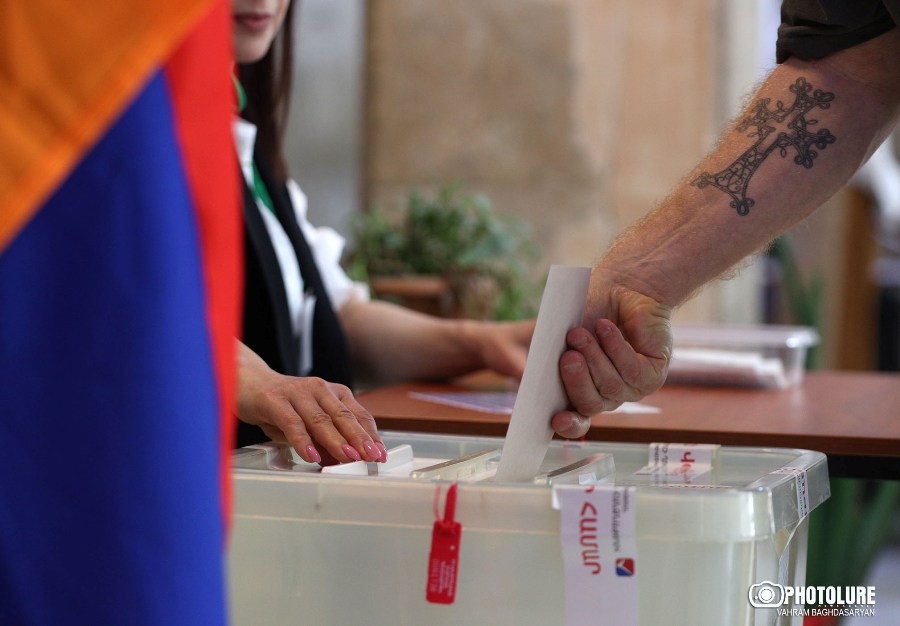
Western observers certified the vote, but allegations of intimidation, electoral manipulation, and political bias continue to cast a shadow over Armenia’s future.
visegrad24.com. Six weeks ago, I warned that Armenia’s June 7 parliamentary election was already being stolen. I take no satisfaction in having been right. I am in Yerevan now, and I have watched the theft completed up close.
A Victory Declared Before the Votes Were Counted
Start with the number the government would rather you skip. Prime Minister Nikol Pashinyan’s Civil Contract was declared the winner with 49.8 percent – short of a majority of the Armenians who actually voted, and short of the two-thirds supermajority he needs to deliver the constitutional changes Baku and Ankara demand of him. A leader whose approval is among the lowest of any sitting world leader nonetheless emerged with 64 of 107 seats. The machinery, not the electorate, produced that result.
Consider how it began. At about two o’clock on the morning after polls closed, with the Central Electoral Commission (CEC) having processed barely 10 percent of ballots, drawn mostly from the small rural precincts where his support runs highest – Pashinyan declared victory. The returns still outstanding were the ones he had most reason to fear: Yerevan, the capital, and Gyumri, the second city, which broke heavily for the opposition. The early counts pointed toward a result in which the two main opposition parties combined would outpoll him. He did not wait for them. He announced a win the data did not support and, in doing so, handed the Commission (led by a former ruling party member) its assignment, produce numbers to justify the claim. That is not winning an election; it is usurping power.
Read also
An Election That Could Never Be Lost
This was never a normal election. By Pashinyan’s own admission, the loss of Nagorno-Karabakh was “a calculated sacrifice”, and under Armenia’s constitution, deliberately surrendering sovereign territory is an act of treason. A leader who loses power here does not retire to write his memoirs; he faces a reckoning, and very possibly a court martial. For Pashinyan, June 7 was not a contest to be won but a sentence to be avoided. That is the real reason he could not allow it to be free.
Intimidation, Arrests, and Electoral Manipulation
The irregularities are real and they are documented – in the recounts now underway, in the criminal cases opened on election night, in the gaps between the tallies signed at the precincts and the figures the CEC later posted. Those numbers will be litigated for weeks. But to argue the election only on the arithmetic is to concede the smaller ground. An election is not stolen at the ballot box alone. It is stolen in the days before it by a sustained, well-documented campaign of arrests and intimidation of opposition activists.
There is more. On direct orders Pashinyan issued during the televised debate of party-list leaders the night before, a fringe party aligned with him petitioned the CEC, barely thirty-six hours before polls opened, to strip the largest opposition party, Strong Armenia, of its very right to compete. The Commission threw the case out for lack of evidence, but that a sitting prime minister would move, on live television, to delete his strongest rival from the ballot tells you the spirit in which this election was run.
What the Observers Saw and Ignored
I do not level that charge lightly. As a co-founder and president of Policy Forum Armenia, an anti-corruption think tank, I have spent a decade – between 2008 and 2018 – documenting electoral fraud in Armenia, more of it than most organizations have. I know what it looks like. What I saw and heard this week tracked the pattern I observed in the past exactly.
The OSCE’s observers’ conclusion was that conditions on the ground “cast doubt on whether political competitors were afforded genuinely equal conditions.” The same observers had already documented the “extensive use of administrative resources,” public employees pressured into attending ruling-party events, and a state broadcaster showing “clear bias in favour of the ruling party.” Despite this, they certified the elections anyway. It appears that the Western observers are not interested in a free and fair election. They are interested in an outcome, and the outcome they want is Pashinyan.
The West’s Strategic Miscalculation
I understand the logic. The aim is to pull Armenia out of Russia’s orbit, and it is one I share. But pursuing it through Pashinyan is a mistake on three counts. First, he is the wrong vehicle: his Russian entanglements are extensively documented – from meetings with the head of Russia’s foreign intelligence service years before his “Velvet Revolution,” to a campaign program vowing to permit no “problems” with Moscow while branding critics “foreign agents,” the Kremlin’s own term. You do not escape Russia by anointing a man with Russia’s fingerprints on him.
Second, the bet is reckless. The West is staking everything on the single most unpopular figure in Armenian public life – the architect of the Artsakh capitulation and of concession after concession to Baku. Tie your Caucasus strategy to a leader despised by his own people and you have built it on sand.
Third, the premise is false. The case for Pashinyan rests on the claim that the main opposition, Strong Armenia, is a Russian proxy. While Russia is interested in twisting the outcome its way, it is not Strong Armenia that it supports. The bloc has signaled a far more diversified foreign policy than Pashinyan’s and kept active contacts with constituencies in Washington, London, and Tel Aviv. Caricaturing it as Moscow’s instrument is not analysis; it is an alibi for backing the incumbent.
What the architects of this approach refuse to see is that the combined opposition is unlikely to play along under these conditions. Expect it to reject the results outright, which leads either to a second round few anticipate, or to the streets. Either path points to the same destination: Pashinyan’s days appear to be numbered. The West is investing its credibility in a leader on his way out, and it will own the wreckage when he goes.
Democracy or Convenience?
There is an old line that electorates get the leaders they deserve. The Armenian people deserve far better than this. What they have is a kakistocracy, government by the worst, that capitulated abroad and jailed its critics at home, prosecuted the country’s oldest church, called opposition voters “dogs and jackals” and a displaced Artsakh mother a “deserter,” threatened from the parliamentary podium to jail and “destroy” its rivals before and after the vote, and manufactured a parliamentary majority it could not win at the ballot box. That such a record can be laundered into Western praise is not a vindication of Armenian democracy; it is an indictment of those who claim to defend it.
The Constitutional court is likely to take up the recount in coming days/weeks. International monitors can revisit what they were so quick to certify. The only question is whether anyone in Washington or Brussels wants the truth badly enough to help people of Armenia to look for it. After all, an illegitimate Prime Minister is not a good tool to bring Armenia closer to the West.
David A. Grigorian
Research Fellow | Harvard Kennedy School