



























The essence of music lies not in the sounds themselves, but in the perception of the forces of tension and striving that operate within them and between them. Most musicians would probably agree with this idea, expressed a century ago by the German musicologist Ernst Kurth.
This is indeed the case. Yet connecting one note to another, one section to another, is possible only when the music is actually sounding: you cannot understand it by looking at the score alone. But sound itself is not enough either—the performer must feel, understand, and consciously grasp these connections, and then convey them to us.
And these connections, or, in Kurth’s terminology, these tensions and strivings (Spannung, Strebung), are not merely a handful or even dozens. When we are dealing with great works of music, they are infinite.
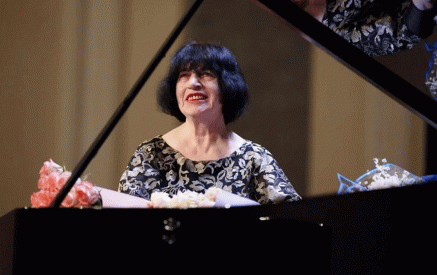
These were the thoughts that came to me after Svetlana Navasardyan’s concert yesterday at the Arno Babadjanian Concert Hall. The pianist has performed this program (Mozart, Chopin) before, but because the inner connections and “lines” hidden deep within the masterpieces of these two great composers are inexhaustible, so too are the discoveries made by our incomparable pianist.
Read also
How can one not recall the words attributed to another great pianist, Arturo Benedetti Michelangeli, who said that when he begins working on a piece he has already performed many times, he approaches it as though he were seeing it for the first time.
Take, for example, Mozart’s Twelve Variations on the French song “Ah! vous dirai-je, Maman”, with which Navasardyan concluded the first part of the concert. The simple melody that today is heard everywhere with different words takes on, in Mozart’s hands, the form of a dazzling diamond. But light can be cast upon that diamond from different angles. That is precisely what the pianist does—revealing new rays of light to us each time.
Or consider Chopin’s Waltz (Op. 34 No. 2), which begins with an “empty” fifth in the left hand, thereby signaling to the listener not to expect a conventional salon-style waltz. (Although even within that form Chopin is remarkably diverse, and his musical expression differs greatly from one work to another.)
From what perspective should this waltz be presented—as a nocturne? As an elegy? Svetlana Navasardyan rises above these genre categories and, while taking them into account, creates something new: a phenomenon without a name.
One could speak in this way about all the works performed at the concert. But, of course, it cannot truly be conveyed through words—it must be heard.
What I mean is that Svetlana Navasardyan is not merely a pianist, not even merely a musician. Through her performances, she creates a certain kind of magic that rises above “pianism”—whether that word is understood in its negative or even its positive sense.
And one more thing. The pianist’s performances are so fresh, so filled with youthful energy, that speaking about her age is simply meaningless.
Aram ABRAHAMYAN
Aravot Daily
22.07.2026