























Another serviceman’s death in the Armenian Armed Forces this week was met with little more than official—and, to a large extent, public—silence.
The Investigative Committee announced that criminal proceedings had been launched. It was later reported that two individuals had been arrested on charges of driving the serviceman to suicide. Beyond that, however, the Ministry of Defense issued no statement on yet another tragedy in the armed forces during peacetime. Nor did it offer any public expression of condolence.
The apparent reason is that such tragedies do not fit the government’s narrative of a “transformed” army. They fall outside the scope of its messaging and are therefore considered neither politically expedient nor advantageous. These recurring deaths—which continue with disturbing regularity—have also fallen outside the priorities of much of today’s civic activism and human rights advocacy.
With the exception of a handful of human rights defenders who have remained true to the principles they upheld before May 2018, a significant part of Armenia’s civic activism and human rights community has, since 2018, either immediately or gradually—but steadily—been drawn into the orbit of the current government, effectively becoming part of the ruling establishment.
Read also
The public outcry they once raised has itself undergone a “transformation”—into silence.
Perhaps that is because their priorities, objectives, demands—and even their interests—have changed. But this very transformation raises a fundamental question: what, in fact, lay behind all the outrage before 2018? What were its real objectives, demands, and motivations? One conclusion seems increasingly difficult to avoid: genuine concern for the ordinary soldier was not the driving force. Had it been, that concern would be just as visible today.
Instead, each new tragedy in the army is now accompanied by what might be called a “magic formula.” Significantly, that formula has been articulated at the highest level of government.
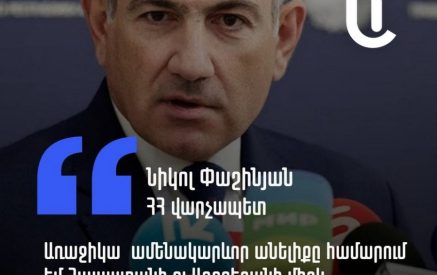
“There is nothing that happens in the army whose roots are not in society.”
That is, in essence, the argument put forward by Prime Minister Nikol Pashinyan, effectively diffusing responsibility across society as a whole. The underlying message is simple: this is who you are; therefore, if something happens in the army, blame yourselves—not us.
In effect, this amounts to a carte blanche for irresponsibility—not only for those directly responsible within the armed forces, but across the system of government as a whole.
And irresponsibility and tragedy have always marched hand in hand.
Hakob BADALYAN