

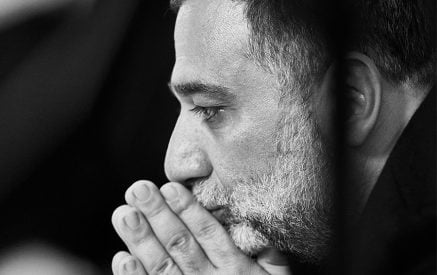




































Cultural Heritage Ombudsman of Artsakh, Vice President of the Azgayin (National) Cultural-Historical NGO Hovik Avanesov:
A photograph taken in the area of the Holy Mother of God Cathedral in Stepanakert has recently been circulating on Azerbaijani social media. What makes the situation particularly painful is the fact that the Azerbaijani girl who posted the photograph had also visited the same location in 2025, when the cathedral was still standing. Thus, the new photograph documents not only the destruction that has taken place, but also provides an obvious indication of the attitude that has developed toward Armenian cultural and spiritual heritage.
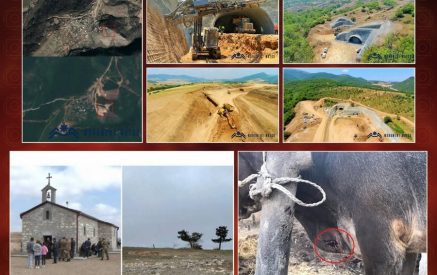
Satellite monitoring data confirm that the cathedral was destroyed between March 3 and April 2, 2026. In recent months, the Office of the Ombudsman for the Cultural Heritage of Artsakh, as well as other organizations and experts working in the field of cultural heritage protection and satellite monitoring, have repeatedly raised the alarm over the destruction of the cathedral.
However, one of the most revealing and, at the same time, most painful aspects of this story is the caption accompanying the photograph: “gorbagor oldu,” meaning “it disappeared” or “it was destroyed.” The destruction of an Armenian church is presented not as a cause for grief or concern, but rather as a source of pride and satisfaction.
Read also
This phenomenon cannot be viewed merely as the behavior of one individual or an isolated social media user. It is a manifestation of a deeper and systemic problem. When the destruction of a church is accompanied in the public sphere by expressions of joy and pride, this indicates that the cultivation of Armenophobia and hostility toward Armenian cultural heritage in Azerbaijan has acquired a systemic character.
The actions directed against Armenian cultural heritage in Artsakh have long ceased to be merely a matter concerning the fate of individual monuments. They concern a systematic policy aimed at erasing the Armenian presence, whereby churches, monasteries, cemeteries, khachkars, monuments, entire settlements, historic neighborhoods, and other cultural sites are either destroyed or subjected to alterations and reinterpretations designed to deny their Armenian identity.
The destruction of the cathedral is particularly symbolic because it is taking place at a time when the international community, international organizations, and cultural heritage protection bodies are fully aware of the threats facing Armenian heritage in Artsakh. For years, documents, expert reports, photographs, and satellite evidence have been published, yet these records have too often not been followed by practical and preventive measures.
The current response of international institutions is clearly disproportionate to the scale of the threat. Statements, expressions of concern, and appeals following each new act of destruction cannot substitute for genuine action. If the international community limits itself to documenting destruction after it has already occurred, this is not heritage protection; it is merely the retrospective registration of its destruction.
It is equally unacceptable that professional organizations are forced to identify the destruction of monuments through satellite imagery, while competent international bodies remain unable to establish effective mechanisms for continuous monitoring, independent expert assessment, fact-finding missions, and accountability.
Saving the cultural heritage of Artsakh requires not another round of procedural statements, but concrete measures: the establishment of international monitoring mechanisms; the involvement of independent experts; the systematic collection and publication of satellite data; the legal documentation of every act of destruction; the identification of those responsible; and the application of international legal and political accountability mechanisms.
The destruction of the Holy Mother of God Cathedral in Stepanakert must serve as yet another serious warning to the international community. If an Armenian church can be destroyed today and that act presented as a “victory”-and, moreover, celebrated with pride-this is not an entirely new phenomenon. The same logic was evident when the Azerbaijani authorities glorified Ramil Safarov, who murdered the sleeping Armenian officer Gurgen Margaryan with an axe, and in the case of the beheading of Kyaram Sloyan. The continuity of this logic means that yet another monument of Armenian heritage in Artsakh may be at risk tomorrow.
Cultural genocide begins precisely when the destruction of a monument is no longer perceived as a crime and instead becomes a symbol of victory. International inaction, regardless of the political or other reasons invoked to justify it, effectively creates an environment of impunity.
The destruction of the Stepanakert Cathedral must not only be documented; it must become a matter of the international legal and political agenda. Silence, delayed responses, and vague statements are no longer sufficient. To save the Armenian cultural heritage of Artsakh, which constitutes a heritage of universal value, immediate, systematic, and measurable action is required—while the monuments that remain can still be saved.