












From the FB page of Jonathan Spangenberg, Chairman, Central Council of Armenians in Germany e.V.
Appeal to the Hessian State Parliament and the Board of Trustees of the Hessian Peace Prize
Dear Madam President of the Hessian State Parliament,
dear Members of the Hessian State Parliament,
dear Members of the Board of Trustees of the Hessian Peace Prize,
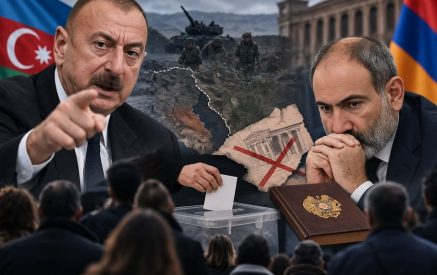
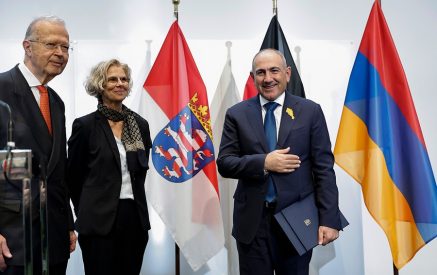
On 18 September 2026, the Hessian Peace Prize will be awarded to Armenian Prime Minister Nikol Pashinyan at the Hessian State Parliament. We, the undersigned organizations, expressly support a sustainable peace between Armenia and Azerbaijan. However, such a peace can only be just and sustainable if the rights of the Armenian population forcibly displaced from Nagorno-Karabakh are taken into account on the basis of international law, human rights, and the obligations under the UN Genocide Convention. These rights have so far been largely excluded from the current peace process. When awarding of the prize, the Hessian State Parliament must not ignore the grave crimes and the suffering associated with them of the affected population, as well as the ongoing destruction of the millennia-old Armenian and Christian cultural heritage in Nagorno-Karabakh by Azerbaijan.
Germany officially recognized the Genocide of the Armenians and other Christian minorities in the Ottoman Empire from 1915 only 101 years after the beginning of the crimes, with the Bundestag resolution adopted on 2 June 2016. With this, the German Bundestag broke a long silence and marked a turning point in German culture of remembrance. The resolution was more than a symbolic act: it reaffirmed Germany’s historical responsibility and at the same time established the principle that the remembrance of this crime against humanity must not remain without consequences and that responsibility for the present and the future arises from it.
This responsibility is also reflected in the worldwide remembrance of the Genocide, which is carried by the descendants of the survivors and Armenian communities. In addition to the numerous commemorative events held throughout Germany around 24 April, this remembrance has also been commemorated for more than 30 years in the historic Paulskirche in Frankfurt – a site that stands for democracy, human rights, and responsibility arising from German history.
Ten years after the recognition of the Genocide by the German Bundestag, in view of the tragic events in Nagorno-Karabakh in 2023, the question of what consequences arise from the historical assumption of responsibility at that time takes on new urgency. Events since then unfortunately show how fragile the lessons of history remain when they are not translated into concrete political action.
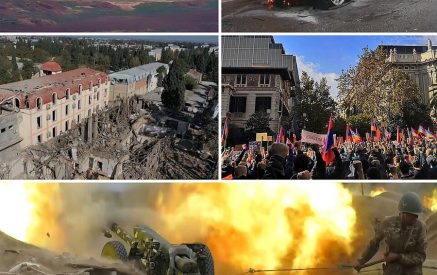
Following a nine-month blockade of the Lachin Corridor and the associated interruption of vital supplies to the Armenian population of the de facto Republic of Artsakh, Azerbaijan launched a military offensive against Nagorno-Karabakh in September 2023. As a result, the entire Armenian population of the region was forced to flee or was displaced within a few days. More than 100,000 people lost their homes.
The then UN Special Advisor on the Prevention of Genocide, Alice Wairimu Nderitu, had already drawn attention in September 2023 to the risk of the gravest violence, including genocide. The then Federal Foreign Minister Annalena Baerbock also spoke at the UN Security Council of unacceptable displacement and a forced exodus.
The former UN Special Adviser Juan Méndez later reaffirmed that forced flight and the associated severe psychological harm fall under the criteria of the Genocide Convention. In November 2023, the International Court of Justice obliged Azerbaijan to enable the displaced persons to return safely and unhindered.
The former Chief Prosecutor of the International Criminal Court, Luis Moreno Ocampo, had already warned in August 2023 of a genocide against the Armenians in Nagorno-Karabakh. In his commemorative speech at the Paulskirche in Frankfurt on 24 April 2024, he reaffirmed this assessment and emphasized that mass killings are not the only form of genocide. Starvation and severe psychological harm also constitute genocidal acts under Article II of the Genocide Convention. Both methods, he stated, had been applied against the Armenians in Nagorno-Karabakh.
This assessment is also shared by the International Association of Genocide Scholars (IAGS). In its resolution on Nagorno-Karabakh adopted in September 2024, the international professional association assessed the living conditions brought about by the blockade of the Lachin Corridor as genocidal acts and the forcible displacement of the Armenian population in 2023 as ethnic cleansing and crimes against humanity.
Despite these findings and despite the ongoing efforts for a peace between Armenia and Azerbaijan, the rights of the Armenian population displaced from Nagorno-Karabakh have so far remained largely from still ongoing peace negotiations. The recipient of the Hessian Peace Prize, Armenian Prime Minister Nikol Pashinyan repeated excludes addressing these open human rights issues, while declaring that “the Karabakh issue is closed”. To this day, 19 Armenian hostages also remain in Baku, although the European Parliament has repeatedly called for their release. A sustainable peace, however, cannot be based solely on political understanding between two states while the consequences of the displacement, the rights of the people affected by it, and the fate of the Armenians still being held remain unaddressed.
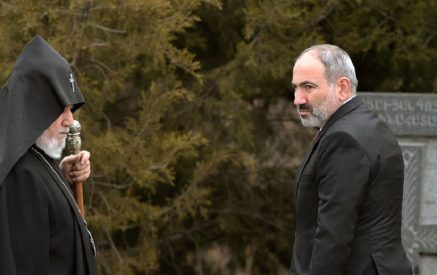
Against this background, granting the Hessian Peace Prize to Prime Minister Nikol Pashinyan also deserves differentiated consideration with regard to developments within Armenia. Under his government, the Armenian Apostolic Church is increasingly coming under state pressure. Clergy, including archbishops, have been imprisoned and subjected to travel bans. At the same time, the government intervenes in internal church affairs and places the Catholicos under political pressure, including calls for his removal. This is also connected with the efforts of the Church and its representatives on behalf of the rights of the displaced Armenians from Nagorno-Karabakh. Parliamentary opposition forces that advocate for the rights of the displaced are likewise subjected to political pressure and politically motivated detentions.
The government’s public treatment of Armenians displaced from Nagorno-Karabakh is also cause for concern. Prime Minister Pashinyan has repeatedly publicly attacked and insulted displaced persons and has in part attributed responsibility for their displacement to them. In March 2026, he publicly asked a woman displaced from Nagorno-Karabakh why she had not stayed there; in May 2026, he directed the statement “Why didn’t you die?” at now incarcerated representatives of the Karabakh Armenians, whom he accused of having abandoned their soldiers. Such treatment of those affected stands in a troubling tension with a Peace Prize awarded for democratic values and peaceful conflict resolution.
If the Hessian Peace Prize honors the still unfulfilled peace process without addressing the grave human rights violations and consequences under international law of the events in Nagorno-Karabakh, and without taking into account the rights of those affected arising from them, there is a risk that the award will not contribute to peace, but will instead be perceived as whitewashing the crimes committed.
We therefore appeal to the Hessian State Parliament and the Board of Trustees of the Hessian Peace Prize to use the awarding of the prize to Prime Minister Nikol Pashinyan as an opportunity to clearly name the outstanding questions and unresolved consequences of the conflict and to demand that they be taken into account in the peace process. These include in particular:
• the right of the Armenians displaced from Nagorno-Karabakh, protected under international law, to a safe and dignified return;
• the immediate release of the 19 Armenian hostages still being held in Baku;
• the effective and internationally monitored protection of Armenian cultural heritage in Nagorno-Karabakh.
Signatories
Jonathan Spangenberg, Chairman, Central Council of Armenians in Germany e.V.
Sarah Reinke, Head of Human Rights, Society for Threatened Peoples e.V.
Dr. John Eibner, President, Christian Solidarity International (CSI)
Dr. Tessa Hofmann, Working Group Recognition – Against Genocide, for International Understanding e.V., as well as the Supporting Association for an Ecumenical Memorial for Victims of Genocide in the Ottoman Empire (FÖGG) e.V.