
























In September 2026, the Yerevan Municipality imposed arbitrary restrictions on several planned public assemblies.
The assembly scheduled for September 20th
The first case concerns the notification by Russian citizen Yan Slovitskyi regarding the assembly planned for September 20th, from 12:00 PM to 4:00 PM, in the area adjacent to the statue of Alexander Myasnikyan. The day of the planned assembly coincided with the State Duma elections in the Russian Federation, and voting was taking place at the Russian Embassy, located near the statue of Myasnikyan. According to media reports, the purpose of the assembly was to protest against the war in Ukraine and the policies of the Russian authorities. The timing of the voting and the assembly (12:00 PM) was also specific—in this way, the participants were expressing their protest against the war in Ukraine, which resulted in a long queue forming near the embassy.
According to information available on the Yerevan Municipality’s website, a restriction was imposed on the assembly organized by Y. Slovitskyi. The municipality proposed the following to the participants:
Read also

“During the assembly, do not disseminate such statements and do not voice such calls, nor use such items and objects (posters, etc.) the combination of which would be considered propaganda for the electoral process. Specifically, do not voice calls and statements in favor of or against voting for any political party (candidate) participating in the elections, and do not use posters with their names, designations, or photographs.”
Although the municipality framed this as a restriction on the “manner” of holding the assembly, it actually pertained to the content of the assembly. The “manner” of an assembly should be understood as, for example, the use of sound amplification systems, lighting systems, tents, stages, and other non-permanent structures, which in itself is not related to the content (Guidelines on Freedom of Peaceful Assembly (3rd Edition), Venice Commission and OSCE/ODIHR, para. 148). Restrictions on content are exhaustively listed in the RA Law “On Freedom of Assembly”—it is prohibited to hold an assembly for the purpose of forcibly overthrowing the constitutional order, inciting national, racial, or religious hatred, or promoting violence or war (RA Law “On Freedom of Assemblies“, Article 5, Paragraph 2). In fact, the purpose of the assembly initiated by Y. Slovitskyi was the exact opposite: to express protest against the war. As for the criticism of authorities (including foreign ones) within the framework of a peaceful assembly, restricting it is unlawful under any circumstances (Guidelines, para. 149). Moreover, the municipality’s formulations, in essence, are restrictions related to the “silence day” of the elections held in the Russian Federation. The law of another state cannot be applied in the territory of the Republic of Armenia; consequently, the municipality’s restriction has no legal basis and contradicts the international standards of the right to freedom of assembly.
The assembly scheduled for September 27-29
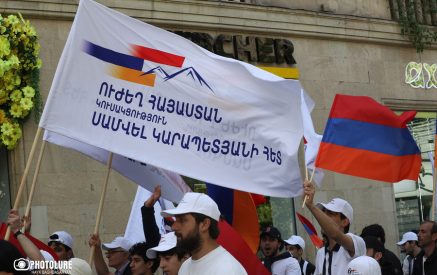
The second restriction concerned the assembly planned for September 27-29 at Liberty Square, related to the social and economic issues of Artsakh Armenians.
The Yerevan Municipality imposed the following restriction․
“By the decision of the authorized representative of the Mayor of Yerevan dated 14.09.2026, a restriction was imposed on the time of the assembly planned by citizen Nzhdeh Iskandaryan for September 27th of this year, from 2:00 PM, until September 29th of this year, at 3:00 PM, at Liberty Square—proposing to hold the assembly on September 27th of this year, from 2:00 PM to 10:00 PM, at Liberty Square.”
The exhaustive grounds for proposing conditions (imposing limitations) related to the time, place, or manner of an assembly are set out in Article 18 of the RA Law “On Freedom of Assemblies.” The imposition of a restriction is lawful only if it is clear from the notification submitted or from the information available to the municipality that the planned time, place, or manner of the assembly may directly disproportionately restrict the fundamental rights of others or the interests of the public. Moreover, each case of a restriction on time and duration must be assessed individually, taking into account all the circumstances of the given assembly, because the duration of the assembly itself may constitute part of its purpose (Guidelines, para. 146). Even the mere presence of an assembly in the same place and at the same time, or of a counterdemonstration, is not in itself a ground for imposing such a restriction. The state has duty to facilitate each of them (Guidelines, paras. 77, 78).
Information about another assembly planned for the same days at Liberty Square is not available in the “Public Assembly” section of the Municipality’s website. Consequently, the restriction on the duration of the assembly at Liberty Square, a traditional venue for peaceful assemblies, cannot be interpreted as a measure against disproportionate restriction on the rights of others.
According to the assembly organizer, the municipality stated that “in this stage, it is considered inappropriate to hold demonstrations” and justified the restriction by “violations” during another assembly held about a year and a half earlier. “Inappropriateness” is not a legitimate pupose for restricting the freedom of peaceful assembly and contradicts Article 18 of the European Convention on Human Rights. Furthermore, the restriction cannot be based solely on the experience of previous assemblies by the same organizer or participants, even if violations occurred during them. Moreover, the assembly-sit-in that started on March 29, 2025, of which the municipality speaks, was entirely peaceful, making the municipality’s claims more unsubstantiated.