




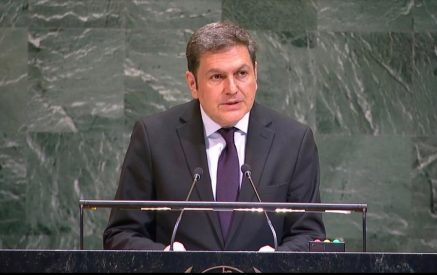
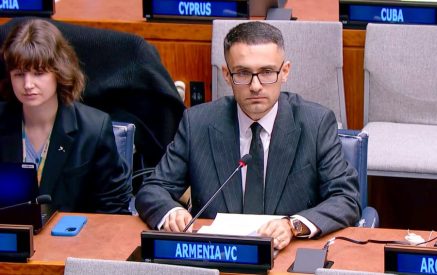

Statement by Hovik Avanesov, Ombudsman for the Cultural Heritage of Artsakh
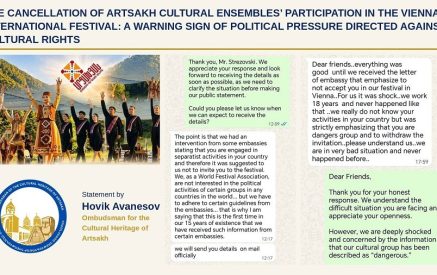
We are not dealing with an ordinary organisational decision, but rather with an intervention of a political nature that has deprived the living bearers of Artsakh’s cultural heritage of the opportunity to participate in an international cultural event.
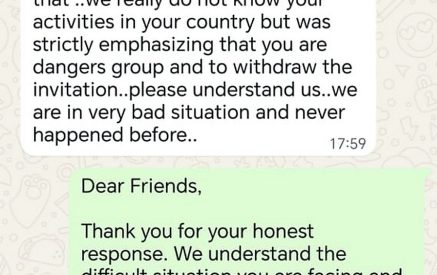
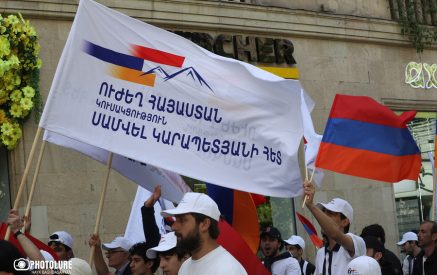
According to the clarifications provided by Zoran Strezovski, President of the World Festival Association (WOFA), which were conveyed by the organisers to the NGO “Artsakh Cultural Preservation Center ”, several embassies intervened, labelling the Artsakh cultural ensembles as being engaged in “separatist activities” and portraying them as “dangerous.” These allegations require immediate, comprehensive and public clarification. Nevertheless, even at this stage, the circumstances known are sufficient to raise serious questions about the politicisation of cultural events and the restriction of the rights of Artsakh artists.
 LABELING CULTURE AS “SEPARATISM”: A DANGEROUS MANIFESTATION OF POLITICAL MANIPULATION
What, in reality, poses a threat to the international community: the sound of national musical instruments, Armenian songs and dances, the preservation of cultural traditions shaped over centuries, or attempts to silence all of these through political labels and push them off international platforms?
Read also
The cultural ensembles of Artsakh are not political organisations. They are the bearers of Armenian cultural identity, historical memory and creative traditions passed down from generation to generation. Their activities are centred on preserving and promoting national music, song, dance and the performing arts. Characterising such activities as “separatism” not only carries the danger of political stigmatisation but also contributes to the development of discriminatory attitudes based on national origin.
If the international representation of Armenian culture is unacceptable to any state or diplomatic mission, a straightforward question must be asked: what is the real reason behind this intolerance? Why should artists who carry Artsakh’s cultural heritage be held responsible for representing their people’s history and identity through song, music and dance?
Cultural identity is not something to be eliminated through political accusations. It is a fundamental component of the dignity of individuals and communities, historical continuity and self-expression.
In September 2023, as a result of Azerbaijan’s military operations, the indigenous population of Artsakh was forcibly displaced and deprived of the opportunity to continue living a normal life in its historical homeland. The consequences of this genocidal policy dealt a severe blow to Artsakh’s cultural life as well, disrupting the activities of cultural institutions, the natural environment in which traditions are transmitted, and the professional work of artists.
Under these circumstances, the continued activities of Artsakh’s cultural ensembles are not merely an artistic matter. They are an important means of safeguarding national cultural heritage, transmitting historical memory and ensuring the continuity of community identity in conditions of forced displacement.
Artsakh artists have already been compelled to continue their activities outside their historical homeland, overcoming the numerous obstacles associated with forced displacement, the loss of their professional environment, material hardship and the organisation of their creative work. Their international performances provide opportunities to preserve traditions, present Armenian culture to the global community and demonstrate that forced displacement cannot destroy a people’s cultural life.
It is precisely under these circumstances that the cancellation of their participation, if motivated by unfounded accusations of a political nature, takes on an even more serious and dangerous significance. It may be perceived as an attempt not only to deprive the Armenians of Artsakh of the opportunity to live in their homeland, but also to restrict their cultural self-expression in the international arena.
Do certain representatives of the international community believe that, following the depopulation of Artsakh, the international presence of Artsakh’s Armenian culture should also disappear? Must a people deprived of its homeland now also be denied the right to present its songs, dances, music and historical memory?
 If such political reasoning exists, it must be exposed and subjected to clear public scrutiny.
INTERNATIONAL LAW AND THE PRINCIPLE OF CULTURAL SELF-EXPRESSION
 Cultural rights are an integral part of the system of fundamental human rights. Article 27 of the Universal Declaration of Human
1. Everyone has the right freely to participate in the cultural life of the community, to enjoy the arts and to share in scientific advancement and its benefits.
2. Everyone has the right to the protection of the moral and material interests resulting from any scientific, literary or artistic production of which they are the author.
Article 15 of the International Covenant on Economic, Social and Cultural Rights, adopted on 16 December 1966, likewise stipulates:
a) To take part in cultural life; b) To enjoy the benefits of scientific progress and its applications; c) To benefit from the protection of the moral and material interests resulting from any scientific, literary or artistic production of which they are the author.4. The States Parties to the present Covenant recognise the benefits to be derived from the encouragement and development of international contacts and cooperation in the scientific and cultural fields.
Furthermore, UNESCO’s 2003 Convention for the Safeguarding of the Intangible Cultural Heritage includes performing arts among the principal domains of intangible cultural heritage, emphasising the importance of ensuring its continued viability and transmission to future generations.
 International cultural cooperation must be based on professional standards, mutual respect and the exclusion of discrimination. If the refusal to allow participation resulted from political pressure exerted by a state or diplomatic mission, it is necessary to establish the nature of that intervention, its factual basis and its potential legal consequences.
WHY A FULL AND TRANSPARENT INVESTIGATION IS NECESSARY
This incident must not be reduced to correspondence between the festival organisers and the Armenian side. It is necessary to establish: Which embassies intervened in the organisation of the festival, and what was the content of their communications? What specific evidence was used to portray the cultural ensembles of Artsakh as “dangerous” and accuse them of engaging in “separatist activities”? Did the organisers independently verify the information presented to them, or did they make their decision under diplomatic pressure without providing adequate explanations to the NGO “Artsakh Cultural Preservation Center ” ? What were the actual reasons for cancelling the ensembles’ participation, and were the principles of fairness, transparency and equal treatment upheld in the decision-making process? What measures will be taken to protect the rights of Artsakh artists, reconsider the situation and prevent similar incidents from recurring?The answers to these questions are important not only for the two ensembles concerned, but also for all artists who represent Armenian culture on international cultural platforms.
THE PRESERVATION OF ARTSAKH’S CULTURAL HERITAGE MUST NOT BECOME A TARGET OF POLITICAL ACCUSATIONS OUR DEMANDS 1. I demand a comprehensive and transparent explanation of the circumstances surrounding the cancellation of the participation of the State Orchestra of National Instruments of Artsakh and the State Song and Dance Ensemble “We Are Our Mountains” in the Vienna International Festival. 2. I call on the leadership of WOFA to publish, or, subject to applicable legal and confidentiality restrictions, provide the available information concerning the alleged intervention, the factual basis of the accusations made and the details of the decision-making process. 3. I call on the Ministry of Foreign Affairs of the Republic of Armenia to pursue this matter consistently, establish the circumstances of any possible diplomatic intervention and take the necessary steps within its authority to help protect the cultural rights of Artsakh artists. 4. I call on UNESCO, international organisations working to protect cultural rights, and festival organisers to pay close attention to cases in which the participation of Artsakh artists is restricted and to assess whether such cases are consistent with the principles of cultural diversity and non-discrimination. 5. I demand that discriminatory treatment based on national origin or cultural identity be ruled out and that the activities of Artsakh’s cultural ensembles be assessed according to professional and lawful criteria, rather than through unfounded political accusations. 6. I call on the international community not to remain silent when the bearers of the cultural heritage of a forcibly displaced people face further restrictions.