

























Cultural Heritage Ombudsman of Artsakh Hovik Avanesov
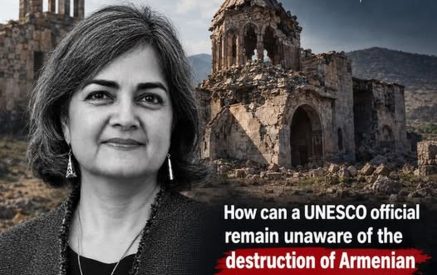
The response given by Jyoti Hosagrahar, Deputy Director of UNESCO’s World Heritage Centre, during an interview with NEWS.am on 26 October 2026, in the context of an international meeting dedicated to nature and culture held at the Matenadaran, raises serious questions concerning UNESCO’s mandate, its professional responsibilities, and the fulfilment of its commitments to the protection of cultural heritage.
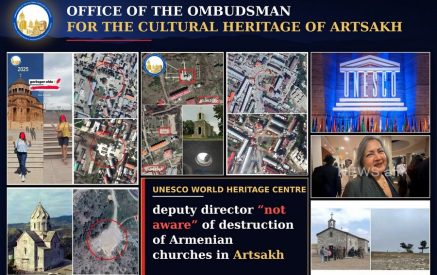
In response to a question about the destruction of Armenian churches and historical and cultural monuments in Artsakh, the official stated that she could not comment on these cases because she was unaware of them. When the journalist subsequently returned to reports of vandalism and the profound concern within Armenian society regarding the preservation of Armenian cultural heritage, the response was simply: “I’m sorry, I have to go.”
This response is not merely concerning; it also raises serious questions about the professional conduct of an institution whose principal areas of responsibility include supporting the protection of the world’s cultural heritage.
Read also
Ignorance as a Justification for Avoiding Responsibility
The statement made by the Deputy Director of UNESCO’s World Heritage Centre inevitably raises questions: How can a senior representative of an international organisation be unfamiliar with information concerning the systematic destruction of monuments of exceptional historical, religious, and cultural significance? Why did this question not, at the very least, prompt a statement acknowledging the need to verify the available evidence, conduct professional investigations, and provide an appropriate response?
If the official is genuinely unaware of the situation, this does not bring the matter to a close; rather, it constitutes a reason to initiate an investigation. The responsibility of a representative of an international organisation is not limited to answering questions for which they happen to possess readily available information at a given moment. It also entails acknowledging the seriousness of the issue, referring it to the relevant professional departments, and clarifying the mechanisms through which the concerns raised can be investigated.
Lack of awareness cannot serve as a justification for inaction, particularly when the preservation of humanity’s cultural memory is at stake.
Furthermore, if a senior representative of UNESCO’s World Heritage Centre publicly states that she is unaware of reports concerning the destruction of Armenian churches in Artsakh, clarification is required as to whether the Centre monitors the condition of cultural heritage in the region, what information it has received, what investigations have been conducted, and what measures are being undertaken to document potential damage.
However, the issue extends beyond the personal awareness of a single official. More importantly, it is necessary to understand how UNESCO fulfils its responsibilities for gathering, verifying, and professionally assessing information when concerns about the destruction of cultural heritage continue to be raised.
Extensive Evidence Concerning Cultural Genocide in Artsakh Has Been Published: UNESCO Must Not Ignore It
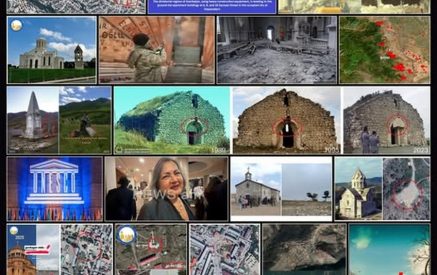
For years, extensive documentary materials, research studies, analyses, and reports have been published concerning the endangered state of Artsakh’s cultural heritage, the damage to or destruction of Armenian churches and monasteries, alterations to the historical environment, and the distortion of Armenian cultural identity. These materials have been produced by specialised institutions, independent academic platforms, non-governmental organisations, researchers, and other initiatives engaged in cultural heritage preservation.
In particular, the following organisations and initiatives have published material concerning the protection, monitoring, and documentation of Artsakh’s cultural heritage:
The Office of the Ombudsman for the Cultural Heritage of Artsakh, which consistently raises concerns regarding the preservation of Artsakh’s historical and cultural monuments, their damage or destruction, and the distortion of their historical identity, making relevant evidence, materials, and satellite imagery publicly available.
MONUMENT WATCH, an independent academic platform that documents and analyses the condition of cultural heritage in Artsakh and the wider region through professional monitoring and academic research, with particular attention to key issues affecting the preservation of monuments.
Artsakh Cultural & Tourism Development Agency, a non-governmental organisation that contributes to raising public awareness of Artsakh’s cultural heritage and drawing attention to issues concerning its preservation.
The Research on Armenian Architecture (RAA) Foundation, which conducts research into and documents Armenian architectural heritage.
The State Service for the Protection of the Historical Environment of Artsakh, whose activities are associated with the preservation and documentation of Artsakh’s historical environment, monuments, and cultural assets.
Caucasus Heritage Watch, a research initiative that monitors the condition of cultural heritage sites across the region through the analysis of satellite imagery.
The publications produced by these organisations, together with those of other professional and civil-society initiatives, provide an important body of information for assessing the condition of Artsakh’s cultural heritage, documenting changes to monuments, and keeping their preservation on the international agenda.
Particular emphasis must be placed on the fact that these publications are not only widely disseminated through public and professional information platforms but are also regularly transmitted to relevant specialised institutions, including UNESCO. Consequently, information concerning the condition of Artsakh’s cultural heritage is not confined to isolated publications or concerns circulating within civil society. It consists of documentary evidence, professional assessments, and research findings that are made public, disseminated, and presented as matters warranting international attention.
This circumstance makes the statement by the Deputy Director of UNESCO’s World Heritage Centre all the more significant and raises legitimate questions: if materials concerning Artsakh’s cultural heritage are widely disseminated and regularly transmitted to the relevant institutions, including UNESCO, why does a senior representative of the Centre state that she is unaware of them?
Have the materials received reached the relevant UNESCO departments? Have they been examined? What procedures have been used to assess these publications, and what measures have been taken, or are planned, in response to the issues they raise?
These questions require clear answers. If the official is unaware of the published materials, it is necessary to clarify not only the extent of her personal knowledge but also the effectiveness of the organisation’s internal mechanisms for circulating, verifying, and professionally assessing information.
The work of international organisations in the field of cultural heritage preservation cannot be based solely on official communications or information supplied by individual states. Attention must also be paid to independent researchers, academic institutions, satellite-monitoring data, and professional documentation.
We are not demanding that unverified information be presented as established fact. We are demanding that published materials be properly examined and assessed, without selective treatment.
However, when reports and documentary materials concerning the destruction of cultural heritage are widely disseminated and transmitted to specialised institutions, a declaration of unawareness cannot substitute for substantive examination of their contents.
When various professional and civil-society organisations have been documenting and publicising threats to cultural heritage for years, and the relevant materials are also regularly transmitted to UNESCO, the priority for international institutions should not be to limit themselves to declarations of unawareness. It should be to ensure the proper examination and professional assessment of the published information and to undertake the necessary action.
UNESCO’s Mandate Extends Beyond Statements
UNESCO is an international organisation whose mission is associated with strengthening peace through education, science, culture, and international cooperation. In the field of cultural heritage preservation, its role entails not only recognising the value of heritage but also promoting professional cooperation, monitoring, and international attention aimed at safeguarding it.
Accordingly, when concerns are raised about the destruction or damage of historical and cultural monuments, the distortion of their identity, or the erasure of their historical traces, representatives of international organisations are expected, at a minimum, to acknowledge the need for these concerns to be properly investigated.
This is not about serving the interests of any particular state or political force. It is about consistently applying the universal principles governing the protection of cultural heritage.
If the protection of cultural heritage is a universal value, the treatment it receives cannot depend on a monument’s geographical location, its cultural affiliation, or the political environment in which it is situated.
Armenian churches, monasteries, khachkars, cemeteries, and other historical monuments constitute an integral part of the Armenian people’s spiritual and historical memory. They also possess scientific and universal significance. Their preservation requires scientific accuracy, professional consistency, and international cooperation.
Information concerning their possible destruction cannot be disregarded merely because an international official is not prepared to comment at a particular moment.
Artsakh’s Cultural Heritage Requires Documentation and Continuous Monitoring
The preservation of Armenian cultural heritage in Artsakh cannot be treated as a secondary issue or merely as a subject of political debate. It has historical, scientific, legal, spiritual, and universal significance.
Numerous concerns have been raised regarding the damage or destruction of monuments in Artsakh, the distortion of their identity, and alterations to the historical environment. Such information requires professional verification through the comparative analysis of satellite imagery, photographs, historical documents, archival materials, and independent expert assessments.
It is particularly important to establish monitoring mechanisms that make it possible to record changes in the condition of monuments, compare them with data from previous years, and respond to potential threats in a timely manner.
Satellite monitoring, digital documentation, and independent professional assessment can play a significant role in evaluating the condition of cultural heritage, especially in areas where direct access and on-site investigations are impossible or restricted.
If UNESCO states that it is unaware of the relevant cases, the logical next step should be to gather the available information, verify it, and conduct a professional assessment based on the evidence.
The question is not simply what UNESCO knows today. The question is what it intends to do to become better informed tomorrow and provide meaningful support for the preservation of cultural heritage.
Walking Away from a Journalist’s Question Does Not Make the Problem Disappear
Particular concern is also warranted by the fact that, after the journalist raised a follow-up question concerning reports of vandalism, the official chose to end the conversation without providing any further clarification on the substance of the issue.
Of course, any official may face time constraints, and declining to comment on a particular question does not, in itself, prove deliberate inaction or political bias. Nevertheless, such a response from a senior representative of an international organisation raises legitimate questions, particularly when the issue under discussion concerns the protection of cultural heritage.
The journalist’s question concerned a matter of public importance: the preservation of Armenian churches and other cultural assets, as well as the potential response of an international organisation.
Such questions should be regarded as an opportunity to inform the international community about the available evidence, discuss the issues at a professional level, and identify possible solutions.
Walking away from a question concerning the destruction of cultural heritage does not mean that the threat of destruction has disappeared. Silence will not preserve monuments, and unanswered questions cannot replace professional action.
The Responsibility of the International Community
The protection of cultural heritage cannot be confined to general statements, declarations, and symbolic messages delivered at international conferences. Such statements are important, but they are insufficient when specific reports of damage to or destruction of monuments have been brought forward.
The credibility of international organisations depends not only on the principles they proclaim but also on the consistency with which those principles are applied in practice.
If the preservation of cultural heritage is regarded as a shared responsibility of the international community, that responsibility must also be demonstrated in cases where the condition of monuments situated in politically sensitive or complex circumstances needs to be investigated.
Concerns regarding Armenian cultural heritage in Artsakh require sustained international attention, independent documentation, and professional assessment. It is also essential to ensure that cultural heritage preservation does not become a casualty of political expediency or indifference to information.
We expect UNESCO and the relevant international institutions to provide clear explanations regarding the following:
What information do they possess concerning the current condition of Armenian churches, monasteries, khachkars, cemeteries, and other historical and cultural monuments in Artsakh?
Are published reports concerning the destruction, damage, or distortion of the identity of cultural heritage sites being examined?
Have materials submitted to UNESCO by specialised institutions and research initiatives been received and examined?
What mechanisms are available for conducting independent satellite monitoring and documenting changes in the condition of monuments?
What steps can be taken to obtain appropriate professional assessments and develop measures to protect cultural heritage on the basis of those assessments?
How will public awareness and sustained professional attention at the international level be ensured if new evidence is documented?
These are not rhetorical questions. They concern matters of public importance and require clear, substantive answers.
Cultural Heritage Cannot Wait for International Indifference to End
Armenian cultural heritage in Artsakh is an integral part of the Armenian people’s historical memory, spiritual identity, and civilisational presence. Its preservation is not merely a demand made by one people; it is also a matter of putting the principles of international cultural heritage protection into practice.
Every report left unexamined, every piece of evidence left unverified, and every missed opportunity may make it more difficult to assess the condition of cultural heritage and implement the measures necessary for its preservation. Timely responses, independent documentation, and professional cooperation are therefore of paramount importance.
The response given by the Deputy Director of UNESCO’s World Heritage Centre should serve as an occasion to examine the extent to which international cultural institutions are prepared to respond to issues requiring their attention.
The necessary course of action is not simply to declare that information is unavailable, but to establish effective mechanisms for gathering and verifying information and providing an appropriate response.
The mission of cultural heritage protection entails not only recording the past but also taking action to preserve, for the future, what can still be saved.
In the case of Armenian cultural heritage in Artsakh, the international community’s responsibility does not end with a declaration of unawareness. It begins precisely when a warning is raised.