
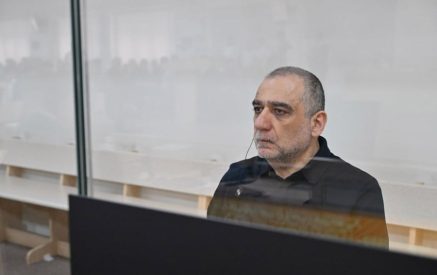





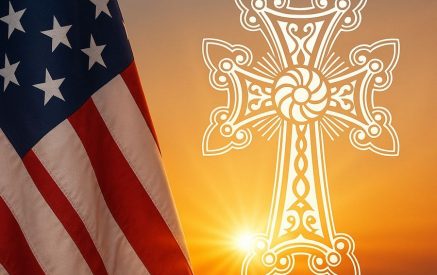


The All-Armenian Council for the Protection of the Armenian Church informs that His Eminence Archbishop Pargev Martirosyan has sent an official appeal to the President of the United States of America, members of the U.S. Senate and House of Representatives, the Pope, as well as the leaders of Christian churches and influential international organizations, drawing their attention to the ongoing destruction of Armenian Christian spiritual and cultural heritage in the territories that have come under Azerbaijani control.
In the appeal, Archbishop Pargev stresses that this is not only a matter of Armenian heritage, but of preserving sanctuaries, ecclesiastical monuments, cemeteries, khachkars, and historical memory that are of pan-Christian and universal human value. He presents, on a factual basis, data recorded by international bodies and confirmed through academic monitoring, underscoring that the tangible evidence of Armenian Christian presence in the region is being subjected to systematic destruction.
Below is the full English text of the appeal:
With deep respect, I address you concerning a tragedy that affects not only the Armenian people, but the entire Christian world. In the territories that have come under Azerbaijani control, the destruction of Armenian Christian cultural and spiritual heritage continues – churches, cemeteries, sanctuaries, monuments of ecclesiastical architecture, and other sacred sites that bear witness to the centuries-old presence of Christianity on that land.
Read also
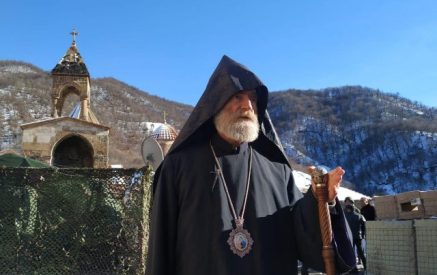
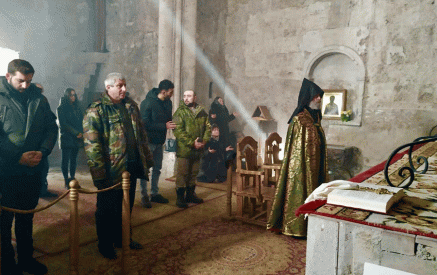
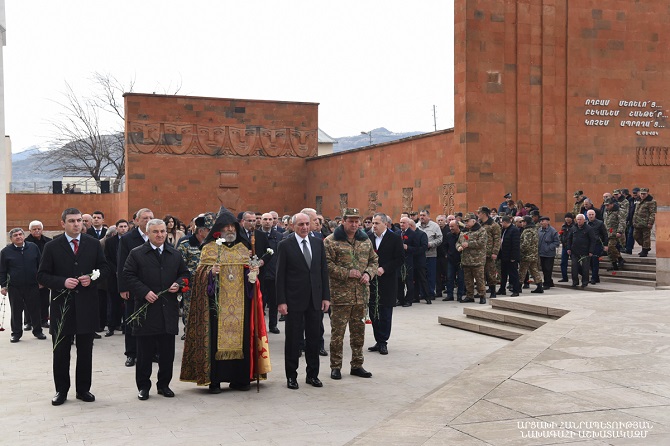
Also particularly alarming is the fact that in recent days, two churches in Stepanakert have been razed to the ground one after another: Surb Hakob Church and the city’s principal sanctuary, the Holy Mother of God Cathedral of the Protection. These new blows show that this is no longer a matter of isolated incidents of vandalism, but of the deliberate and systematic eradication of the material testimony to Armenian Christian spiritual and historical-cultural presence.
For us, this is not a matter of political rhetoric, nor a subject of historical dispute. It is a matter of preserving sacred sites, of defending historical truth, of responsibility toward the memory of generations, and of safeguarding a spiritual heritage that belongs not to one nation alone, but to the whole of Christian civilization.
On 7 December 2021, the International Court of Justice ordered Azerbaijan to take all necessary measures to prevent and punish acts of vandalism and desecration directed against Armenian cultural heritage, including churches and other places of worship, monuments, landmarks, cemeteries, and artefacts. A decision of this kind by the highest judicial body of the United Nations is in itself evidence of how serious and real the threat to Armenian heritage had already been recognized to be at that time.
On 10 March 2022, the European Parliament, in its official resolution, strongly condemned the policy of erasing and denying Armenian cultural heritage in Nagorno-Karabakh and firmly insisted that UNESCO be granted unhindered access to monuments under Azerbaijani control. However, in its official statement of 21 December 2025, UNESCO recorded that, despite repeated requests, the dispatch of a mission to the site was still awaiting only Azerbaijan’s response. This means that an independent international assessment of the condition of these sanctuaries and monuments has still not been carried out in full.
At the same time, the independent academic satellite-monitoring initiative Caucasus Heritage Watch, carried out by researchers from Cornell and Purdue Universities, stated in written testimony submitted to the U.S. Commission on International Religious Freedom that since 2021 Azerbaijan has destroyed 14 heritage sites, damaged 14 more, and that 30 sites are under immediate threat of damage or destruction. Among the documented cases already recorded are the demolition of Shushi’s Surb Hovhannes Mkrtich Church, known as Kanach Zham, which took place between 28 December 2023 and 4 April 2024, as well as the complete destruction of the Ghazanchetsots Cemetery in Shushi, recorded in satellite imagery in April 2024.
These facts cause profound pain above all because this is not simply a matter of old stones or architectural monuments. It is a matter of places of prayer, of sanctities consecrated by the faith of a people, of the living traces of Christian life preserved through the centuries. When such sanctuaries are destroyed, it is not only the cultural landscape that is devastated; a blow is also struck against spiritual memory, historical continuity, and the witness of Christian presence in the region.
It is particularly troubling that this issue has already found resonance in the international Christian world. In 2026, the World Council of Churches published a special volume devoted to freedom of religion and to the preservation of Armenian religious, cultural, and historical heritage in Artsakh/Nagorno-Karabakh. That publication explicitly states that it is a response to the forced displacement of the Armenian population after the events of 2023 and to the gravest threats hanging over Armenian sanctuaries and cultural heritage in the region.
The 2026 report of the U.S. Commission on International Religious Freedom (USCIRF) also notes that the destruction of Armenian religious heritage was raised in the U.S. Congress, and that American lawmakers drew special attention to the destruction of Armenian religious sites in the region. This means that the necessary factual basis for a serious international response already exists. Yet a sufficiently clear, consistent, and effective response is still lacking.
Therefore, with deep respect, I ask you to give the most serious attention to the ongoing destruction of Armenian Christian heritage in the territories under Azerbaijani control.
I ask you to raise your voice in defense of sanctities that belong not only to the Armenian people, but to the whole Christian world and to the common heritage of human civilization.
I ask you to:
- a) provide a clear and public moral and legal assessment of the ongoing destruction of Armenian churches, cemeteries, khachkars, and other Christian monuments;
- b) support the demand for the immediate and unhindered access of UNESCO and other competent international bodies to these sanctuaries and monuments;
- c) help establish a stable international mechanism for monitoring the condition of Armenian religious and cultural heritage in the region;
- d) use all political, diplomatic, public, and ecclesiastical means available to you so that the protection of this heritage is placed on the agenda clearly, consistently, and effectively;
- e) take every possible measure to protect those sanctuaries that can still be saved from final destruction.
Please do not leave unprotected those Christian sanctuaries which today require not only words of compassion, but real attention, international protection, and a firm moral stance.
If the international community truly recognizes the value of Christian heritage, then today is the moment to affirm that not only in statements, but in deeds. If the destruction of sacred sites anywhere else in the world would provoke universal outrage, then the devastation of Armenian churches and cemeteries must not remain without a clear response merely because it concerns a small people and a politically complex region.
At moments such as these, the silence of the international community is felt with particular weight. That is precisely why today, more than ever, it is important that a clear, dignified, and responsible voice be raised in defense of desecrated sanctuaries and trampled historical memory.
With deep hope, I appeal to your conscience, to your sense of responsibility, and to your fidelity to those Christian and universal human values that teach us not to pass by another’s pain and not to remain indifferent in the face of injustice.
Respectfully and in hope,
Archbishop Pargev Martirosyan
Clergyman of the Armenian Apostolic Church,
Pontifical Legate,
Primate of the Diocese of Artsakh, 1989–2021
All-Armenian Council for the Protection of the Armenian Church